


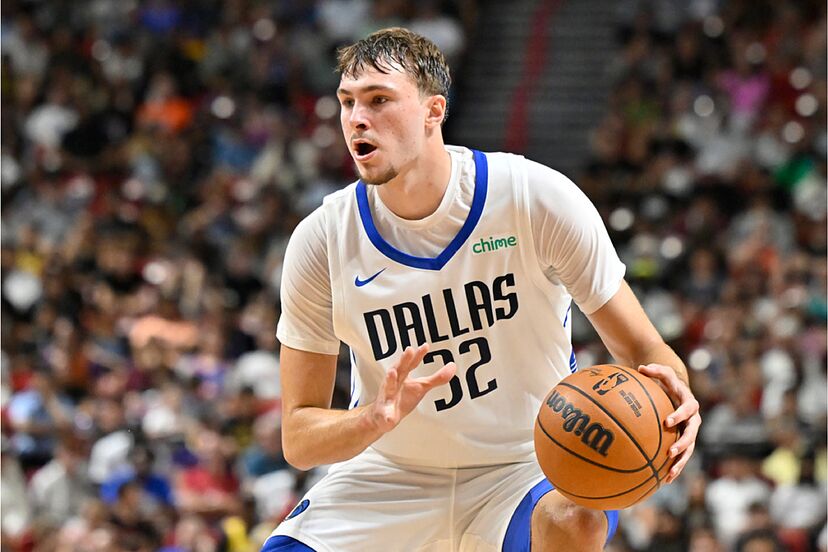
Dallas may have drafted him No. 1 overall for nights like this, but even the Mavericks weren’t expecting this version of Cooper Flagg to arrive so soon. The former Duke superstar delivered the most complete and electrifying game of his young NBA career on Friday night, erupting for 29 points, seven rebounds and five assists in a 118–115 NBA Cup comeback win over the New Orleans Pelicans — a performance that felt like the moment Flagg officially announced himself to the league.
At just 18 years old, Flagg didn’t just shine; he controlled the game’s emotional temperature, lifted his struggling team from a double-digit deficit, and showed flashes of the franchise centerpiece Dallas believes he will become. For Duke fans, it was a familiar sight — the signature blend of competitiveness, poise, and late-game fearlessness that made him the most dynamic Blue Devil of the Jon Scheyer era.
A Second-Half Takeover
What made the night so eye-opening wasn’t simply the totality of Flagg’s stats, but the circumstances he emerged from. Dallas trailed by 14 at halftime, their offense sputtering while New Orleans found rhythm early. The Mavericks desperately needed a spark. Flagg responded with his most dominant stretch as a professional.
Across the third and fourth quarters, he scored 21 points on an astounding 8-of-9 shooting, playing with a decisive aggression that pushed Dallas into comeback mode. He attacked downhill, rose confidently into jumpers, created for teammates and, perhaps most impressively, refused to shy away from contact against the Pelicans’ frontcourt.
This wasn’t the performance of a rookie trying to find his footing. This was the performance of a rookie grabbing the moment and bending the game to his will.
Facing a Familiar Foe
Adding intrigue to the matchup was Flagg’s duel with former Montverde Academy teammate Derik Queen, now starting at center for New Orleans. Their history — two high-profile prospects, two very different games, one powerhouse program — made their early NBA meetings must-watch events.
Their first pro clash earlier this month ended bitterly for Flagg, who missed a potential game-tying shot in the final seconds on Nov. 5. His hands on his head, jaw clenched, frustration visible as he walked off the floor — that moment stuck with him. He said little afterward, but everyone around Dallas knew it hit him harder than most early-season losses.
Friday night was his answer.
Against Queen and the Pelicans, Flagg downshifted into the role of playmaker early, then became the dominant scorer his team needed late. With the win, he evened their NBA series at one game apiece, setting the stage for what could become a compelling rivalry over the years.
For fans of Montverde — and especially Duke — the image of these two competing at the highest level is a reminder of just how deep their basketball roots run.
Building Momentum After Early-Season Heartbreak
Flagg’s breakout didn’t come out of nowhere. It’s the latest step in an upward trend that began after a tough stretch early in the season. He dropped 26 points against Milwaukee on Nov. 10, then followed it with 21 points in a 138–133 overtime win against Portland on Nov. 15. Those games were hints. Friday night was confirmation.
Coaches around the league often say that for young players, the toughest leap is learning how to respond to failure. Flagg’s growth since that missed shot on Nov. 5 is the perfect example of this development. Instead of shrinking from the moment, he has embraced it — a quality Duke fans saw plenty of during big-game environments in Durham.
Dallas head coach Jason Kidd praised Flagg’s resilience earlier this week, noting his ability to “process, adjust, and come back stronger.” Friday night gave Kidd the most convincing proof to date.
The Duke DNA on Display
For anyone who followed Flagg’s season at Duke, this level of performance is less a surprise and more a continuation of what he was building long before draft night.
At Duke, Flagg turned in a series of unforgettable, nationally spotlighted performances. His career-high 42 points against Notre Dame showcased the full depth of his scoring arsenal — attacking the rim, connecting from deep, scoring through contact, dominating in transition. His 30-point explosion against Arizona in the Sweet 16 was one of the signature performances of the 2025 NCAA Tournament, a display of competitive fire that convinced many NBA evaluators he was ready to lead a franchise.
Those same traits — the competitive overdrive, the unshakeable confidence, the ability to elevate in high-stakes moments — materialized again on Friday night. Even in a rebuilding season for the Mavericks, Flagg has managed to bring the same level of intensity that made him a beloved star in Durham.
For Duke supporters watching from afar, his rise has carried an extra emotional layer. It’s not just that Flagg is succeeding — it’s that he is doing it in a way that feels unmistakably like the player they came to know.
Rookie Numbers That Reflect More Than Flashes
Through 17 games, Flagg is averaging 16.4 points, 6.4 rebounds, and 3.3 assists, numbers that already place him among the more productive teenage rookies of the last decade. What’s more encouraging, though, is the trajectory behind them. His efficiency is climbing, his comfort with NBA physicality is improving, and his role within the Mavericks’ offense is expanding with each passing game.
Dallas still sits at 5–12 to start the 2025–26 season, a record that doesn’t reflect the strides Flagg has made individually. But for a rebuilding organization, the priority is development — and Flagg’s rapid evolution is the biggest reason for optimism.
Even in losses, he has shown the ability to defend multiple positions, initiate offense, score from all three levels and read defenses with patience uncommon in players his age. These signs point to a ceiling that remains as high as scouts predicted when he was a generational prospect.
Why This Game Matters — For Dallas, for Duke, for Basketball
Every star has “the moment” — the night where the league collectively realizes a young player isn’t just promising, but inevitable. For Cooper Flagg, Friday might have been that night.
Not because he hit some arbitrary scoring milestone or because the Mavericks needed a win desperately (though they did). But because of the way he took ownership of the game:
He overcame adversity, both from earlier in the season and within the game itself.
He stepped up under pressure, delivering big shots in the second half.
He showed leadership, anchoring Dallas through its best run of the night.
He demonstrated maturity, playing within the flow rather than forcing hero-ball.
That ability to blend star power with composure is exactly what made him so magnetic at Duke. It’s what made him the clear No. 1 pick. And it’s what makes Friday’s performance feel like the beginning of something much larger.
For Duke fans, Flagg’s rise in Dallas is more than just an NBA rookie finding his footing. It’s a continuation of a story they watched unfold in Durham — the emergence of an athlete whose basketball future always seemed destined to stretch far beyond Cameron Indoor Stadium.
What Comes Next
The Mavericks will continue to lean on Flagg as they navigate the early months of the season. As defenses adjust to his growing confidence and expanded role, he will face new challenges — more double-teams, more physicality, more game planning designed specifically to stop him.
But if Friday night made anything clear, it’s this: Cooper Flagg isn’t backing away from those challenges. He’s running toward them.
He’s growing faster than expected. He’s learning in real time. And for the first time in his NBA career, he has delivered the kind of performance that makes teammates trust him, coaches rely on him, and opponents prepare for him differently.
For Dallas, it’s a glimpse of the future.
For the NBA, it’s a warning.
For Duke fans, it’s a reminder: Cooper Flagg’s star isn’t just rising — it’s arriving.




