


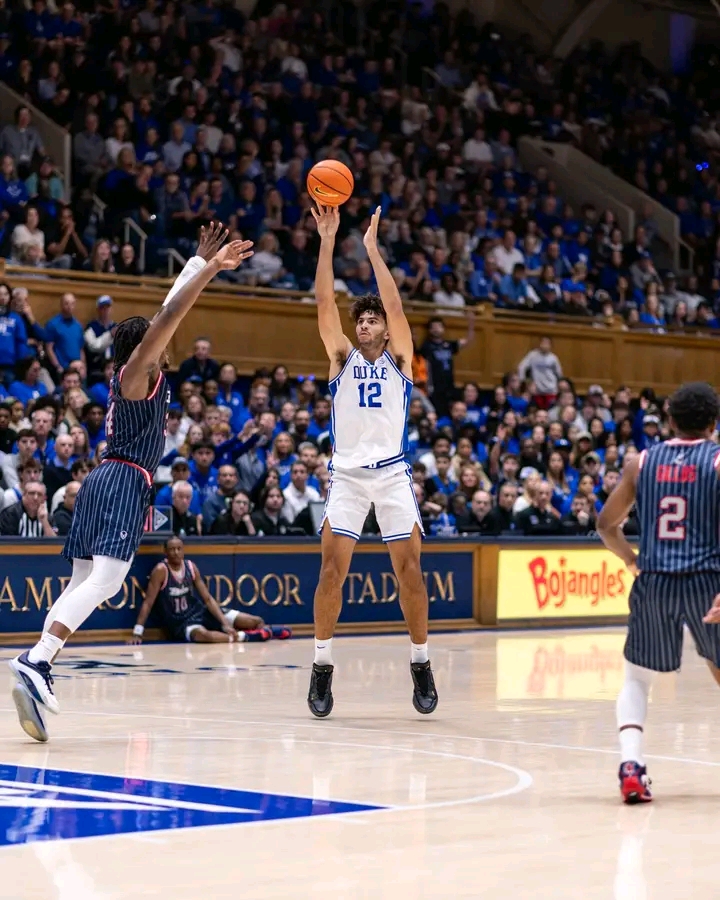
If Duke basketball fans were looking for a sign—a moment, a performance, a spark—that sign arrived on a loud Sunday afternoon inside Cameron Indoor Stadium. The Blue Devils didn’t just beat Howard. They didn’t just dominate. They delivered a 93–56 avalanche that felt less like a November tune-up and more like a proclamation: this Duke team may have arrived earlier, stronger, and more dangerously balanced than anyone expected.
And at the center of that eruption was an 18-year-old freshman whose last name already carries decades of weight in basketball circles. On this day, Cameron Boozer didn’t simply contribute—he announced himself. With 26 points, 12 rebounds, and a command of the floor that looked far beyond his years, Boozer played the kind of game that raises eyebrows across the college basketball landscape.
So now the question isn’t whether Duke looks dominant. The question is whether this was the day a new superstar officially emerged.
Let’s break down why Boozer’s performance—and Duke’s blowout—felt like something much bigger than just another nonconference win.
A Statement Win That Felt Different
Sure, Duke entered the game as heavy favorites. Sure, Howard, despite being coached by former Blue Devil Kenny Blakeney, isn’t a program built to withstand the full weight of an elite, top-five Duke roster. But a 93–56 win hits differently—not because of the margin, but because of how Duke got there.
The Blue Devils shot a blistering 67.7% from the field, peaking above 70% well into the second half. Their ball movement was sharp, their pace was electric, and their defensive anticipation suffocated Howard from the opening tip. When Duke led 23–8 less than eight minutes into the game, it wasn’t just a slow building advantage—it was an avalanche that Howard never had a chance of digging out from.
And then, as the first half wound down, Duke closed with an 11–0 run to go up 52–18 at halftime, marking the second straight game where Duke held its opponent under 20 points in the opening period. That’s not normal. That’s not common. And that’s not something you see from teams still “figuring things out.”
That’s the sign of a team playing with early-season clarity—something rare in the sport.
But while Duke as a whole was humming, the brightest spotlight belonged to Boozer.
Cameron Boozer: The Freshman Who Played Like a Veteran Star
There are great freshman games. There are breakout performances. And then there are moments where you watch a young player and think: This is going to matter later in the season.
Boozer’s 26-point, 12-rebound performance was one of those moments.
Let’s put his efficiency into context:
10-of-12 shooting from the field
2-of-3 from three
Total control in the paint
Never rushed, never sped up
Defensive physicality far beyond most freshmen
This wasn’t a freshman scoring in transition or padding stats in garbage time. Boozer scored at all three levels, exploited mismatches with patience, and played with the composure of someone who has been playing college ball for two or three seasons already.
And consider this:
Howard entered the game with Bryce Harris averaging over 22 points per game. Boozer outscored Harris by 11, out-rebounded the entire Howard frontcourt by himself, and was the best player on the floor from start to finish.
That’s not just a good game. That’s a superstar’s blueprint.
A Team Effort—But a Clear Emerging Leader
While Boozer stole the headlines, Duke wasn’t a one-man show.
Patrick Ngongba II
16 points on 8-for-9 shooting—a near perfect performance in its own right. Ngongba is building his reputation as one of the best interior finishers among freshmen nationally.
Isaiah Evans
11 points, strong above-the-rim play, and a burst of aggression that electrified the home crowd.
Ball Movement & Chemistry
At one point, Duke had 10 assists on its first 13 made field goals, a sign of a young team that, according to Jon Scheyer, is “doing a great job sharing the ball.”
When freshmen are this unselfish this early, the ceiling skyrockets.
Duke’s Defense: The Most Overlooked Dominance of the Day
Holding any college team to 18 first-half points would be impressive. Doing it twice in a row is almost unheard of. Howard entered with scoring talent, physicality, and confidence—but Duke shut it all down with:
Pressure on the perimeter
Physicality at the rim
Active hands in passing lanes
Rotations that looked midseason sharp
A defensive rebounding wall anchored by Boozer
Even when Howard hit tough shots, it didn’t matter. Duke’s intensity never allowed them to find rhythm.
The Blue Devils turned the paint into private property. They outscored Howard 36–4 inside in the first half and erased nearly every attempt to get downhill.
Duke’s defense didn’t just stop Howard. It overwhelmed them.
Cameron Indoor’s Biggest Moment Had Nothing to Do With Basketball
It’s not often that a basketball blowout includes one of the loudest football celebrations of the season—but that’s what happened when Duke’s football players rolled the Victory Bell onto the court during a stoppage.
Less than 24 hours after beating arch-rival North Carolina in football, Duke fans erupted as the bell rang throughout Cameron Indoor.
That energy spilled directly into the second half of the basketball game, and Duke’s players fed on it. Plays got flashier. The intensity ramped up. The arena’s atmosphere transformed from confident to celebratory.
It became a party. And Boozer was its headliner.
Was This Just a Blowout—or Something Bigger?
Now comes the important question:
Was this just another nonconference mismatch? Or was this the moment Duke revealed the identity of its future?
To understand why this performance mattered so much, consider three factors:
1. Duke is now 7–0, and none of their home wins have been close.
All have been won by at least 31 points. That’s not typical for young teams or teams still building chemistry. That’s dominance.
2. Boozer isn’t just playing well—he’s ascending.
Each game has shown progression.
Each game shows more confidence.
Each game shows more versatility.
He’s starting to look like the kind of player a Final Four team is built around.
3. Jon Scheyer is quietly building his strongest team yet.
This is Scheyer’s best start as Duke’s head coach.
The roster is longer, deeper, and more offensively fluid than any of his previous teams.
If this early-season trajectory continues, Duke could easily enter conference play as one of the most complete teams in the nation.
What Comes Next: Duke’s First Major Test
While the Blue Devils have cruised through home games, the real test arrives Thursday:
Duke vs. No. 21 Arkansas – Chicago
This is where the questions surrounding Boozer and his breakout will intensify.
Can he dominate in high-pressure, national spotlight environments?
Can he handle the physicality of ranked opponents?
Can he maintain efficiency when defenses game-plan specifically to stop him?
If his performance against Howard was any indication, the answer might be yes.
Did Sunday Reveal a Superstar? All Signs Point to It.
Cameron Boozer didn’t just deliver numbers. He delivered a message.
He played with confidence, control, and charisma—traits usually reserved for veteran stars and NBA-bound upperclassmen. His poise in traffic, his accuracy from deep, and his command of Duke’s offense point toward a player who is accelerating his development faster than expected.
Fans can feel it. Scheyer can see it. Opponents can sense it.
If this was the game where Boozer officially stepped into the spotlight, then Duke may have secured something every elite program dreams of:
a franchise-level freshman whose presence elevates everyone around him.
And if that’s true, then Duke didn’t just blow out Howard.
They may have introduced the country to their next superstar.




