


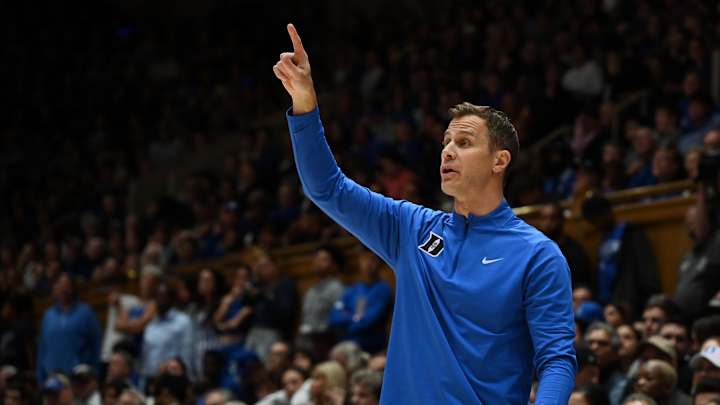
For months, Duke basketball fans have asked the same question every offseason: What exactly does Duke pay — and get paid — for those high-profile nonconference games that fill Cameron Indoor Stadium before ACC play begins? Every year, the schedules come out. The matchups get hyped. And the headlines scream about classics, challenges, and rivalry renewals.
But the financial side?
That part stays hidden.
Or at least, it used to.
Because Duke University is a private institution, it doesn’t have to share game contracts with the public. That secrecy has always sparked curiosity, debate, and even conspiracy theories among fans who want to know how a blue-blood powerhouse navigates the business side of college basketball.
But now, through open records obtained from Duke’s public opponents, the curtain has been pulled back — not fully, but enough to finally reveal the inner workings of Duke’s nonconference money machine for the 2025-26 season.
And what we find is fascinating.
This is the story of how Duke pays, how Duke earns, and how much cash actually flows around the most recognizable brand in college basketball before the ACC season even begins.
THE BLUEPRINT BEHIND DUKE’S NONCONFERENCE DEALS
Before the Blue Devils dive into ACC battles, their schedule is built around a carefully crafted sequence of home games, neutral-site showdowns, preseason exhibitions, and blockbuster television events. Each one comes with its own financial structure — payouts, ticket allocations, incentives, and revenue shares.
In Jon Scheyer’s fourth season, Duke set up a nonconference slate that covers all angles: fan favorites, returning legends, premiere TV events, and major recruiting platforms.
But behind every game is a contract.
And behind every contract is money.
Let’s break down where the dollars actually go.
WHAT DUKE PAYS AT HOME — AND WHY
Cameron Indoor Stadium is one of the most iconic stages in sports. Smaller than most major arenas, louder than all of them, and surrounded by a brand unlike any other, it is a privilege — and a payday — for mid-major programs who get the call to play Duke at home.
For the 2025-26 season, Duke is hosting:
Western Carolina (Nov. 8)
Indiana State (Nov. 14)
Niagara (Nov. 21)
Howard (Nov. 23)
Florida (Dec. 2)
Lipscomb (Dec. 16)
But not all financial details are available. Only the contracts from public schools could be obtained — meaning Western Carolina and Indiana State.
THE PRICE OF A CAMERON TRIP: $90,000 EACH
Both programs — Western Carolina and Indiana State — will receive:
$90,000 payout
75 complimentary tickets
That’s the cost for Duke to secure a home buy-game.
These matchups are designed to achieve multiple goals:
warm up the roster
build chemistry before the heavy hitters
introduce freshmen under the lights
extend Duke’s home-court dominance
generate early revenue before conference play
For some fans, those games are routine. For the programs visiting Cameron?
It’s a financial lifeline.
A $90,000 check for one night is massive for mid-major athletic departments, and Duke’s brand gives them exposure that simply doesn’t exist elsewhere.
THE ONES WITHOUT DISCLOSED CONTRACTS
The matchups vs. Niagara, Howard, and Lipscomb do not have public financial records because they are private institutions. However, the Niagara and Howard matchups are part of The Brotherhood Run, an event symbolically tied to Duke alumni coaches Greg Paulus and Kenny Blakeney.
Duke also played UCF in a preseason Brotherhood Run exhibition, marking Johnny Dawkins’ return — but again, UCF’s athletic association is exempt from Florida public records law, so those contract details remain sealed.
Even without the numbers, the pattern is clear:
Duke pays solid guarantees, offers ticket blocks, and benefits from sold-out home crowds that generate significant revenue.
THE NEUTRAL-SITE GAMES: WHERE THE REAL MONEY LIVES
Duke’s nonconference schedule isn’t just built on buy-games.
It’s built on national showcases.
These are the types of events that boost TV ratings, dominate headlines, attract NBA scouts, and turn November basketball into a spectacle.
This season, Duke will play five major matchups away from Cameron:
Texas (Charlotte — Dick Vitale Invitational)
Kansas (Madison Square Garden — Champions Classic)
Arkansas (Chicago — CBS Sports Thanksgiving Classic)
Texas Tech(MSG — SentinelOne Classic)
Michigan (Washington, D.C. — Duel of the District)
THE ONLY FULLY REVEALED DEAL: KANSAS
Kansas will receive:
$300,000 payout from ESPN
Potential bonus if ticket revenue exceeds $1.2 million
76 complimentary tickets
No other neutral-site opponent has a guaranteed payment.
That doesn’t mean there isn’t money — it simply means the payment structure may be tied to revenue splits, media rights already negotiated by conferences, or internal event agreements.
Given Duke’s status, it is highly likely that the Blue Devils receive identical incentives, but we cannot confirm because Duke’s private status shields those numbers.
TEXAS, ARKANSAS, TEXAS TECH, MICHIGAN — THE UNKNOWN FIGURES
For these programs:
No guaranteed payments are listed.
Texas Tech and Michigan are confirmed to receive 100 complimentary tickets.
Texas did not supply a contract.
Neutral-site games often operate differently:
Instead of payments, value comes through national television exposure, ESPN partnerships, recruiting visibility, and high-profile branding opportunities.
These games are less about payouts and more about power.
THE AWAY GAMES: WHAT DUKE GETS ON THE ROAD
Duke’s away nonconference schedule includes:
Tennessee (Oct. 26 — exhibition)
Army West Point (Nov. 11)
Michigan State (Dec. 6)
Contracts from Tennessee and Army were not received, but Michigan State’s was.
The Michigan State Deal: Duke Gets 150 Tickets
Duke will receive:
150 complimentary tickets
75 of them directly behind the Blue Devils’ bench
No financial element was disclosed, but that’s typical for powerhouse vs. powerhouse matchups — the real value is the exposure, not the payout.
THE BUSINESS BEHIND DUKE BASKETBALL — AND WHY IT MATTERS
According to Duke’s 2025 EADA report:
Men’s basketball revenue:$52.7 million
Expenses: $31.8 million
Athletic department total revenue: $181.6 million
Men’s basketball is second only to football in generating revenue.
And this is where things get interesting:
Duke doesn’t rely on buy-games for financial survival.
But smaller programs do.
A $90,000 check may not change Duke’s economy, but it can drastically impact a mid-major’s budget.
On the flip side, Duke’s real financial power comes from:
TV contracts
Media events
Brand visibility
High-profile neutral-site games
Ticket sales
Merchandising
Tournament runs
The Blue Devils are a global brand.
Their schedule reflects that.
WHY THESE NUMBERS MATTER TO FANS
Fans often look at schedules and ask:
Why is Duke playing this team?
Why are they traveling here?
Why this event?
Why don’t we have more home-and-home series?
The financial answers explain the strategy.
Home buy-games:
Bring guaranteed wins
Settle rotations
Build rhythm
Sell out Cameron
Produce early revenue
Neutral-site blockbusters:
Elevate the brand
Increase national TV visibility
Boost recruiting
Attract NBA scouts
Strengthen postseason résumé
Road challenges:
Build toughness
Prepare for March
Keep Duke in elite company
It’s a system.
And Duke is one of the best in the country at managing it.
SO WHAT DOES IT ALL MEAN FOR THE 2025–26 SEASON?
This year’s nonconference schedule might be the most strategically balanced of Jon Scheyer’s tenure.
It features:
Buy-games that favor development
Emotional returns (Paulus, Blakeney, Dawkins)
Premier national events
Neutral-site showcases
A blue-blood road rivalry
A financially efficient structure across all fronts
Behind every matchup is a contract.
Behind every contract is a business strategy.
And behind that business strategy is a program built not just to win basketball games — but to stay one of the most valuable brands in college athletics.
The numbers we uncovered paint a clear picture:
Duke is not just scheduling games.
Duke is investing in a long-term competitive empire.
And the financial commitment behind this schedule shows that the Blue Devils are not slowing down anytime soon.




