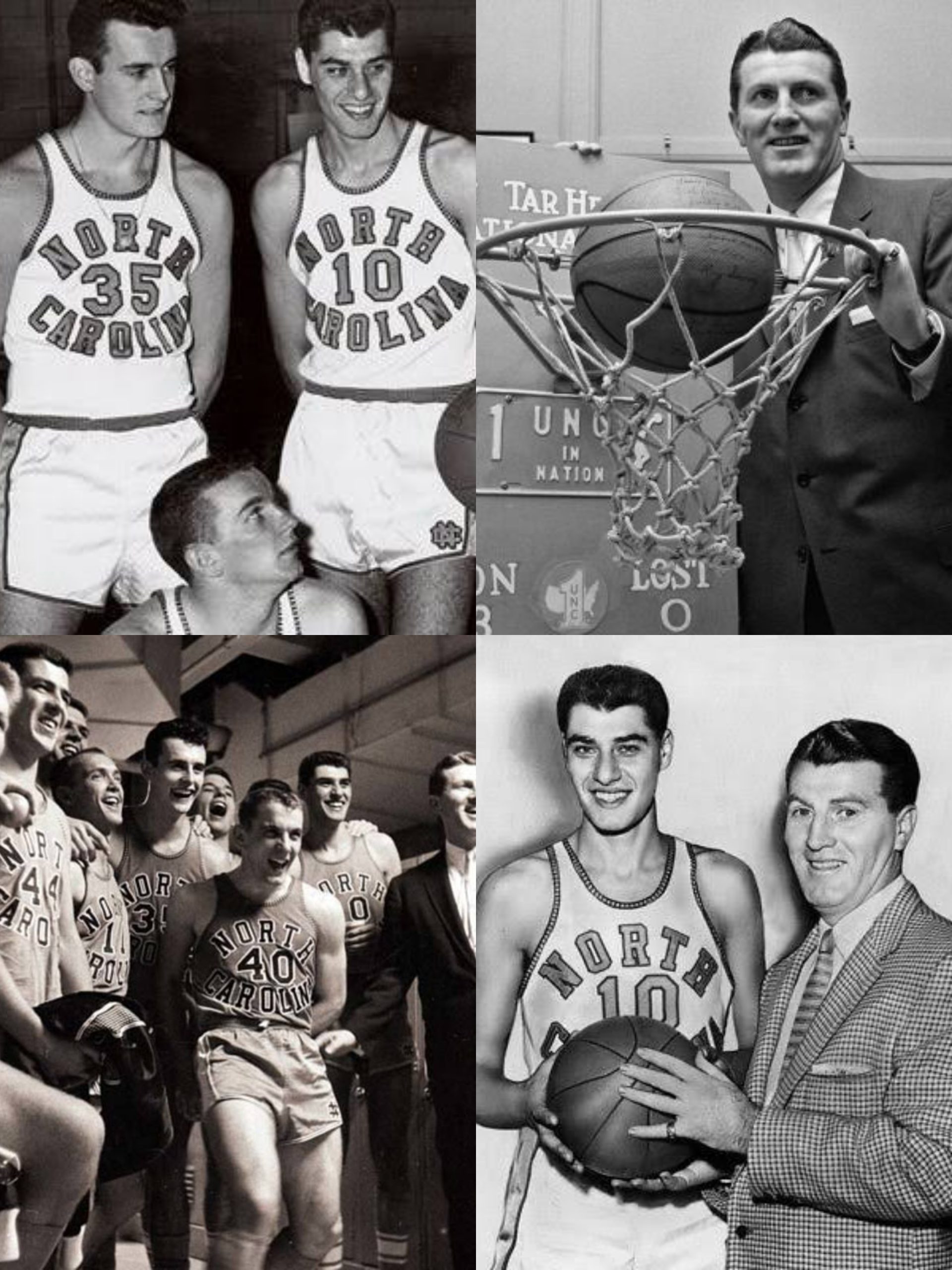
THE FORGOTTEN MIRACLE: The 1957 Team Everyone Remembers… But for the Reasons No One Ever Mentions — The Hidden Side of That Triple-OT Classic and Frank McGuire’s Bold Strategy That Stunned the Nation
The 1957 North Carolina Tar Heels are often spoken of in reverent tones. An undefeated season. A triple-overtime national championship victory over Wilt Chamberlain’s Kansas. The first NCAA title in school history. On paper, it feels like the kind of basketball story everyone already knows by heart.
But dig deeper, and a different truth emerges — one that transforms the ’57 miracle from a feel-good memory into something far more dramatic, far more unlikely, and far more visionary than the glossy headlines of the era ever dared to reveal.
This wasn’t simply a team that won. This was a team that wasn’t supposed to exist, led by a coach who broke rules of tradition long before he ever broke an opponent’s spirit. This was a team stitched together from New York grit, southern skepticism, and a strategy so bold it left even basketball purists shaking their heads.
The perfect season? That was only the surface.
The real miracle was everything underneath.
The Blueprint Nobody Understood — Until They Did
To understand how UNC pulled off one of the greatest seasons in college basketball history, you have to go back to Frank McGuire — the charismatic, stubborn, streetwise coach from Queens who dared to do something unheard of at the time:
He brought New York basketball to Chapel Hill.
Recruiting outside your region was frowned upon. Recruiting an entire pipeline of New York players? That was borderline scandalous. Yet McGuire didn’t blink.
Why?
Because he knew something the rest of the South hadn’t learned yet:
If you wanted players with toughness, swagger, and the ability to thrive under suffocating pressure, you didn’t just recruit the South — you recruited the city.
Thus emerged “The New York Boys”:
• Lennie Rosenbluth, the smooth-scoring star who averaged 28 points per game
• Tommy Kearns, the fearless guard who never backed down
• Pete Brennan, the bruising rebounder
• And the rest of the street-hardened group who brought city basketball to a region that had only seen glimpses of it
McGuire didn’t simply coach a team — he imported a culture.
And that culture became the foundation of the 1957 miracle.
The Kansas Mountain: Facing Wilt at His Peak
When UNC reached the national championship game, everyone believed the undefeated Tar Heels had finally met their ceiling. Kansas had a 7-foot-1 force of nature in Wilt Chamberlain — a player so dominant that teams didn’t strategize against him but rather strategized around the damage he would inevitably cause.
And that’s when McGuire revealed the part of his genius that history rarely highlights.
He didn’t try to beat Kansas.
He tried to exhaust them.
He slowed the game to a crawl, turned every possession into a chess match, and forced Wilt to play a style of basketball that felt more like a grind than a highlight reel. His players, many of whom grew up playing physically unforgiving basketball on New York playgrounds, were told one thing:
“Make him uncomfortable. Every second. Every step. Every shot.”
The result?
A national title game that became an instant classic — three overtimes of raw heart, tactical brilliance, and emotional chaos.
UNC didn’t overpower Kansas.
They outlasted them.
And in that endurance, a legend was born.
The Real Miracle: What No One Talks About
Most fans know the ending. Rosenbluth’s heroics. The final defensive stand. The celebration that echoed across North Carolina.
But what few talk about is the psychological warfare McGuire played that night.
The moment that still stands out?
When he sent 5’11” guard Tommy Kearns to jump center against the 7’1″ Wilt Chamberlain to start the game.
A mismatch? Of course.
A mistake? No chance.
It was a message — a quiet but cutting declaration that UNC would play this game on their terms, not Kansas’s. The crowd laughed. Wilt smirked. But Kansas felt something subtle shift.
That was McGuire.
That was the ’57 team.
That was the forgotten miracle.
Why 1957 Still Matters Today
UNC’s first national championship wasn’t just a trophy moment — it was a turning point in college basketball culture. It marked:
• The beginning of UNC’s basketball dynasty
• The validation of recruiting pipelines that expanded across states
• The birth of a modern playing philosophy built on tempo, spacing, and discipline
• And the rise of North Carolina as a national powerhouse rather than a regional hopeful
But most of all, it proved something timeless:
That basketball is not simply about talent — it’s about belief, identity, and the courage to do what no one expects.
Frank McGuire’s “New York Boys” didn’t just win games.
They rewrote the blueprint for winning itself.
A Legend Not Forgotten — Just Misunderstood
The 1957 Tar Heels will forever be remembered for surviving Kansas in triple overtime. But the real beauty of that story lies in the layers people often overlook — the recruiting revolution, the cultural clash, the psychological warfare, and the unshakeable confidence of a coach who refused to let geography dictate success.
This wasn’t a fairy tale.
It was a rebellion.
A rebellion that ended with an undefeated season…
a national title…
and the foundation of everything UNC basketball would one day become.
And that — more than the final score — is the part of the miracle we should never forget.
Related