


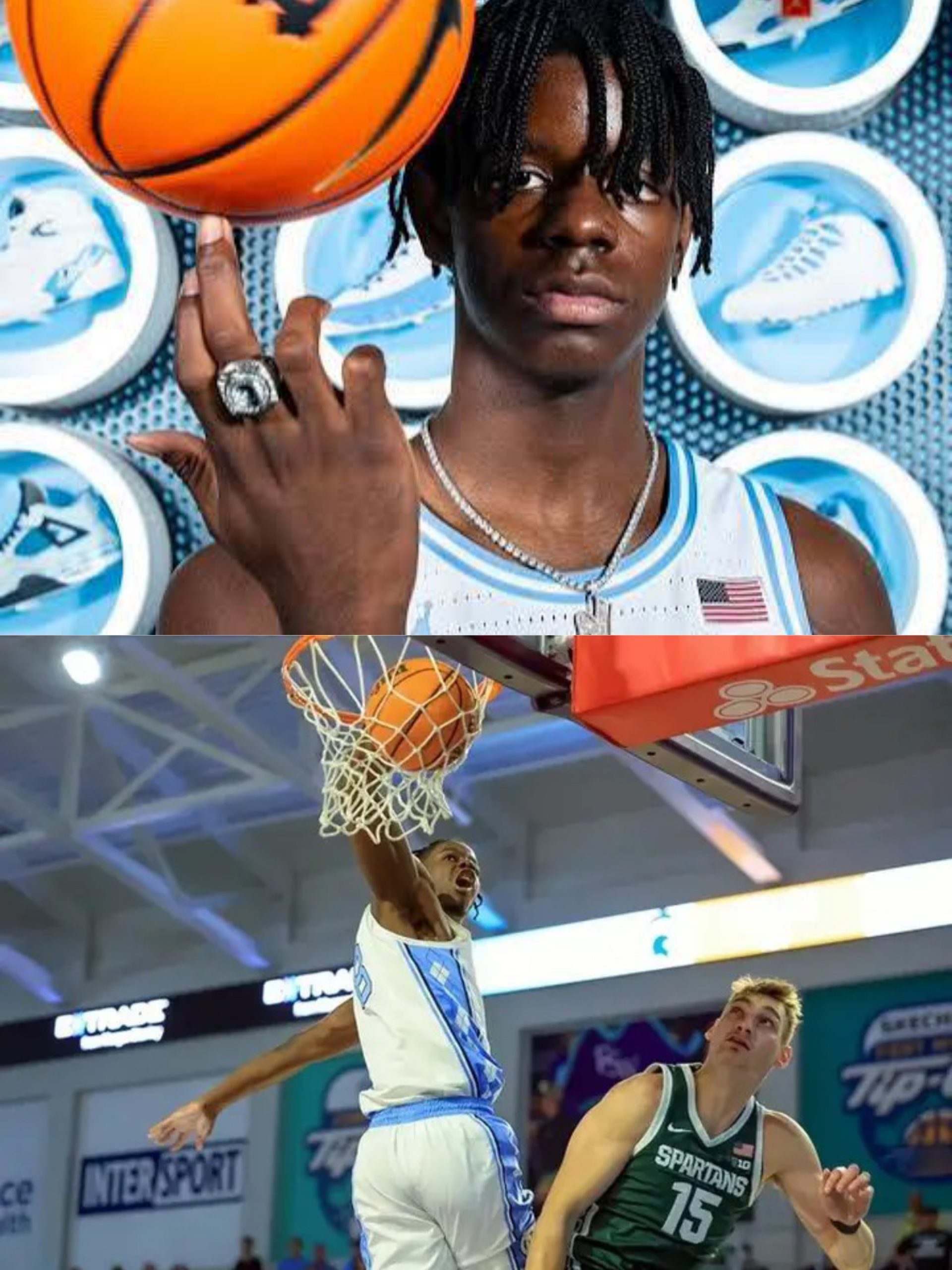
The “Jordan Rules” Reimagined? Thanksgiving Turns Into the Debut of the ‘Caleb Wilson Rules’ — How Tom Izzo Quietly Borrowed an Old-School Blueprint to Disrupt UNC’s Rising Star
Thanksgiving basketball usually delivers drama, but this year’s UNC–Michigan State showdown came with an unexpected storyline — one that sent Tar Heel Nation spiraling into conversations they never thought they’d be having about a freshman.
Because for the first time in his young career, Caleb Wilson — the explosive, smooth, seemingly unguardable UNC phenom — ran into something that looked strangely familiar to older fans:
A defensive scheme pulled straight out of the 1980s and 90s… the era of the legendary “Jordan Rules.”
And while no one is comparing Wilson to Michael Jordan, the strategy Tom Izzo’s Spartans used on Thanksgiving Day felt like a throwback to the league that once threw entire defensive systems at MJ simply to slow him down.
Only this time, the target was an 18-year-old from Chapel Hill.
UNC fans didn’t take long to give it a name:
“The Caleb Wilson Rules.”
A Blueprint With History — and a Message
From the opening tip, Michigan State played Wilson with a tone that was impossible to ignore: physical, suffocating, and punishing. Every drive he made came with body pressure. Every touch brought a second defender shading toward him. Handoffs became traps. Screens became collisions.
It was not random.
It was not accidental.
And it was not just “good defense.”
Izzo’s strategy was deliberate, calculated, and almost retro:
Force Wilson into traffic. Body him early. Throw him off rhythm. Make him uncomfortable. Never let him see the same look twice.
Sound familiar? It should — because it’s the same conceptual framework Detroit once unleashed to contain Michael Jordan in the late 80s.
And just like those Pistons teams forced MJ to elevate to another level, the Spartans were daring the freshman to grow up on the spot.
UNC Fans Saw It… and They Didn’t Like It
Tar Heel fans instantly recognized the physicality — and they immediately questioned whether the officiating tolerated too much of it.
Social media lit up with comments like:
“This isn’t defense — it’s a wrestling match.”
“Michigan State has a green light to hit him on every drive.”
“So this is what it looks like when teams panic about stopping Wilson already?”
Whether the whistles were swallowed or simply slow, Wilson’s frustration was visible. He wasn’t shaken — but he wasn’t free, either. Every movement felt like it was happening under a microscope, with defenders glued to him in a way rarely seen in college basketball this season.
The Spartans’ Strategy: Make Wilson Beat Five People, Not One
Michigan State didn’t just send pressure — they manipulated UNC’s spacing to force Wilson into impossible decisions.
Here’s what Izzo’s staff leaned on:
1. Hard hedges and immediate body checks
Every screen Wilson used became an invitation for two defenders to hit him early.
2. Forcing him into the big
The weak-side help collapsed inward instead of staying attached to shooters — daring UNC to make them pay.
3. Physical off-ball harassment
Wilson couldn’t even cut without contact. This took away his rhythm before he ever touched the ball.
4. Rotating length onto him
Izzo alternated wings, guards, and forwards, giving Wilson no consistent matchup to study.
It wasn’t just a strategy. It was a message:
“We’re not letting you destroy us. Beat this — if you can.”
Did It Work? Yes… and No
Statistically, the plan slowed Wilson down. He didn’t dominate the scoring column. He didn’t control the pace like in previous games.
But here’s the twist:
This game wasn’t a referendum on Wilson’s weaknesses — it was a blueprint for how high his ceiling really is.
Because a freshman only draws this kind of targeted, hyper-physical, everything-must-go-through-him attention when a coaching titan sees something that scares him.
Wilson has played just a handful of college games, and already:
-
Teams are assigning shadow defenders
-
Coaches are designing schemes specifically for him
-
Opponents are treating him like the engine of UNC’s offense
You don’t get the “Jordan Rules” treatment unless you’re seen as that important.
UNC’s Perspective: A Lesson… and a Warning
Hubert Davis didn’t hide from the truth postgame — UNC will see this again. Maybe from rival ACC teams. Maybe in March. Maybe in the tournament games that define reputations.
The message was clear:
If Wilson is going to be the superstar everyone believes he can be, this will become his normal — and he must learn to punish it.
UNC staff is now faced with a long to-do list:
-
Creating better spacing
-
Giving Wilson cleaner entry angles
-
Using him as a decoy to collapse defenses
-
Designing wrinkle actions to counter hyper-physicality
This loss didn’t break UNC — but it revealed what the future looks like when your freshman is already the center of every opponent’s game plan.
Why Fans Are Calling It the “Caleb Wilson Rules”
Because this wasn’t just Michigan State being physical.
It was a coordinated, persistent, multi-pronged strategy built entirely around one player.
And that’s not normal.
Not in November.
Not for a freshman.
Not unless that player has game-changing superstar potential.
UNC fans aren’t angry about the scheme — they’re stunned by what it means:
Wilson is already commanding the kind of attention only generational talents receive.
And that’s why the comparisons, the jokes, and the memes rolled in:
“If they’re already giving him the MJ treatment, the ACC is in trouble.”
“If these are the Caleb Wilson Rules, I can’t wait to see how he breaks them.”
The Final Takeaway: A New Era Has Started
The Jordan Rules were about respect.
The Caleb Wilson Rules?
Those are about fear.
Michigan State revealed something UNC fans didn’t realize until the final horn:
Caleb Wilson isn’t just another talented freshman — he’s a game-plan-breaking, opponent-altering force.
And if Thanksgiving was any indication, every major team UNC faces from here on out will try to rewrite the rulebook to contain him.
The question is simple:
How long before he outgrows even these rules?
Because if the history of college basketball tells us anything, it’s this:
When a true star starts getting this kind of treatment…
They don’t stay stoppable for long.




