


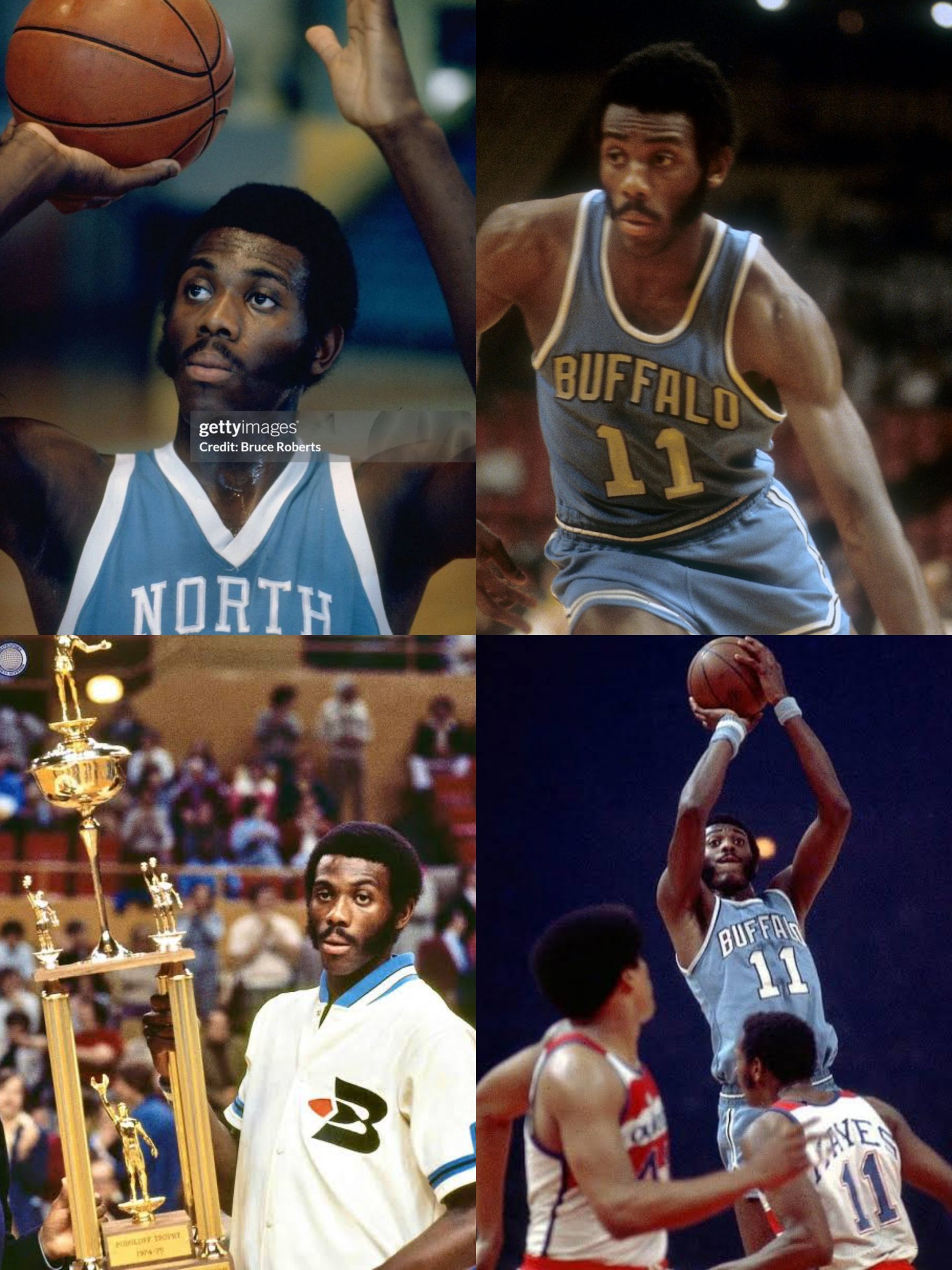
UNC’s One-Year Wonder Who Ruled the NBA—But Couldn’t Conquer the Playoffs: The Bob McAdoo Story — He Led the League in Points and Rebounds, Won MVP—but Why Did Bob McAdoo’s Team Always Fall Short? See why…
Bob McAdoo’s career reads like a study in extremes: a single electrifying college season, a rookie campaign that announced a new star, a blistering MVP year in which he led the league in scoring, and a string of playoff exits that left fans asking the same question — how could so much individual brilliance result in so little team postseason success? This feature traces McAdoo’s path from Chapel Hill prodigy to NBA icon, breaks down the 1974–75 MVP season that cemented his legacy, and explains the mix of roster, tactical, and contextual reasons the Buffalo Braves couldn’t turn his greatness into deep playoff runs.
From Vincennes to Chapel Hill: One Season that Changed Everything
McAdoo’s journey to national attention began before he ever donned a Tar Heel uniform. After success at Vincennes (a junior college), he arrived at the University of North Carolina for the 1971–72 season and immediately made an impact. In his lone season at UNC, he averaged 19.5 points and 10.1 rebounds, earned first-team All-America recognition, and helped Dean Smith’s club to a deep run in the NCAA Tournament — a profile that turned pro scouts’ heads and set the stage for McAdoo’s early entry into the NBA.
In an era when early departures were uncommon, McAdoo applied for and received hardship eligibility to enter the 1972 draft. His size (6’9″), mobility, soft hands, and reliable midrange game made him an unusual frontcourt talent for the time — a player who could score from multiple levels and rebound with authority. Those traits defined his pro identity from the first minute he played in Buffalo.
Rookie of the Year — The Arrival of “Big Bob”
Selected No. 2 overall in the 1972 NBA Draft by the Buffalo Braves, McAdoo’s debut was immediate and attention-grabbing. He averaged roughly 18 points and 9 rebounds as a rookie and earned NBA Rookie of the Year honors in 1973. The accolade marked the beginning of a rapid ascent from standout newcomer to league MVP in just a few years.
More than raw numbers, what made McAdoo special was his efficiency: his shot selection and ability to convert in traffic and from the perimeter gave defenses very few easy answers. He combined the instincts of a traditional big man with a skill set that allowed him to score off the dribble and from 12–18 feet — rare attributes that forced opponents to rethink matchups.
Peak: The 1974–75 MVP Season — Numbers That Stunned the Basketball World
McAdoo’s 1974–75 campaign was explosive. He led the NBA with 34.5 points per game and 14.1 rebounds, playing enormous minutes and carrying an offense that often ran through him. That season earned him the league MVP award — a striking achievement for a player on a team not widely viewed as a title favorite. Season-long scoring at that level, combined with elite rebounding, placed McAdoo among the best offensive performers in NBA history.
In the 1974–75 playoffs, McAdoo averaged even higher points per game, logging mammoth minutes and demonstrating that his conditioning and competitive intensity matched his scoring output. Yet even these extraordinary numbers weren’t enough to push the Braves past their playoff opponents.
The Paradox: Why Individual Dominance Didn’t Equal Playoff Breakthroughs
Numbers can be intoxicating, but basketball is a team sport. McAdoo’s situation with the Braves exposes the truth that superstar numbers must be paired with systemic balance to win in the postseason. Several interlocking reasons explain why Buffalo repeatedly ran into the same playoff ceiling:
1. Lack of complementary star power
Championship contenders almost always have more than one elite or above-average offensive option. During McAdoo’s Buffalo tenure, the roster lacked a reliable secondary scoring threat to alleviate pressure on him in critical moments.
2. Defensive shortcomings and matchup vulnerabilities
While McAdoo excelled offensively, the Braves often struggled defensively. Opposing teams with strong interior defenders and athletic wings could expose Buffalo’s weaknesses, especially in playoff series where coaches exploit mismatches and defensive strategy becomes crucial.
3. Organizational context and roster-building constraints
The Buffalo franchise in the 1970s was still establishing itself. Financial limits and roster-building challenges made it difficult to assemble a supporting cast capable of sustaining deep playoff runs.
4. The competition was elite
The mid-1970s featured several battle-tested, championship-caliber teams. Even McAdoo’s transcendent performances could be blunted by disciplined defensive schemes, veteran coaching, and superior team depth.
Case Studies: Playoff Series That Left Questions Unanswered
In 1974, the Braves faced the Boston Celtics — a veteran team with championship experience. Despite McAdoo’s strong performance, Buffalo lacked the consistency and depth needed to advance. In 1975, they pushed the Washington Bullets to seven games in the conference semifinals. McAdoo’s individual numbers were extraordinary, but Washington’s balanced attack and physical play in decisive moments spelled the difference.
Statistically, McAdoo’s playoff box scores are staggering — yet the final result was elimination. His story illustrates that even the most dominant individual performances cannot overcome a lack of team balance in the playoffs.
Beyond the Braves: A Fuller Career and Lasting Impact
After leaving Buffalo, McAdoo continued to score at elite levels and eventually contributed to Los Angeles Lakers championship teams in the early 1980s. He later extended his career in Europe, demonstrating adaptability and basketball IQ. His combination of scoring titles, MVP award, All-Star selections, and later championships creates a nuanced legacy that resists reduction to playoff shortcomings alone.
McAdoo’s greatest legacy may be stylistic: a prototype for the mobile, face-up big man who could stretch defenses and create matchup problems. Today’s NBA emphasizes spacing and high-post shooting for bigs, and McAdoo’s toolkit appears remarkably prescient.
Final Reckoning: Why the Question Still Matters
Decades later, asking why Bob McAdoo’s Braves never advanced deeper invites broader discussions about team construction, market dynamics, and the limits of relying on a single superstar. McAdoo’s career shows that greatness is multifaceted: statistical brilliance, cultural influence, and team success are related but distinct metrics.
Ultimately, McAdoo’s story is a complicated triumph: he rewrote scoring norms for big men, won the league’s highest individual honor, and left unforgettable playoff performances — even if the team didn’t achieve its championship dreams. His peak seasons continue to inspire and provoke discussion among basketball fans and historians alike.
Quick Timeline (Key Milestones)
-
1971–72: One season at UNC — averaged 19.5 PPG and 10.1 RPG; All-American and Final Four appearance.
-
1972: Selected No. 2 overall in the NBA Draft by the Buffalo Braves.
-
1973: NBA Rookie of the Year.
-
1974–75: NBA Most Valuable Player — led the league with 34.5 PPG and 14.1 RPG.
-
Mid–late 1970s/early 1980s: Continued high-level play, contributed to Lakers championship teams, and extended career overseas.
Related




