


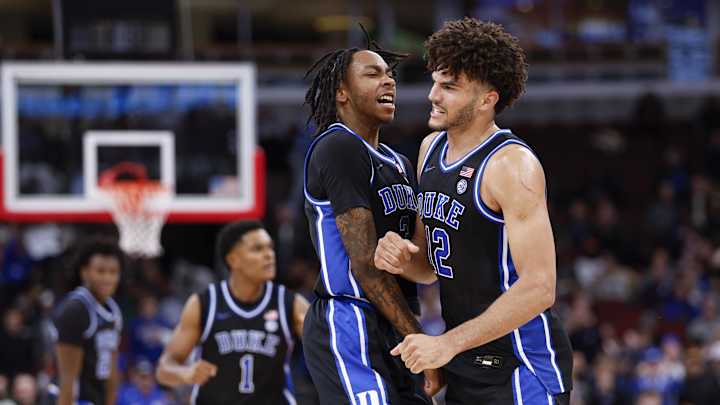
The calendar has barely flipped to December, yet the Duke Blue Devils find themselves thrust into one of the most pressure-packed moments of their young season. On Tuesday night, No. 4 Duke finally welcomes its first major opponent of the year to Cameron Indoor Stadium — the defending National Champion Florida Gators. On paper, it’s a Top-15 blockbuster. In reality, it carries an unusual and heavy weight for the home team.
For most programs, hosting the reigning champions would come with a sense of elevated anticipation, maybe even nerves. But Duke’s situation is different. Expectations around Jon Scheyer’s squad have soared over the past month. With one of the most talented rosters in the country, a rabid home crowd behind them, and a spotless home record to protect, the Blue Devils enter the matchup as clear — perhaps overwhelmingly clear — favorites. That dynamic places the spotlight squarely on Duke. Anything less than a convincing performance will be viewed as a disappointment.
Florida, meanwhile, arrives in Durham surrounded by more questions than praise. Despite boasting one of the most dominant frontcourts in the nation, the Gators have endured a rocky start to their title-defense campaign. Their interior presence should challenge Duke’s young big men — especially Cameron Boozer and Pat Ngongba — but Florida’s guard play has yet to match last season’s consistency and explosiveness. That contrast between frontcourt strength and backcourt instability is one of the defining storylines heading into the game.
The Gators’ offseason additions at guard have struggled to make an immediate impact. Princeton transfer Xaivian Lee, expected to bring steadiness and shot-making, hasn’t fully adapted to Todd Golden’s system. His transition from the Ivy League to SEC-level intensity has been bumpier than projected. Likewise, Arkansas transfer Boogie Fland has produced respectable scoring numbers, but his efficiency has raised red flags. The Gators are still trying to discover who can reliably run their offense, control tempo, and generate perimeter pressure against elite teams.
Their early results reflect that uneven identity. Florida opened the season with a loss to then-No. 13 Arizona, a game where lapses on both ends proved costly. Their rivalry showdown with Florida State required a furious second-half rally merely to avoid an upset on their home court. Most recently, the Gators squandered a double-digit lead against TCU, further fueling doubts about their late-game execution. These struggles explain why Duke is not just favored — it is expected to win decisively.
That expectation is where the pressure begins.
The Blue Devils have been outstanding through their first month, demonstrating versatility, depth, and flashes of dominance. Yet they’ve also experienced firsthand that being the favorite does not guarantee comfort. Earlier this season, Duke entered the Champions Classic matchup against Kansas with nearly every advantage. The Jayhawks were missing star Darryn Peterson, leading many to label Duke a certain winner. Instead, Kansas played with toughness and precision, refusing to back down until Duke managed to pull away late in the second half at Madison Square Garden.
A similar pattern emerged during Duke’s Thanksgiving matchup against Arkansas. Oddsmakers made Duke a surprising 10-point favorite, a margin that many fans found generous. The Razorbacks, however, pushed the Blue Devils deep into the second half, forcing Scheyer’s squad to mount a late comeback to secure the win. In both cases, Duke survived — but the lesson was unmistakable: nothing in college basketball is automatic, especially when you’re the team everyone expects to deliver a flawless performance.
That brings the Blue Devils to Tuesday night, where the stakes feel amplified. The opportunity is enormous — not only to defeat the defending champions but to reinforce Duke’s national title aspirations. Yet the risk is equally real. A loss, especially at home against a team trying to regain its footing, would raise immediate questions about Duke’s consistency, poise, and ability to dominate when circumstances demand it.
The matchup itself presents intriguing challenges. Florida’s frontcourt physicality could force Duke’s youthful interior to grow up fast. If Boozer and Ngongba struggle to contain the Gators’ big men, Duke may need to rely heavily on its perimeter scoring and defensive pressure to dictate pace. Conversely, if Duke’s guards exploit Florida’s backcourt vulnerabilities, the Blue Devils could seize control early and place the Gators on their heels.
One of the defining elements of Duke basketball has always been its ability to thrive under intense pressure — the packed arena, the national spotlight, the legacy expectations. Tuesday night will be a test of whether this generation of Blue Devils can embrace that identity. They have the talent, the depth, and the home-court advantage. What remains to be seen is whether they can balance confidence with composure.
Florida, despite its inconsistencies, remains dangerous. A team with championship DNA can never be overlooked. The Gators have size, athleticism, and the experience of having climbed the mountaintop last season. If they find rhythm early or if Duke allows them to control the boards, this could easily shift from a presumed Duke victory to a tense, grind-it-out battle.
Ultimately, the expectations surrounding Duke are what make this matchup compelling. The Blue Devils are not merely trying to win — they are trying to validate their status as one of the nation’s elite teams. The pressure is undeniably real, but so is the opportunity to make a statement.
On Tuesday night inside Cameron Indoor Stadium, Duke will face more than just the Florida Gators. They will face the weight of expectation, the unpredictability of college basketball, and the challenge of proving that they can rise to the moment when everyone believes they should.




