


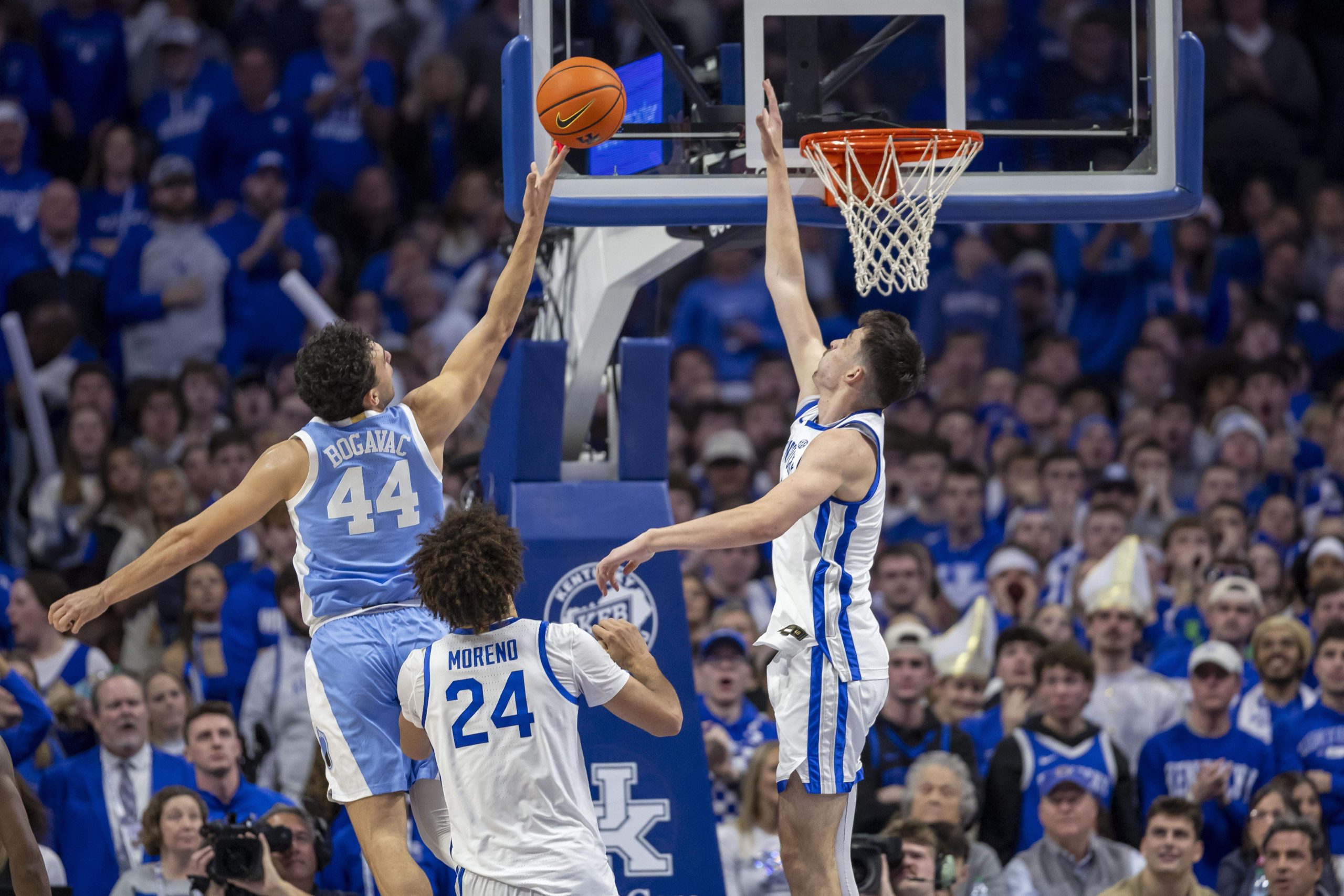
North Carolina walked into Rupp Arena on Tuesday night knowing it would face its toughest test of the season — a top-20 opponent, a roaring crowd, and the type of pressure only Kentucky basketball can apply. What the Tar Heels didn’t know, however, was that their biggest heroes would come not from their veterans or their stars, but from the very players whose roles had still been taking shape.
By the final buzzer, No. 16 UNC had survived a late charge, leaned on two reserves in a tense closing stretch, and escaped with a hard-earned 67–64 victory over No. 18 Kentucky. In a building designed to rattle even seasoned players, it was freshman guard Derek Dixon who delivered the poise, playmaking, and shot-making that ultimately pushed the Tar Heels across the finish line.
Head coach Hubert Davis, visibly fired up in the final minutes, needed two late timeouts as the game tightened. Both times, the Tar Heels’ drawn-up play sputtered. And both times, Dixon bailed them out.
The first came when the offense stalled and the shot clock dipped. Dixon took a hard dribble, stepped back, and drilled a cold-blooded three. Moments later, after Kentucky’s Collin Chandler tied the score, Dixon attacked through traffic and finished a difficult, twisting layup — a shot that silenced Rupp Arena long enough for UNC to regroup. That bucket stood as the final field goal of the night for either team.
Kentucky had one final chance, down two with 12 seconds remaining, but Chandler’s layup rimmed out. Freshman forward Caleb Wilson — who continues to look every bit like the high-level recruit UNC hoped for — snagged the rebound, drew a foul, and iced the game at the free-throw line. His final points padded the score, but the work he and Henri Veesaar did for forty minutes meant far more.
Veesaar, the steady forward from Estonia, put together one of his most complete performances as a Tar Heel, finishing with 17 points on 8-of-12 shooting and dominating the glass. Wilson added 15 points and six assists, and together the pair combined for a staggering 22 rebounds, powering UNC to a 41–30 rebounding edge and a season-high 20 offensive rebounds that ultimately defined the game.
Davis had predicted earlier in the week that this matchup would be won “in the trenches,” and it was. UNC outscored Kentucky 22–5 in second-chance points — the clearest difference in an otherwise tight duel marked by whistles, scoring droughts, and long stretches where each possession felt like a fistfight.
UNC’s Bench Delivers When It Matters Most
After producing just five bench points in their win against Michigan State, the Tar Heels knew they needed more from their reserves. And on the road, in a hostile environment, they absolutely got it.
Jonathan Powell knocked down two threes in the first half, helping UNC build and regain momentum during several early swings. Dixon added four points before halftime, but his value stretched well beyond scoring. With freshman point guard Elliot Cadeau battling turnovers and foul trouble, Dixon took over ball-handling duties multiple times — including during crunch time. Davis praised his composure afterward, saying Dixon “did a really good job containing the dribble drive, making them take tough shots, and running the team.”
At one point, Dixon logged 24 minutes, more than veteran Seth Trimble, signaling that his role may be expanding just as ACC play approaches. His combination of size, defense, and fearlessness made him vital against Kentucky’s screen-heavy attack.
UNC is still searching for consistency from its backup bigs, however. Sophomore Zayden High scored a single basket — a layup that tied the game at 56 — but otherwise struggled to make an imprint. Still, with Powell and Dixon emerging as reliable options, the Tar Heels’ depth looks more promising than it did a week ago.
Turnovers Nearly Cost UNC — Until They Didn’t
For all the positives, UNC’s early sloppiness nearly doomed them. The Tar Heels handed Kentucky seven first-half turnovers, leading to multiple leak-out dunks and rapid-fire scoring swings. Twice UNC built a small lead, and twice Kentucky erased it within seconds because of careless passing.
Davis acknowledged the issue postgame, saying the Wildcats excel at jumping passing lanes and turning mistakes into “pick-six turnovers.” Fortunately for UNC, the second half told a different story. The Tar Heels finished with only three points allowed off turnovers after halftime, a dramatic improvement that allowed them to control pace, get into their sets, and keep Kentucky from feeding off crowd energy.
A True Road Test — And a True Confidence Boost
Rupp Arena delivered the full Kentucky experience: exploding pyrotechnics, a chest-rattling sound system, and the infamous “Eruption Zone” operating at full volume. For UNC’s 11 newcomers — including two freshmen who took center stage in the final minutes — this type of environment cannot be replicated on a neutral court.
But the Tar Heels passed the test.
They showed toughness. They showed resilience. And they showed that on nights when the offense sputters or when veterans aren’t available, the bench has players capable of rising to the occasion.
Most importantly, they showed that their freshmen aren’t afraid of the moment.
If this group continues to grow — and if Dixon’s confidence continues to rise — Tuesday night’s win in Lexington may become a defining moment early in the Hubert Davis era.




