


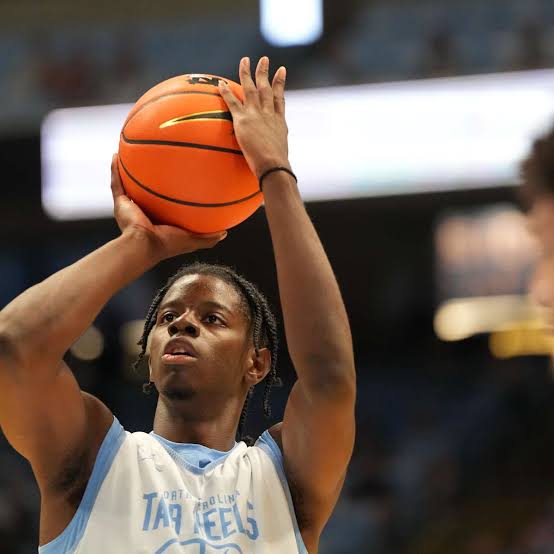
There are nights in college basketball when a team simply survives. There are nights when a star carries the load. And then, there are nights when a program sends a message—loud, clear, and impossible to ignore.
Tuesday in Lexington was one of those nights for the North Carolina Tar Heels.
In a matchup between blue-blood giants inside a hostile Rupp Arena, UNC didn’t just earn a résumé-building victory—it unveiled something far more intriguing: a frontcourt combination that looked every bit like the next unstoppable force in college basketball.
Henri Veesaar and Caleb Wilson didn’t merely play well. They dominated. They imposed their will on Kentucky’s frontline, controlled the glass, punished mismatches, and delivered the type of two-man masterclass that instantly changes the ceiling of a team.
And suddenly, everyone—from fans to analysts—started asking the same question:
Have the Tar Heels discovered a super-frontcourt that can change the entire ACC landscape?
Because if Tuesday night was any indication… the answer may be yes.
A Performance Too Loud to Ignore
The numbers alone tell a story, but the eye test screamed even louder.
Henri Veesaar:
17 points
10 rebounds
67% shooting
Caleb Wilson:
15 points
12 rebounds
6 assists
A double-double from both. Efficiency from both. Leadership from both.
But the most impressive piece? Their synergy.
For the first time this season, UNC fans saw what this pairing could look like at full power. Wilson’s mobility and playmaking complemented Veesaar’s size, touch, and rim protection beautifully. When one wasn’t scoring, he was facilitating. When one wasn’t rebounding, he was sealing off space for the other. When Kentucky tried to take away one option, the other punished them.
This didn’t look like two talented individuals.
It looked like a foundation.
The Frontcourt That No One Wants to Deal With
For weeks, Tar Heel fans have debated rotations, scoring consistency, and whether this team had a real identity.
Tuesday night reshaped that conversation.
UNC’s identity may now live with its two bigs.
Veesaar is becoming the interior anchor Carolina has been missing. His motor never dipped. His footwork around the rim was clean. And when the moment tightened, he remained poised, physical, and fully in control.
Wilson, meanwhile, looks like a player made in a lab for today’s college game:
Long
Smooth
Unselfish
Multi-positional
Skilled enough to create mismatches all night
Kentucky defenders learned the hard way that he isn’t just a scoring threat—he is a connector. His passing out of the high post broke down the Wildcats’ defense repeatedly, especially in pressure moments.
Together?
They forced Kentucky to abandon their original defensive scheme. That’s how dangerous the duo was.
The Moment the Game Turned
In the second half, when UNC desperately needed someone to stabilize an offense that had looked shaky, it wasn’t the guards who rescued the Tar Heels—it was the frontcourt.
Kentucky went more than 10 minutes without a field goal yet somehow kept the lead for nearly all of that drought. The game was screaming for someone to take ownership.
Veesaar and Wilson answered.
Veesaar sealed his man deep and finished through contact.
Wilson grabbed offensive rebounds in traffic and extended possessions.
Both made critical defensive rotations that erased what would’ve been easy Kentucky buckets.
They didn’t flash. They didn’t gamble.
They controlled.
And UNC, despite its turnovers and struggles at the free-throw line, suddenly had stability.
What This Means for Hubert Davis
Much has been said about Hubert Davis and his ability to win these types of games. But Tuesday was one of the clearest examples yet of Davis adjusting, trusting his personnel, and leaning into what the game presented.
Davis and his staff drew up perfect sets out of timeouts, especially late. Fans online were quick to praise—not criticize—the coaching:
“Hubert Davis was tremendous calling offensive sets… noticeable throughout the game.”
— @RelDMC
“End-of-game management looked very similar to Scheyer’s—an improvement from last year.”
— @dek842
One tweet stood out more than the rest:
“Henri needs to be the foundation of the offense. Wilson needs to play off Veesaar, not vice versa. If they figure that out, they’ll be one of the most productive front lines in the country.”
— @hutchinsroy
That is the exact blueprint UNC executed in the second half—run offense through Veesaar’s interior gravity while letting Wilson operate as the decision-maker.
For Carolina fans who have been asking for offensive identity, Tuesday may have been the clearest glimpse yet of where this season is heading.
UNC Didn’t Play Beautiful Basketball — But They Played Winning Basketball
The Tar Heels had:
12 turnovers
A stretch of stagnant halfcourt offense
Missed free throws
Poor rhythm for long stretches
And still won on the road against the No. 18 team in the country.
That’s what elite frontcourts do.
They give you a margin for error.
UNC didn’t need to be perfect—they just needed their bigs to show up. And they did.
In games like this, where everything feels uncomfortable and every possession becomes a battle, championship-caliber teams survive through defense, physicality, and interior dominance.
Carolina had all three.
Why This Frontcourt Matters Long-Term
Frontcourts with this combination of:
✔️ Size
✔️ Skill
✔️ Mobility
✔️ Passing
✔️ Rebounding
✔️ Defensive length
…do not come around often.
Many fans immediately began drawing comparisons on social media to legendary UNC pairings—May & Williams, Meeks & Hicks, Johnson & Brice. Some even asked if Veesaar–Wilson could become the most balanced Tar Heel frontcourt since the 2009 national championship team.
Is that premature? Maybe. But it speaks to what people are beginning to see:
Veesaar looks like a future NBA rotation big.
Wilson looks like a potential one-and-done lottery talent.
And together, they look like a nightmare for anyone trying to out-rebound or out-physical UNC.
The better they play, the better the spacing becomes for the guards.
The better they rebound, the more opportunities there are in transition.
The better they defend, the more control UNC has over pace.
They don’t just impact the game—they shape it.
Kentucky Saw the First Version… Opponents Won’t Enjoy the Next One
If this is the baseline, what happens when they take another step?
What happens when Wilson’s touch improves even more?
When Veesaar gets comfortable taking more midrange shots?
When both fully master playing off each other?
UNC fans left this game asking the same thing:
Are we witnessing the early stages of something special?
Because the energy on social media said it all:
“That Tar Heel frontcourt is a PROBLEM.”
— @recruitsnews
And “problem” might be an understatement.
A Win That Changes the Trajectory of the Season
This wasn’t just a resume win.
This wasn’t just an ACC/SEC Challenge victory.
This was the kind of performance that strengthens belief inside and outside the locker room.
The Hubert Davis era hasn’t always been consistent in these environments—but this win felt different.
It felt like the emergence of an identity.
It felt like a turning point.
It felt like two players announcing themselves to the country.
UNC is now 7-1 with two top-25 victories, and more importantly, it has something other teams in the ACC cannot easily match:
A frontcourt that can win games by itself.
What Comes Next for UNC?
The schedule gets tougher. The spotlight grows brighter. Expectations will rise. But with Veesaar and Wilson, UNC has something sustainable—something that travels well, shows up in March, and stabilizes games when everything else breaks down.
If the guards continue developing, if the rotations tighten up, and if Davis keeps trusting the inside-out approach that worked so well Tuesday, this team could be far more dangerous than preseason polls suggested.
Because championship teams aren’t built on just flash.
They’re built on foundations.
And UNC may have just discovered theirs.
Final Thoughts:
A Question That Won’t Go Away
After Tuesday night, college basketball fans can argue about UNC’s shooting, turnovers, guard play, or overall consistency.
But one question rises above the rest—one that keeps popping up online, one that makes this team suddenly fascinating, one that gives Tar Heel fans real hope:
Did UNC just unleash the most dominant frontcourt in college basketball?
If Veesaar and Wilson keep playing like this, the answer won’t stay a mystery for long.




