


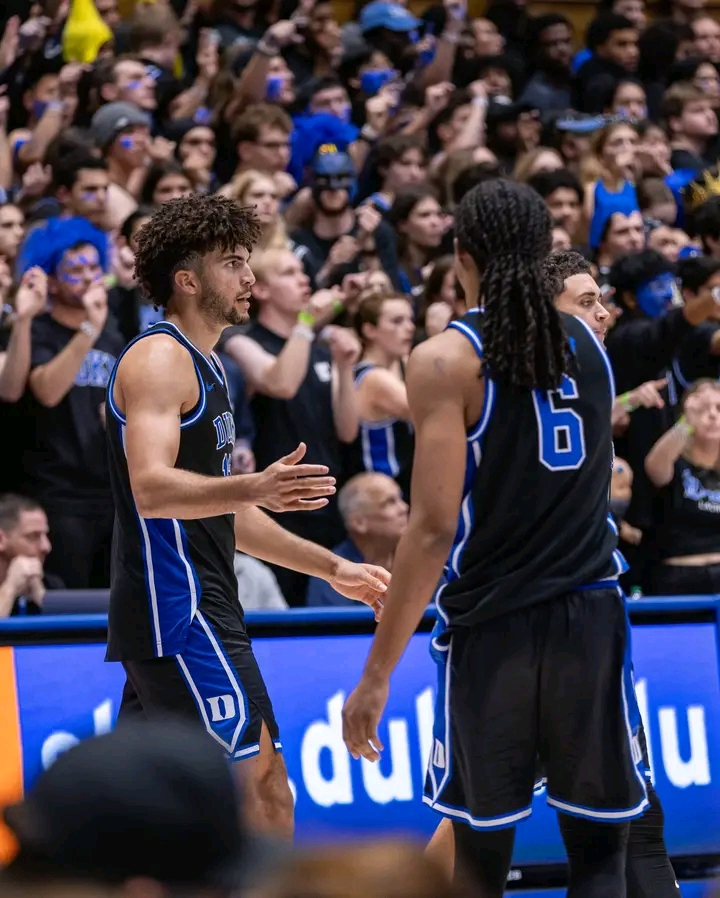
The Duke Blue Devils are undefeated, ranked among the nation’s elite, and looking every bit like a team capable of chasing down something special this season. A 9–0 start doesn’t happen by accident. Their frontcourt dominance is real. Their defensive toughness is improving. Their late-game maturity is evolving faster than most people expected. And with Cameron Boozer already looking like he was built in a Duke laboratory, the hype feels justified.
But even inside the walls of Cameron Indoor Stadium… even in a dramatic 67–66 win over No. 15 Florida… even in the heat of a moment that electrified Durham and sent the student section into chaos… something uncomfortable revealed itself again.
Something that could cost Duke everything in March if it does not change.
Something that is not new — but is becoming louder.
The Blue Devils still don’t have reliable backcourt production.
And on Tuesday night, that weakness wasn’t just visible — it was screaming.
The 9–0 Start Is Real — But So Is the Flaw
Duke fans have every reason to be excited about this start. Any program would celebrate a spotless record with wins over Arkansas and Florida. The Blue Devils have star power, NBA-level talent, and a frontcourt that is devouring every matchup thrown at it. Cameron Boozer and Pat Ngongba have been sensational. Isaiah Evans, though streaky, has leveled up in clutch moments.
But basketball doesn’t let you hide weaknesses forever.
Some flaws disappear as a season unfolds.
Some fade as chemistry builds.
Some improve as confidence arrives.
This one is different.
This one is structural.
This one is repeated.
This one is dangerous.
And Duke’s win over Florida highlighted it in flashing neon lights.
Florida Didn’t Just Test Duke — They Exposed What It Can’t Escape
Duke’s guards didn’t just struggle — they disappeared for long stretches.
And against a ranked opponent with elite athleticism, pressure, and physicality, that vanishing act almost cost Duke its perfect record.
Caleb Foster: A Game of Missed Opportunities
Caleb Foster has all the tools.
He has all the talent.
He has the confidence of Jon Scheyer and the respect of the locker room.
But on Tuesday night, Duke needed him — and he simply didn’t deliver.
2-for-7 shooting
Six points
Zero assists
Two shot attempts in the second half
A missed front end of a one-and-one with 1.5 seconds left
That free-throw trip is what Duke fans will remember most.
Hit it, and Duke goes up three.
Miss it, and Florida gets a prayer.
He missed.
That happens to good players.
But what’s concerning is how little impact Foster had outside of that moment.
For a starting guard on a No. 1-seed-caliber team, six points and zero assists simply won’t cut it — especially when the opponent’s backcourt is aggressively hunting weaknesses.
Foster has shown flashes — his performance against Arkansas on Thanksgiving was tremendous — but Duke needs more than flashes. Duke needs reliability. Especially in March. Especially late in games. Especially when Boozer is double-teamed and Ngongba is muscled inside.
Cayden Boozer: A Sudden Disappearance
Before Tuesday night, Cayden Boozer had been building momentum. His confidence was up. His scoring touch was improving. His decision-making was becoming sharper.
But against Florida?
He played 10 minutes.
Ten.
And did not touch the floor for the final 12:18 of the game.
Not because of injury.
Not because of foul trouble.
But because he wasn’t impacting the game strongly enough to stay in it.
That’s the kind of development stall that cannot become a trend for Duke.
Cayden is supposed to be Duke’s long-term backcourt anchor — the steady, physical, high-IQ guard who complements Foster. When he fades from the picture, Duke loses ball-handling stability, secondary creation, and someone who can take pressure off the wings.
For Duke to grow, both Boozer brothers must be consistently impactful. One cannot be a superstar and the other a spectator.
Dame Sarr: Silent When Duke Needed Sound
Dame Sarr’s story Tuesday night can be summed up in one number:
0.
Zero shots attempted in the final 36 minutes of the game.
Zero attempts after being removed from the starting lineup.
Zero impact in a matchup where Duke desperately needed a spark.
Sarr is talented.
He’s skilled.
He has shown flashes of elite perimeter shooting and scoring ability.
But Duke can’t afford a guard who goes entire games without leaving a fingerprint. A team with championship aspirations cannot have a rotational guard who takes himself out of the game mentally after early cold shots or early substitution changes.
Florida didn’t just defend him — they erased him.
Isaiah Evans: Brilliant, Broken, and Brilliant Again
This is the Isaiah Evans experience:
Miss seven straight threes.
Look disconnected and unsure.
Then… hit the game-winner in front of a roaring Cameron Indoor Stadium.
Evans is a star in the making. He’s long, explosive, flashy, and fearless. But he is not consistent — not yet. He can be the best player on the floor or the quietest.
And when Duke’s most reliable guard option is also its streakiest perimeter player… that’s a problem.
Why This Weakness Is So Dangerous
Duke’s frontcourt is arguably the best in the country. Boozer and Ngongba dominate opponents physically and tactically. But every frontcourt — no matter how elite — needs guards who can:
relieve pressure
hit big shots
handle traps
manage tempo
break presses
create for others
score late in the shot clock
keep defenses honest
Right now, Duke isn’t getting consistent versions of any of those things from its backcourt.
A team can survive this in December.
A team can survive this in Cameron.
A team can survive this against single-coverage matchups.
But in March?
Against elite teams?
Against pressure defenses?
Against trapping schemes?
Against programs with elite guards?
This weakness becomes fatal.
Championship teams aren’t perfect — but they all have dependable guards.
This Isn’t a Crisis — It’s a Challenge
Duke is 9–0.
Duke is rolling.
Duke is a legitimate national contender.
The Blue Devils aren’t losing because of this flaw — not yet. But they will lose because of it if it doesn’t change. And that’s what makes this such an urgent storyline.
The good news?
The fix is possible.
Caleb Foster needs assertiveness.
He needs to hunt shots, not wait for them. He needs to initiate offense, not defer. Duke plays better when he plays aggressively.
Cayden Boozer needs trust — and minutes.
His confidence shrank against Florida. That cannot become a habit. His development is tied directly to Duke’s ceiling.
Dame Sarr needs presence.
The skill is real. But the consistency must come. Duke needs him to be active, loud, and decisive — not invisible.
Isaiah Evans needs a balance between freedom and discipline.
He’s explosive. He’s clutch. But he must avoid disappearing for long stretches.
If even two of these four guards take a step forward, Duke becomes terrifying.
If all four improve?
Duke becomes a national title favorite.
What This Game Really Told Us
It told us Duke is tough.
It told us Duke can win ugly.
It told us Duke’s stars can carry them through cold nights.
It told us Duke is resilient.
But it also told us something else:
This team will only go as far as its backcourt allows.
The frontcourt is championship-caliber.
The defense is improving.
The coaching is sharp.
The potential is enormous.
But March is won by guards.
And if Duke wants to cut down nets, that flaw — the one Florida exposed — must be fixed before the ball goes up in the ACC Tournament.




