


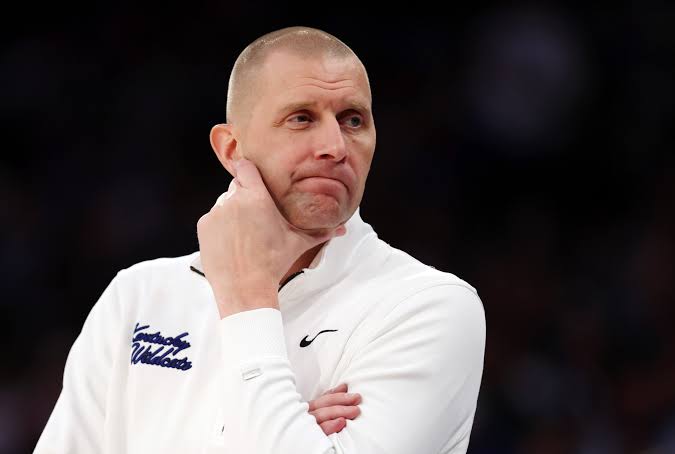
Kentucky basketball doesn’t panic easily. Not in a program built on banners. Not in a fanbase that expects Final Fours like holidays. Not in a place where pressure is oxygen and the bright lights of Rupp Arena are supposed to make everyone else crack, not the Wildcats themselves.
But after three opportunities — three huge opportunities — to show they belong among college basketball’s elite this season, the Wildcats have walked away with the same outcome every single time: another loss, another missed chance, another reason to worry.
And now, after Tuesday night’s stunning 67–64 defeat to North Carolina — a Tar Heel team that had not won inside Rupp Arena since 2005 — that concern has officially become something heavier.
This is no longer “a bump in the road.”
This is no longer “growing pains under a new coach.”
This is no longer “they’ll figure it out.”
This is the moment when the alarm bell stops being subtle and starts being deafening.
For Kentucky, for Mark Pope, and for a roster that was expected to be older, tougher, and more polished than most teams in the country, this is now a season that sits squarely at a crossroads.
And what happens next — especially with the schedule about to become even more brutal — will determine whether this becomes a course correction… or a collapse.
THE PATTERN KENTUCKY CAN NO LONGER IGNORE
You can explain away one loss.
You can justify two.
But when the same issues keep repeating at the highest level of competition, eventually the excuses run out.
Kentucky has faced three ranked opponents so far:
No. 6 Louisville (loss)
No. 8 Michigan State (loss)
No. 17 North Carolina (loss)
Three games.
Three chances to prove legitimacy.
Three strikes.
And each defeat felt like a new chapter in the same frustrating story — one where Kentucky hangs around long enough to make people believe… only to crumble when it’s time to deliver the final blow.
The Louisville loss could be chalked up to the first road challenge for a transfer-heavy roster.
The Michigan State setback could be attributed to the physicality and matchup issues.
But North Carolina?
At home?
Against an unranked blueblood in crisis-mode just a season ago?
Against a Tar Heel squad missing stars and struggling with identity?
This wasn’t supposed to be the breaking point.
But it became one.
THE FRESHMAN WHO SHOCKED RUPP ARENA
If Kentucky had been beaten by Caleb Wilson — North Carolina’s freshman phenom and future NBA lottery lock — fans might’ve simply tipped their cap. Wilson is that good.
But the Wildcats were undone by Derek Dixon, a reserve freshman guard not even listed among the Tar Heels’ top scoring threats.
First, it was the cold-blooded stepback three with 53 seconds left.
Then it was the fearless drive and game-winning layup with 16 seconds remaining.
Two plays.
Two punches to Kentucky’s gut.
Two reminders that poise, confidence, and execution don’t care about rankings, NIL deals, or recruiting stars.
North Carolina finished the game believing they belonged in that moment.
Kentucky didn’t.
THE 13 MINUTES THAT EXPOSED EVERYTHING
With 13:08 remaining, Kentucky made a field goal.
Then the clock kept running…
and running…
and running…
Until finally, with 2:43 left, the Cats ended a brutal drought of 13 straight misses.
You can’t go 10+ minutes without a made basket and expect to beat ranked teams.
You can’t go 2-for-16 down the stretch and expect to close out a one-possession game.
You can’t spend the biggest moments of the season afraid to shoot or unsure of where shots are supposed to come from.
This wasn’t bad luck.
This wasn’t officiating.
This wasn’t one player making a costly mistake.
This was identity failure.
This was offensive collapse.
This was the kind of sequence that haunts an entire season.
MARK POPE’S MOST HONEST ADMISSION YET
After the game, Mark Pope didn’t sugarcoat it.
“There’s no safety net right now. We just have to get better.”
That is not coach-speak.
That is not spin.
That is blunt honesty.
And it’s true.
Kentucky doesn’t have a safety net — not with the schedule ahead, not with the expectations attached to this roster, and certainly not with a fanbase that demands results now.
The Cats have no more “easy fixes” to lean on.
Only improvement, toughness, and execution will save this season.
THE BRUTAL TRUTH ABOUT KENTUCKY’S SCHEDULE
Kentucky has no time to breathe.
The next stretch is a pressure cooker:
No. 11 Gonzaga (Nashville)
No. 19 Indiana (Rupp Arena)
No. 22 St. John’s (Atlanta)
Three of the next four games are against ranked opponents.
If Kentucky doesn’t stop the bleeding immediately, this can spiral from “frustrating start” into “season-defining collapse.”
THE SHOOTING MELTDOWN THAT CAN’T HAPPEN AGAIN
Kentucky went 1-for-13 from three-point range.
One.
For.
Thirteen.
The lone made three came from Brandon Garrison, a center who had not hit a single triple all season before this game.
Kentucky entered the night averaging 10 made threes per game.
They had not made fewer than seven in any game this year.
This is not how Kentucky is built to play.
This is not the identity Pope designed.
This is not a blueprint that wins big games.
But it wasn’t just the misses.
It was the hesitation.
It was the lack of confidence.
It was the complete absence of rhythm and flow.
For a team that prides itself on spacing and pace, this was the kind of shooting night that makes coaches age five years overnight.
WHERE DID THE PLAYMAKING GO?
Just eight assists on 23 made baskets.
That number speaks volumes.
Kentucky was:
Too stagnant
Too isolation-heavy
Too predictable
Too reactive instead of proactive
Pope put it perfectly:
“We still have a steep learning curve, trying to figure out how to make plays for our teammates.”
When the ball stops moving, so does Kentucky’s offense.
And in the second half, everything Kentucky tried felt forced, rushed, or improvised.
That’s not how elite teams play.
That’s how bubble teams play.
And that’s exactly what the early NET rankings suggest Kentucky is trending toward.
THE REBOUNDING DISASTER THAT MADE EVERYTHING WORSE
North Carolina:
Outrebounded Kentucky 41–30
Grabbed 20 offensive rebounds
Scored 22 second-chance points
This wasn’t hustle.
This wasn’t luck.
This wasn’t just Mouhamed Dioubate’s absence.
This was a physical mismatch.
This was poor positioning.
This was Kentucky failing to deliver the second hit that great rebounders always execute.
Pope called it “overconfidence” in the defensive scheme — and he isn’t wrong.
Kentucky believed they could contest every shot and still maintain rebounding discipline.
They couldn’t.
THE PLAYERS STILL BELIEVE… BUT BELIEF ISN’T ENOUGH
Guard Otega Oweh, who scored 16 points, didn’t sound rattled.
“We all believe in each other, we all believe in the staff.”
Confidence is good.
Optimism is healthy.
But belief without change is just hope.
And hope doesn’t win games in March.
THE NET RANKINGS REALITY CHECK
Kentucky currently sits at 15th in the NET.
At first glance, that sounds fine.
But zoom in a little deeper:
0–3 vs Quad 1 teams
All five wins are against Quad 4 opponents
You cannot build a tournament résumé this way.
Not at Kentucky.
Not with this schedule.
Not with this fanbase.
Bubble teams have records like this.
Kentucky cannot afford to be one.
THE BOTTOM LINE: THE PANIC IS REAL — AND JUSTIFIED
This isn’t overreaction.
This isn’t fan impatience.
This isn’t noise from outside the locker room.
This is reality.
Kentucky isn’t meeting the moment.
Kentucky isn’t executing late.
Kentucky isn’t rebounding like a contender.
Kentucky isn’t shooting like a modern offense.
Kentucky isn’t solving problems fast enough.
And now, with three more ranked opponents looming, the Wildcats are stepping into the most pivotal stretch of the young Mark Pope era.
The alarm has gone off.
The time to adjust is now.
The time to panic?
It may already have arrived.
Because the next few weeks won’t just test this team.
They will define it.




