


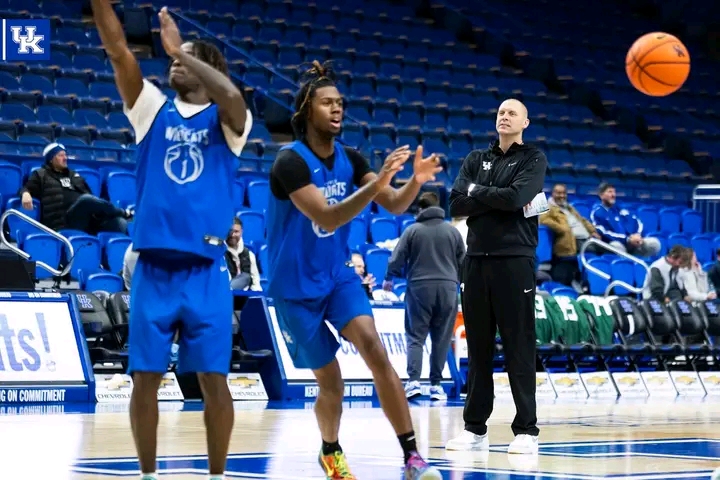
When Brandon Garrison rose up from the top of the key and buried Kentucky’s first three-pointer of the night, the roar inside Rupp Arena came from equal parts surprise and relief. The Wildcats desperately needed something to ignite them, something to jolt them into rhythm, something to remind Big Blue Nation that this team can make shots. For a brief moment, it felt like a spark.
What no one inside the building knew — what no one could have predicted — was that Garrison’s three-pointer would be the Wildcats’ final field goal for what felt like an eternity. Twenty thousand fans could have read the complete works of Leo Tolstoy, made a late dinner, taken a nap, and come back to their seats, and Kentucky still wouldn’t have scored another basket.
The drought wasn’t just painful.
It wasn’t just puzzling.
It was revealing.
Because the moment forced everyone, from fans to analysts to national commentators, to confront a question that has been quietly simmering since the season tipped off:
Does Mark Pope have a roster construction problem — one big enough to define Kentucky’s entire season?
And more importantly…
Is this issue fixable before the Wildcats lose control of everything they’ve been building?
Let’s break down the truth, the tension, and the emerging storyline that has every Kentucky fan on edge.
The Brutal Reality Behind the Scoring Drought
Every team goes cold occasionally. Even elite programs suffer stretches where the ball refuses to fall.
But Kentucky’s drought against North Carolina wasn’t normal.
It wasn’t random.
It wasn’t just a bad night.
It exposed something deeper — a structural flaw in the blueprint of the roster.
Because here’s the truth:
Kentucky does not have enough consistent shot-making.
Kentucky does not have enough perimeter balance.
Kentucky does not have enough natural offensive creators.
You can survive one of those problems.
You cannot survive all three.
And that is exactly the dilemma Mark Pope faces.
The ACC/SEC Challenge showdown was supposed to be a statement game, the kind that announces a team’s identity. Instead, it exposed the very thing this roster has struggled to hide:
When Kentucky’s spacing collapses, the offense collapses with it.
Garrison’s three wasn’t just the first of the night — it was a warning flare.
Why This Roster Feels “Incomplete” — Even When the Talent Is There
Let’s be fair: Mark Pope did not walk into a perfect situation. The transfer portal era is chaos. Retention is difficult. Continuity is almost nonexistent across college basketball.
But every coach, especially at a blue blood, must build with intention.
And this roster shows gaps that Kentucky simply isn’t built to overcome yet.
Here’s the breakdown:
1. Too many non-shooters in key spots
When Kentucky tries to play big, the floor shrinks. When they try to play small, they lose physicality. The balance never quite aligns.
2. Not enough downhill threats
The Wildcats have athletes, but they don’t have a natural driver who can consistently create contact, collapse the defense, and kick out.
3. No reliable “get-me-a-bucket” scorer
Every elite team needs one guy who can steady the offense when the shots stop falling. Kentucky has talented players — but nobody has become that closer.
4. Spacing disappears against good defenses
UNC is long, physical, and disciplined. Against that level of defense, Kentucky’s offensive limitations are magnified.
The result?
A 7+ minute scoring drought that didn’t feel like an exception — it felt like a pattern.
This Is the Moment Kentucky Fans Started Asking Hard Questions
After the loss, the conversation shifted immediately.
Fans weren’t just venting about turnovers.
Fans weren’t just frustrated with missed shots.
Fans weren’t just annoyed by streaky play.
The fanbase began asking:
“Did Pope build this roster the right way?”
It’s a question loaded with emotion, especially in year one. But it’s also a fair question — and one Pope himself has indirectly acknowledged.
Kentucky should not go multiple possessions without quality looks.
Kentucky should not need their big man to be the one breaking the ice from deep.
Kentucky should not be competing with elite teams while lacking elite spacing.
This is not about talent. The Wildcats have talent.
This is about fit.
And that conversation is happening everywhere — from the Rupp Arena concourse to radio shows to Twitter threads that stretch miles long.
How the Game Exposed More Than Just Offense
While the scoring drought got the headlines, the roster construction issue runs deeper than shot-making.
It extends into:
1. Rotation Uncertainty
Pope is juggling combinations, trying desperately to find lineups that don’t fold under pressure. But no combination has consistently offered balance on both ends of the floor.
2. Identity Crisis
Is Kentucky a defense-first team? A spacing team? A physical team? A transition team?
Right now, they are sometimes all of those things — and consistently none of them.
3. Leadership Void
It’s not that Kentucky doesn’t have leaders.
It’s that no one has taken ownership of the team’s emotional identity. And identity is what stabilizes struggling rosters.
But Here’s the Twist: Pope’s Biggest Problem May Also Be His Biggest Opportunity
You know what separates great coaches from average ones?
Not perfection.
Adaptation.
Pope is at a crossroads — and the path he chooses over the next month will define his era at Kentucky.
And make no mistake: he can fix this.
There are three clear solutions to Kentucky’s roster and spacing problem, and all of them are reachable this season.
Solution #1: Shorten the Rotation — and Commit to Shooters
This team has too many players who aren’t threats from deep.
To fix spacing, Pope must do what every elite coach eventually learns:
Play fewer guys — and prioritize floor-stretchers.
Even if it means defensive trade-offs.
Even if it means tough decisions with veterans.
Even if it means leaning hard on younger players.
Kentucky cannot survive with two or three non-shooters on the floor.
No modern offense can.
Solution #2: Define Roles — and Stick to Them
Right now, Kentucky has:
Shooters who aren’t shooting enough
Drivers who aren’t attacking enough
Bigs who aren’t being maximized
Guards who aren’t being empowered
The roles need clarity.
The system needs structure.
The players need freedom within that structure.
When everyone knows their lane, the offense grows instantly.
Solution #3: Find the Go-To Guy — and Build Around Him
Every season, one player becomes the heartbeat of a team.
Pope must identify that player — whether it’s a guard, wing, or forward — and build the offense around their strengths.
Kentucky desperately needs that anchor.
Whoever that player is, he must be trusted in crunch time.
He must be the one who ends droughts.
He must be the one who takes control when the offense tightens.
Big Blue Nation Isn’t Wrong — but They Aren’t Hopeless Either
Kentucky fans are emotional because they care. They always have, always will.
But here’s the truth:
This team is not broken.
This team is not lost.
This team is not finished.
The roster isn’t perfect.
The spacing isn’t optimal.
The shot creation is inconsistent.
But none of these problems are fatal.
They are fixable — and fixable now.
Pope has the basketball mind to solve this.
He has the film awareness to diagnose it.
He has the locker room trust to adjust it.
He has the fanbase passion to fuel it.
The roster construction issues are real.
But the season isn’t slipping away — not unless Kentucky lets it.
Final Word: The Drought Was the Warning Sign, Not the Eulogy
When Brandon Garrison hit that three, it should’ve been the spark Kentucky needed.
Instead, it became the symbol of a deeper issue — one that must be confronted honestly and urgently.
But here’s the thing:
This is not the moment Kentucky falls apart.
This is the moment Kentucky begins to rebuild the right way.
The drought wasn’t the death of the season.
It was the wake-up call.
And if Pope responds, if the players respond, and if Big Blue Nation supports the correction instead of the chaos…
Kentucky’s story this season could still be one worth telling.




