


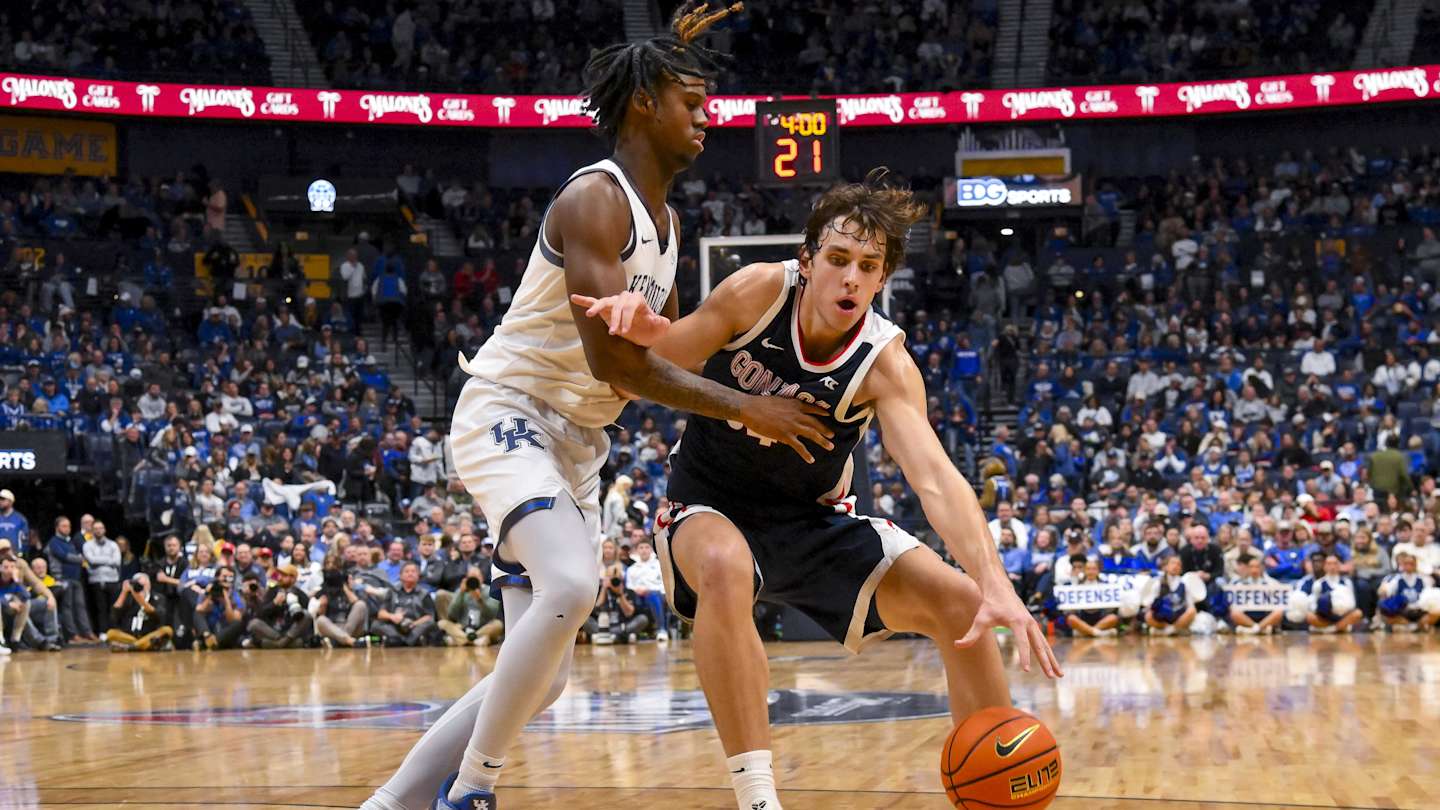
Sometimes numbers can twist a story, blur reality, or hide the truth behind percentages and context. But Kentucky’s 94–59 loss to Gonzaga in Nashville did none of those things. It delivered a blunt, undeniable verdict. This wasn’t simply the Wildcats’ worst defeat since 1990—this was the kind of performance that forces everyone connected to the program to confront uncomfortable questions about who they are, how they play, and where they are going.
From the opening minutes, Kentucky looked stuck in neutral while Gonzaga operated with clarity, rhythm, and purpose. The Zags seized control early, and instead of punching back, Kentucky faltered. What unfolded was a 40-minute unraveling that revealed deeper issues than one cold shooting night or one bad matchup.
And the numbers—ugly as they were—tell the story directly.
Gonzaga big man Graham Ike outscored Kentucky’s entire frontcourt in the paint by himself, making 10 two-point field goals, more than the entire Kentucky roster, which managed just nine. That isn’t just a statistical anomaly—that’s a talent, effort, and execution gap on full display.
Inside scoring wasn’t simply lopsided. It was symbolic of the night as a whole. Gonzaga punished the Wildcats for 46 points in the paint, while Kentucky scraped together only 18. And once the Zags established dominance inside, everything else opened up with ease.
The efficiency gap bordered on shocking:
Gonzaga: 34–60 FG (57%), 9–18 3PT (50%), 11–14 FT (79%)
Kentucky: 15–58 FG (26%), 7–34 3PT (21%), 18–24 FT (75%)
For long stretches, Kentucky looked lost offensively—no rhythm, no spacing, no reliable scoring option. Shot after shot rattled out. Possessions stalled. Turnovers piled up quietly but consistently. The Wildcats finished with just 12 assists, compared to Gonzaga’s sharp, fluid 24.
Rebounding? Again, Gonzaga owned it, winning the glass 43–31 and turning defensive stops into transition opportunities while Kentucky labored for even basic offensive flow. The Bulldogs’ lead swelled to 37 points, and by that point the score felt secondary to the unmistakable mood hanging over Bridgestone Arena.
Because this wasn’t a normal atmosphere.
This was supposed to feel like a home game. More than 95% of the building wore Kentucky blue, creating what should have been a powerful December stage for the Wildcats to show growth, toughness, and competitive maturity.
But instead—Kentucky fans booed their own team.
Not once. Not in frustration at a single play. But repeatedly. Loudly. Emotionally. It was the sound of a loyal fanbase watching something that did not resemble the program they love. As Kentucky insider Triston Pharis wrote afterward, the scene was almost surreal:
“95%+ of Bridgestone Arena was packed with Kentucky fans tonight. They just witnessed Kentucky’s worst defeat since 1990… Just nine games into the season, this could get even uglier.”
That’s not criticism for the sake of noise—that’s anxiety and disappointment spilling over from a fanbase that expects excellence and, at minimum, competitive fire.
Even the players felt the magnitude of the moment. Freshman Collin Chandler didn’t sugarcoat anything after the game.
“It’s disappointing because we care about BBN, but we will do a better job for this University.”
His words weren’t defensive—they were accountable. Honest. They reflected what every player in that locker room surely felt: this performance was far from acceptable for Kentucky basketball.
Head coach Mark Pope echoed that sentiment with equal clarity.
“All the boos we received tonight were incredibly well deserved, mostly for me,” he admitted.
There was no spin. No attempt to explain away the margin, the shooting numbers, or the energy gap. The truth was plain, and everyone acknowledged it.
When you add everything together—the worst defeat in 34 years, the lack of scoring identity, the defensive breakdowns, the rebounding deficit, the boos from a sea of Kentucky blue, and the public accountability from players and coaches—one conclusion becomes impossible to avoid:
This was not “just one bad night.” It was a glaring warning sign.
Kentucky doesn’t get judged on simple wins and losses. The standard is higher. Expectations are heavier. And the fans—who pack arenas in December as if it were March—hold this program to a tradition built on pride, talent, and relentless competitiveness.
A defeat this massive demands a response. Not a polite bounce-back win. Not a temporary surge of effort. It demands transformation—urgency, identity, edge, and a level of fight that makes sure a night like this never happens again.
The loss to Gonzaga may have been historically bad, but it can also become something else: a turning point. A wake-up call. The exact shock a team needs to rise, toughen, and reclaim what Kentucky basketball represents.




