When 18,507 fans poured into Bridgestone Arena, they anticipated a blue-blood battle between No. 11 Gonzaga and No. 18 Kentucky. Instead, they were handed a 40-minute lesson in toughness, execution, and identity — and none of it favored the Wildcats. Gonzaga’s Braden Huff and Graham Ike combined for 48 points, outscoring Kentucky’s entire starting lineup on their own. The final score, a brutal 94–59 loss, was the kind of defeat that forces an entire program to take a hard look in the mirror.
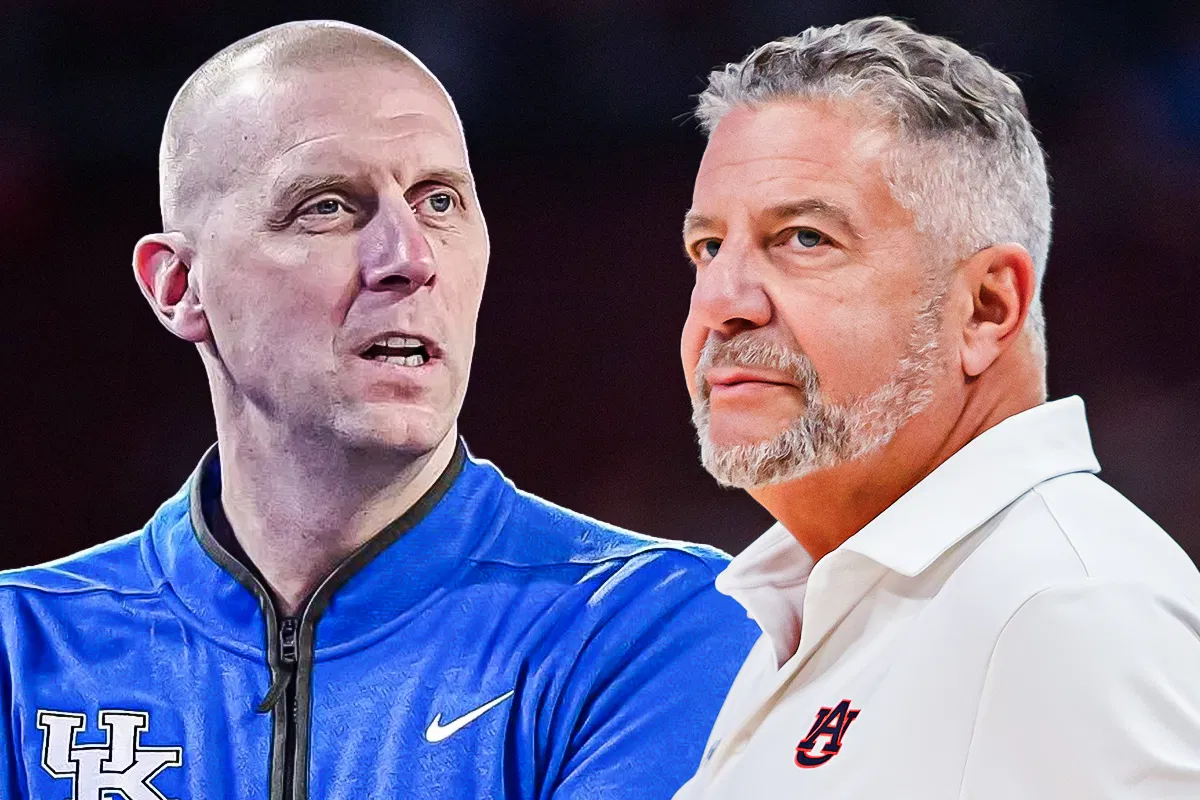
Yet, amid the rising criticism directed at Kentucky head coach Mark Pope, one unexpected voice stepped forward in his defense: former Auburn head coach Bruce Pearl.
Appearing on the TNT Sports Show, Pearl refused to pile on. Instead, he shifted accountability away from Pope and toward the staff around him.
“Mark Pope is a brilliant offensive coach… He’s a great man. He’s a great leader,” Pearl said. “I point to the assistant coaches right now. Those are the guys who have relationships with the players. It’s time to have one-on-one meetings with those players about who they’re playing for. That name on the front of the jersey, Kentucky, has got to mean something, and it’s got to mean more than the names on the back.”
Pearl’s message?
Kentucky’s problems aren’t just strategy or talent. They are cultural — and culture must be built collectively, not by one man alone.
A Night to Forget — And One That Demands Change
As much as Pearl defended Pope, the numbers from this game speak loudly on their own. Kentucky shot an abysmal 27% from the field (16-for-60) and a painful 21% from deep (7-for-34). Gonzaga, by comparison, looked polished and precise, drilling 9-of-18 from three and finishing at 57% overall. The Wildcats were outmatched in execution, in discipline, and in confidence.
The performance frustrated the fanbase so deeply that many left their seats early. Those who stayed greeted the team with boos — not out of malice, but out of disappointment. Kentucky basketball means too much to the people who fill those seats to accept anything less than commitment, grit, and effort.
After the game, Pope didn’t hide behind excuses.
“We feel the responsibility that we have to this university and this fan base, and all the boos that we heard tonight were incredibly well deserved, mostly for me,” he said.
If there’s one positive from this 35-point meltdown, it’s that Pope refuses to sugarcoat reality.
A Season Slipping — and a Coach Fighting Back
Nine games into the season, Kentucky sits at 5–4. On paper, that may not look disastrous. But the troubling part lies beneath the surface: every one of those wins came against unranked opponents. The four times Kentucky stepped onto the court to face a ranked team, they walked off defeated.
Meanwhile, Gonzaga continues to look like a hardened, mature team. They’ve faced quality opponents such as No. 8 Alabama and No. 7 Michigan. Their only loss came against Michigan, and they responded by burying Kentucky almost immediately from the opening tip. They jumped out to a 7–0 lead, held Kentucky scoreless for the first seven minutes, and carried a 43–20 advantage into halftime. It was domination at every level — physical, tactical, and psychological.
And still, Pope didn’t shy away from the truth.
“I gotta lead ’em. I have to get a better product,” he said afterward. “This is beyond unacceptable… There is zero universes where this is acceptable. We came out and we were paralyzed offensively. The question is why. We will try to dig in and find why.”
His words echo the very challenge Pearl laid out. Kentucky’s problems go deeper than shooting slumps or mismatched rotations. They are rooted in identity. Fight. Purpose. Unity.
And those answers must come from inside the locker room — not from the outside noise.
The Road Ahead: Crisis or Opportunity?
Kentucky carries one of the most expensive rosters in college basketball, valued at roughly $22 million in NIL terms. Talent isn’t the issue. But talent without direction is chaos, and right now Kentucky is dangerously close to becoming a team that plays great individually but poorly collectively.
The pressure is rising, and the upcoming schedule won’t offer any favors. Indiana, St. John’s, and Alabama — all well-coached, disciplined programs — await them. These games will either expose every fracture in Kentucky’s foundation or become the turning point that reshapes their season.
What happens next hinges on Pope and his staff.
Do they recalibrate the offense?
Do they challenge players directly?
Do they redefine Kentucky’s competitive standard?
Bruce Pearl believes they can. And Pope’s accountability suggests he’s ready to fight for it.
This is a crossroads moment — the kind that can bury a season or ignite one. Kentucky basketball has been knocked down before, but champions aren’t defined by nights like the Gonzaga game. They’re defined by what they do afterward.
And now, the Wildcats must show who they really are.