


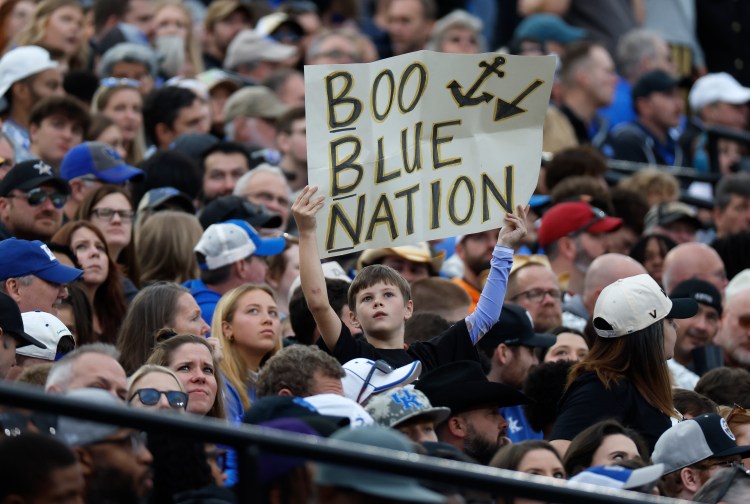
For decades, Kentucky basketball fans lived with an unshakable belief that no matter how chaotic a season looked, no matter how many injuries stacked up, no matter how many freshmen were thrown into roles too big too soon, the program would always find a way to rise. The pedigree, the banners, the culture — all of it created a sense of inevitability. Even in the darkest moments, Kentucky felt bulletproof. But somewhere between the heartbreaks, the humiliations, the quiet walk-offs, and the upsets no one saw coming, something underneath the foundation began to crack. Now, for the first time in generations, a question that once felt impossible — almost blasphemous to even whisper — is being asked openly across Big Blue Nation: Has Kentucky finally hit rock bottom?
This isn’t an emotional reaction to one ugly loss. It isn’t panic after a slow start. It is the cumulative weight of six long, brutal years that have forced fans to redefine what “struggle” means for a program once synonymous with dominance. And when you zoom out and look at everything Kentucky has endured since 2020 — the collapses, the embarrassments, the cultural erosion, the March disasters — it becomes difficult to argue that this isn’t the lowest point the program has ever faced.
Kentucky basketball has always carried expectations that were larger than life, but what fans have experienced recently has felt unreal, like a scripted nightmare that refuses to end. Every year promised hope. Every year delivered heartbreak. And whether Kentucky fans want to admit it or not, the trajectory of the last six seasons paints a picture that is as troubling as it is undeniable.
The collapse began in 2020, in a year no one could prepare for. The pandemic reshaped college basketball, but no blue blood suffered more than Kentucky. The Wildcats finished 9–16, a number so shocking that even now it hardly feels real. A single-digit win season at Kentucky was unthinkable, yet it happened. The team never clicked. The joy disappeared. The players looked defeated long before the season ended. And while fans hoped that year was an anomaly, a freakish outlier caused by chaos around the sport, it became clear in hindsight that it was only the beginning — not the bottom.
Two years later came St. Peter’s, the loss that will echo through Kentucky history for generations. A 15-seed with no recruiting advantages, no financial resources, and no national recognition knocked Kentucky out of the NCAA Tournament. It wasn’t just a loss — it was a stain. It was the moment fans first felt something deeper had broken inside the program. That single night turned into a lasting symbol of everything wrong.
The next season, against Kansas State, only deepened the wound. The Wildcats had the talent and the matchups, yet they fell apart again, exiting March early in back-to-back tournaments. For the first time in decades, Kentucky did not fear failing in March — Kentucky expected to fail in March. The program that once defined March Madness could no longer survive it.
And then came Oakland. A mid-major guard, unknown nationally before tipoff, morphed into Steph Curry and buried Kentucky under a barrage of threes. Another first-round exit. Another season gone far too soon. Another year of “How did this happen again?”
When you step back and realize that Kentucky — Kentucky — has made only one Sweet 16 in six years, the reality becomes undeniable. No Final Fours. No Elite Eights. No magical runs. No March moments. Kentucky hasn’t just fallen from dominance — it’s fallen from relevance. For a program with Kentucky’s history, that level of postseason irrelevance is almost unforgivable.
But the pain of this era isn’t just the losses themselves; it’s the way Kentucky has lost. Opponents who once feared Rupp Arena now walk in with swagger. Ranked opponents expect to beat Kentucky. Unranked teams circle the matchup with confidence. The Wildcats no longer impose their will. They no longer dictate the style. They no longer intimidate anybody.
Add in a string of losses in nationally televised games and the cracks in the program’s identity expanded. Kentucky dropped eight of nine against Top-25 teams. Every big matchup became a punishment rather than an opportunity. Every hyped-up contest felt like a trap waiting to snap shut.
Meanwhile, trust in John Calipari — once the savior of the program — eroded until there was almost nothing left. His stubbornness, his outdated offensive philosophy, his dismissive tone toward fans, the one-and-done frustrations, the March failures, and the feeling that the program was drifting all became too much. By the time Calipari moved on, both sides knew the marriage was finished. Yet even after he left, the damage lingered like a shadow hanging over the program.
So when Mark Pope returned to Lexington, hope felt possible again. A former Wildcat taking over. A modern basketball mind. A coach who preached pace, spacing, culture, toughness. His first season delivered everything fans craved — fight, joy, energy, creativity. A Sweet 16 run. Multiple upset wins. A sense that Kentucky basketball was fun again. And the offseason only amplified the excitement. NIL money surged in. Elite shooters arrived. Big-time recruits committed. The roster filled with depth, size, shooting, and experience. Analysts called Kentucky one of the deepest teams in the country.
But nine games into Pope’s second year, the optimism has all but evaporated.
What Kentucky fans have watched this season feels like a bad dream repeating itself. The team has no identity — none. They don’t dominate offensively. They don’t compete defensively. They don’t rebound. They don’t shoot consistently. They don’t defend the paint or the three-point line. It feels like basketball without a compass, without structure, without confidence.
The offense is chaotic. Spacing collapses. Shot selection feels forced. Players look uncertain, hesitant, or disengaged. The defense is soft, with teams attacking the rim, controlling the paint, and getting any shot they want. The mental toughness issues are glaring. Analysts are calling the roster overrated. Former Kentucky players are questioning the team’s heart. Fans see slumped shoulders and blank expressions that don’t match the pride they expect wearing Kentucky blue.
And the losses themselves have been devastating. Kentucky was outplayed by Louisville. Out-executed by Michigan State. Collapsed late against UNC in a dreadful 10-minute scoring drought. And humiliated by Gonzaga in a game that felt like a historic low — a 94–59 meltdown in front of a crowd dominated by Kentucky fans.
A 35-point blowout at Kentucky would have once been impossible. Now it feels like a symptom of something deeper and more frightening.
And that is why the anger in Big Blue Nation is real. Outsiders cannot understand it because they do not carry the weight of Kentucky’s history. Kentucky fans aren’t furious because of a single loss — they are furious because of what six years of disappointment represent. Failure used to be rare. Now it has become expected. March used to be Kentucky’s playground. Now it feels like a graveyard. The goodwill has evaporated. The patience is gone. The program that once demanded excellence now struggles to demand effort.
Mark Pope has admitted the performances are “beyond unacceptable.” He has taken responsibility. He has absorbed the boos. But at Kentucky, apologies and accountability are not enough. Fans want toughness, identity, culture, discipline, urgency, and wins that matter. Right now, they don’t see any of those things.
So has Kentucky hit rock bottom? The evidence suggests this era is unlike anything the program has ever experienced. The first-round losses. The mid-major embarrassments. The cultural cracks. The coaching drama. The NIL pressure. The national irrelevance. The lowered expectations. The heartbreak that keeps stacking on top of itself every single year. Other blue bloods have struggled, but none have struggled like this — for this long.
Six years of pain. Six years of disappointment. Six years of waiting for a return to greatness that never comes. If this is not rock bottom, then what could possibly be worse?
Which brings us to the final, defining question — the question that will shape the next decade of Kentucky basketball: Can Mark Pope save this? The truth is, he still has time. He still has the locker room. He still has the support of fans who desperately want him to succeed because he represents their history. He still has the opportunity to turn this season around.
But the window is shrinking fast, and for the first time in their lives, Kentucky fans are no longer confident that this program can simply “figure it out.”
That is what makes this six-year stretch feel so heavy, so painful, and so defining. It has forced the fanbase to confront a fear they never thought they would have to face:
Has Kentucky Basketball finally hit rock bottom?
And perhaps the even more haunting question:
How long will it take to climb back up?




