


For weeks now, months even, the loudest conversation in Big Blue Nation has circled around one familiar, easy, convenient target: NIL money. It has become the buzzword, the scapegoat, the explanation people reach for when they cannot understand how a program as historically dominant as Kentucky could look this lethargic, this disjointed, this far removed from the championship standard it once defined. You hear it everywhere — on radio shows, in fan forums, at Rupp Arena, and across social media — the same punchline repeated endlessly: “$22 million for this?” Kentucky fans are angry, hurt, frustrated, and searching for answers, and NIL provides the simplest one. But what if this theory that has spread like wildfire across Big Blue Nation is actually wrong? What if money is not the reason this team struggles to dive for loose balls, defend with purpose, or play with pride? What if the problem goes deeper than paychecks and contracts and collectives? What if NIL is not the disease, but merely the symptom of something far bigger unraveling inside the program?
Kentucky’s journey into the NIL era has been dramatic and expensive. The collective poured resources into the roster, the university embraced the new era, and fans believed the investment would guarantee results. After all, why wouldn’t it? If Kentucky built a roster full of top-tier transfers, elite freshmen, and experienced leaders — all funded at a level few programs can match — surely the on-court product would reflect that level of investment. But nine games into the season, the Wildcats look like a team searching for themselves, unsure of their identity, and incapable of sustaining effort over forty minutes. For fans already exhausted by six years of heartbreak, that is a brutal pill to swallow. And the easiest explanation is to blame the money.
But convenience does not equal truth.
The assumption many fans lean on is simple: if a player is being paid seven figures, he should be willing to dive on the floor for loose balls, fight for rebounds, and play with unshakable intensity. And if he doesn’t? Well, then he must not care because he already got paid. Yet this narrative collapses the moment you look at the broader landscape of college basketball. Players across the country — players making the same or more than Kentucky’s roster — are competing like their careers depend on it. They play with joy, energy, hunger, and accountability. In other words, they play like Kentucky used to play. NIL money is not stopping them from giving maximum effort. So why would it suddenly cripple Kentucky?
The truth is, money does not change an athlete’s work ethic. Work ethic changes an athlete’s relationship with money.
A perfect example sits in Oklahoma City, where former Kentucky guard Shai Gilgeous-Alexander just signed a $285 million contract. That number is astronomical. It is generational. It is life-altering in every sense. And yet, if you watch him play, you would never guess he is one of the highest-paid players in the NBA. He defends, hustles, leads, and competes like a man chasing a job, not a man who already secured one. His paycheck didn’t soften him — it empowered him. It motivated him. It rewarded the very traits that made him great. And while, of course, SGA is an elite superstar and not a college freshman or transfer, the principle still holds true: money does not dictate effort. Personality does.
Which brings us to an uncomfortable truth for Kentucky fans: the issue is not how much these players are being paid. The issue is who Kentucky chose to pay.
Effort is not bought. It is built. It is cultivated. It comes from the inside, not the outside. If you hand significant NIL money to players who do not naturally possess elite competitive instincts, you are not ruining them — you simply misjudged the personalities in the first place. Kentucky didn’t buy laziness. Kentucky bought the wrong traits. And that is a recruiting issue, not a financial one.
But even that explanation does not fully capture the complexity of Kentucky’s situation. Because the struggle is not just about players failing to live up to expectations. It is also about coaches failing to connect with their players, motivate them, and extract the best version of their abilities.
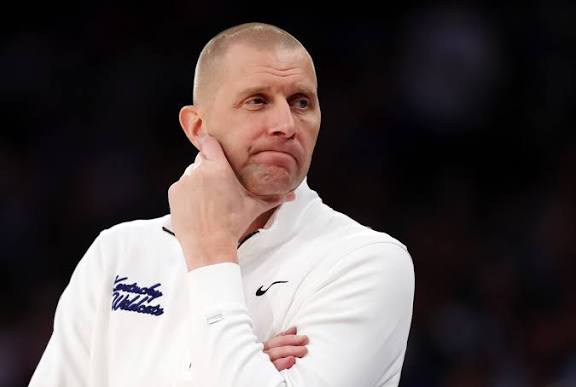
Mark Pope, to his credit, cares deeply. No one questions his passion, positivity, or emotional investment in the program. He loves Kentucky. He wants to succeed here more than anywhere else. He has embraced the fanbase during both the highs and the lows. But caring deeply does not automatically translate into coaching effectively. And right now, there is a clear disconnect between Pope and the roster he assembled.
Players play, coaches coach, but leadership is what bridges the two. At the moment, that bridge looks cracked.
Pope’s positivity is admirable, but positivity without accountability can become noise. When players hear that the team has amazing depth, that everyone will play a role, that the locker room is united, and that the vision is solid, expectations naturally inflate. NIL only amplifies those expectations. A player who believes he will get 25–30 minutes, 10–15 shots, and star-level spotlight is far more likely to become frustrated when reality contradicts those promises. And Kentucky’s rotation — at least the one Pope initially built — had no mathematical chance of fulfilling everyone’s expectations.
There are only 200 minutes in a game. There are only so many shots. Only so many touches. Only so many opportunities to make plays. When you recruit a dozen high-profile players and pay them accordingly, someone is going to feel overlooked. Someone will feel underused. Someone will think he deserves more. That friction is inevitable — not because of money, but because of human nature.
And once frustration sets in, effort declines. Chemistry breaks. Unity crumbles. Leadership fractures.
Which is exactly what Kentucky looks like right now: disconnected, disjointed, and visibly defeated in key moments.
This is not a money problem. It is a culture problem.
Culture determines effort. Culture determines chemistry. Culture determines whether players fight for each other or retreat into themselves. Money is merely a magnifying glass. NIL does not break culture — it reveals it.
Look at programs thriving in the NIL era. UConn is investing just as heavily as Kentucky, but their culture is airtight. Tennessee is paying major NIL deals, but their players defend relentlessly. Alabama, Kansas, Arizona — all NIL giants. None of them struggle with effort. Their cultures define their identity, not their bank accounts. That is the difference.
Kentucky cannot buy its way out of this problem because the issue is not financial. It is foundational.
So if money isn’t the reason Kentucky looks lost, what is? The uncomfortable answer is that everything is contributing a little bit. Chemistry is off. Leadership is lacking. Motivation is inconsistent. Coaching is uncertain. Expectations are clashing. Personalities are mismatched. Everyone — fans, players, coaches — is searching for answers, but there is no single villain to blame.
Fans want the problem to be NIL because that is the easiest solution. If money is the issue, then simply paying players differently would fix everything. But effort does not come from cutting checks. Effort comes from pride, heart, competitiveness, and connection — qualities that must be cultivated long before contracts are signed.
The truth is, Kentucky’s struggles reveal a deeper need for introspection. This program must rediscover what used to make Kentucky Kentucky. It must reestablish the culture of accountability, toughness, and hunger that defined generations of players who wore the blue and white. It must build bonds stronger than individual expectations and paychecks. It must foster leadership — real leadership — that resonates in the locker room and translates onto the court.
And perhaps most importantly, Kentucky must accept that NIL did not cause this collapse. NIL simply exposed it.
Until the program stops searching for convenient scapegoats and starts addressing its internal issues head-on, these problems will persist. Money cannot motivate the unmotivated. Paychecks cannot fix broken chemistry. Contracts cannot create culture. NIL is not the disease. It is merely the mirror.
Right now, Kentucky does not need to spend less. It needs to grow more.
And until that growth happens, Big Blue Nation will continue asking a question it never thought it would ask: If money didn’t cause this collapse, what did?
One thing is certain — the answer will not be found in the bank account, but in the soul of the program itself.




