


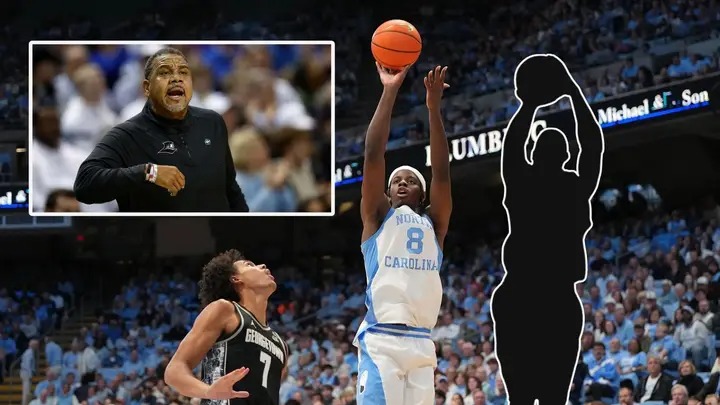
Caleb Wilson compared to NBA legend after UNC took down Georgetown
The conversation surrounding Caleb Wilson has been getting louder each week, but after UNC’s win over Georgetown, it reached a whole new level.
What began as a casual debate among fans has now turned into a full-fledged national discussion, thanks to an eye-opening comparison from Georgetown head coach Ed Cooley—one that immediately sent shockwaves through the college basketball world.
Every season, college hoops fans try to make sense of rising young stars by comparing them to established NBA names. For North Carolina supporters, this is practically tradition. From the moment Wilson stepped on the floor in his debut, the search for the “right” comparison began.
Some observers pointed toward lanky, defensive-minded forwards like Jonathan Isaac. Others mentioned the physicality and versatility of Scottie Barnes. A few even went as far as saying he resembles a young Kevin Garnett in the way he competes, talks, and controls the glass. Each comparison carried its own logic, but none felt quite perfect.
Wilson’s early résumé only fuels the intrigue. Through nine games, the freshman has already delivered six double-doubles, five 20-point performances, and multiple highlight plays that make you wonder just how high his ceiling may be.
His blend of size, skill, and poise is uncommon for an 18-year-old. In Chapel Hill, he has become the player fans and analysts can’t stop talking about. In many ways, he has already taken ownership of the Tar Heels’ identity this season.
But on Sunday night, after UNC handled Georgetown in convincing fashion, Cooley stepped to the podium and delivered a quote that immediately became the story of the night.
Instead of echoing the most popular comparisons circulating online, he went in a completely different—and much bolder—direction. With the tone of a coach who has seen hundreds of elite players, he dropped one name: Tracy McGrady.
Cooley spoke about Wilson with genuine admiration, the kind that grabs people’s attention. “I haven’t seen many players like him in 15 years of college basketball,” he said. “He’s a hell of a talent. I see him being an NBA All-Star. He reminds me of Tracy McGrady.” It was the type of statement that instantly makes everyone stop and reevaluate what they thought they knew about a young prospect.
For those who watched the NBA in the early to mid-2000s, T-Mac wasn’t just good—he was a generational offensive force. A seven-time All-Star, two-time scoring champion, and Hall of Fame inductee, McGrady was a walking highlight reel whose combination of size, ball-handling, shooting, and effortless athleticism made him nearly unguardable.
His injuries kept him from reaching the statistical milestones many expected, but his prime years remain some of the most spectacular individual seasons the league has ever seen.
To be compared to McGrady is not simply a compliment; it’s a validation that a player possesses a certain basketball elegance, a smoothness that cannot be taught. Cooley’s comparison suggests that Wilson isn’t just productive—he’s special in the way he moves, reads defenses, and creates offense off the dribble. Those are the traits that made McGrady legendary, and they are rarely found in a freshman forward who just arrived on campus months ago.
Watching Wilson play, you can see flashes of what Cooley was talking about. His ability to change speeds, pull up in traffic, and finish plays that most forwards don’t even attempt is striking.
His wingspan allows him to glide past defenders, while his footwork gives him the freedom to improvise mid-play. At times, he plays with a calm, almost casual coolness that looks eerily familiar to longtime NBA fans who grew up watching T-Mac dominate.
What’s even more intriguing is that Wilson doesn’t rely on any one specific skill to impact the game. On nights when his jumper isn’t falling, he turns his focus to attacking the rim or controlling the boards.
When defenses key in on him, he finds teammates for open shots. That all-around influence is part of what made McGrady so iconic during his peak years—and it’s becoming part of Wilson’s early UNC identity as well.
For Hubert Davis and his staff, the comparison is both flattering and exciting. They understand that Wilson is still learning, still growing physically, and still tapping into his long-term potential.
If he is already being mentioned in the same breath as McGrady before reaching midseason of his freshman year, it raises the question of just how dominant he might become once he’s had more time to develop inside the UNC system.
Fans have certainly embraced the moment. The idea that a Tar Heel freshman could possess even a hint of McGrady’s skill set has energized the UNC community, giving supporters a glimpse of what this season—and possibly this era—could look like.
Wilson has rapidly become one of the most talked-about players in the country, and comparisons like this will only amplify the national attention surrounding his name.
As the season continues, the basketball world will watch closely to see whether Wilson continues on this meteoric trajectory. Comparisons are fun, but what truly matters is the player he becomes on his own terms. If Cooley’s words prove prophetic, UNC may be witnessing the early stages of a superstar career that could stretch far beyond college basketball.
For now, the Tar Heels are simply enjoying the rise of a unique talent—one whose game is already drawing comparisons to one of the smoothest scorers to ever touch a basketball. And if the early evidence is any indication, this may be just the beginning of Caleb Wilson’s story.




