


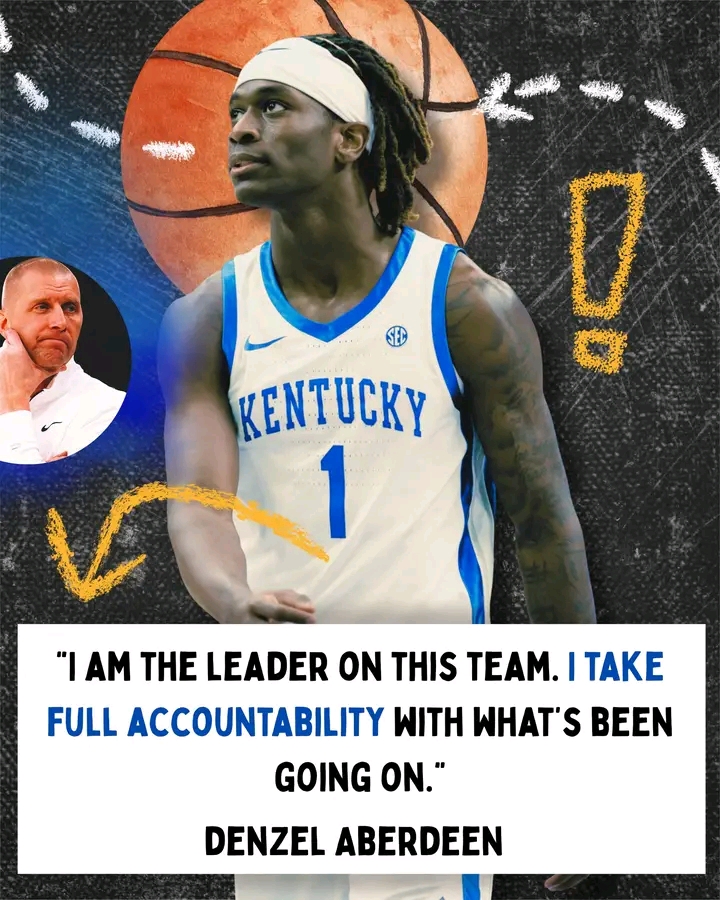
There are moments in a season — especially a rocky one — that don’t look dramatic on the surface but end up defining everything. Not a game-winner. Not a viral dunk. Not even a huge comeback. Sometimes, it’s a sentence. A declaration. A moment of honesty that hits deeper than any highlight. And when Denzel Aberdeen stepped forward after Kentucky’s latest gut-punch of a performance and said, “I am the leader on this team. I take full accountability with what’s been going on,” something shifted. Not just in the locker room — but across the entire Big Blue Nation. Because this wasn’t just a quote. It was a challenge. A confession. A promise. And possibly, the moment Kentucky found the voice it has been quietly waiting for.
For all the talent Kentucky brings in every year, leadership is not something you can recruit. Leadership is not guaranteed by stars, rankings, or NIL deals. Leadership is earned — sometimes painfully, sometimes publicly — and no program in America has higher expectations for leadership than the Kentucky Wildcats. Every season unfolds under the microscope of national media, former players, NBA scouts, and the most passionate fanbase in college basketball. And when the team stumbles, when performances dip, when the energy doesn’t match the standard, someone eventually has to stand up and speak for the group.
This week, that someone was Denzel Aberdeen.
In a moment where he could have hidden behind excuses, pointed fingers, or simply waited for things to blow over, he did the opposite. He stepped into the spotlight, embraced the weight of the jersey, and owned the direction of the team. “I take full accountability,” he said — words that don’t come easily when a fanbase as loud as Kentucky’s is demanding answers. Yet he said them anyway, not with fear, not with hesitation, but with the conviction of someone ready to carry the responsibility that comes with wearing “KENTUCKY” across his chest.
For a player, accountability is more than just admitting mistakes. It’s a declaration of intent. It signals that a player sees the problem clearly and believes he can be part of the solution. And for Kentucky fans, who are always looking for signs of fight, passion, and pride within the roster, Aberdeen’s statement wasn’t just refreshing — it was energizing.
To understand why this moment hit so deeply, you have to understand the emotional terrain of this Kentucky season. It has been a journey filled with highs that spark hope and lows that test patience. The fanbase doesn’t just want effort — they demand growth, consistency, and proof that Kentucky basketball is still built on the same foundational values that carried it through generations of excellence. Toughness. Accountability. Leadership by example. The willingness to take the heat so your teammates don’t have to.
That’s why Aberdeen’s words landed the way they did.
They weren’t polished. They weren’t rehearsed. They weren’t crafted to please anyone. They were raw. Honest. Exactly what Big Blue Nation wants to hear in moments of uncertainty. When Aberdeen said he was the leader, he didn’t wait for anyone to validate it. He didn’t wait for the coaching staff to say it first. He didn’t wait for a winning streak to make it easier. He stepped up in the middle of the storm — and that’s what separates real leaders from placeholders.
And make no mistake: Kentucky needed someone to step forward.
Let’s be clear: leadership on a team doesn’t always come from the most talented player, the highest scorer, or the guy projected to be drafted the earliest. It often rises from the player willing to sacrifice comfort. Willing to be uncomfortable. Willing to confront the things not working and push teammates — and himself — toward something better. That’s what Aberdeen tapped into with one sentence. He didn’t blame injuries. Didn’t blame youth. Didn’t blame chemistry. He looked inward first.
That’s a culture-shifting attitude.
Because when a leader calls himself out, it opens the door for everybody else to look inward as well. Suddenly, the excuses stop. The finger pointing stops. The “we’ll get better eventually” talk becomes real work. And that’s the moment a team begins to transform — not just physically, but mentally.
Kentucky has had rosters full of stars who struggled because none wanted the role Aberdeen just claimed. Other teams fall apart when things get tough, but programs like Kentucky are built on players who embrace the heat instead of running from it. Aberdeen’s statement wasn’t empty, and Big Blue Nation knew it the moment the quote went public.
Fans immediately reacted — some with relief, some with optimism, and some with curiosity. Was this the moment Kentucky finally found its steady voice? Was this the turning point that would give the team the direction it desperately needed? Or was it simply a powerful quote that would fade if not backed up by action?
That’s the question that fuels the curiosity surrounding Aberdeen’s declaration.
The truth is, leadership doesn’t reveal itself in a single moment — but moments like this one are where it begins. This was not a postgame cliché. This was a player stepping into a role that isn’t assigned by coaches or forced by circumstance. Aberdeen didn’t wait to be named a leader. He declared himself one. And by doing so, he invited accountability from every direction — from his teammates, from his coaches, from the fans, and from himself.
That’s not something every player is ready for.
If you look closely at Kentucky’s greatest teams over the past two decades, they all had the same thing in common: a player who took ownership of the roster. Think of John Wall’s swagger and energy. Think of Anthony Davis’ unspoken dominance. Think of Tyler Ulis’ fire. Think of Shai Gilgeous-Alexander turning into a silent assassin of accountability. These players didn’t just play well — they directed the tone of the program.
Aberdeen’s statement felt like the first step toward that kind of role.
He didn’t proclaim himself the star. He didn’t say he was the best player. He didn’t elevate himself above anyone. He simply said he was the leader — a title that comes with expectations, burdens, and responsibility.
And he welcomed all of it.
That’s why fans feel the impact of this moment. It wasn’t loud. It wasn’t dramatic. It wasn’t boastful. It was ownership — the purest form of leadership there is.
The other side of this story is how his teammates will respond. When a player steps forward and declares accountability, the entire dynamic of the locker room shifts. Leaders force action. Leaders create momentum. Leaders set a standard that others must follow. Aberdeen’s statement wasn’t just meant for reporters — it was a message to his teammates that the excuses end now, that the energy must change, that the fight must rise.
Coaches can yell, scheme, and motivate, but player-led accountability is what elevates a program from “good” to “dangerous.”
Kentucky has always been at its best when the players themselves take ownership of the season. That’s the heartbeat of the program. That’s the intangible that turns talented rosters into Final Four threats. And for the first time this season, Alabama, Tennessee, Arkansas, or anyone else watching Kentucky must now ask themselves the same question Big Blue Nation is asking:
Did Denzel Aberdeen just light the spark that changes everything?
There is also an emotional layer to his quote that can’t be ignored. Kentucky fans love their players deeply, sometimes fiercely, but they expect the same passion in return. When Aberdeen said he was taking accountability, he wasn’t just talking — he was showing love for the program. For the jersey. For the responsibility of representing the greatest tradition in college basketball.
Fans connect to players who show heart, humility, and backbone. Aberdeen delivered all three in one sentence.
That’s why Big Blue Nation reacted so strongly. That’s why this quote traveled fast. And that’s why the conversation around his role in the team has grown louder since his statement. Kentucky fans want leadership. They crave it. They celebrate it. And Aberdeen’s willingness to embrace it — in a moment where the team didn’t look its best — speaks volumes.
What comes next?
This is where the story gets interesting.
If Aberdeen backs up his words with performances, energy, and accountability on the floor, this will be remembered as the moment the tide turned. This will be remembered as the quote that shook the entire fanbase — not because it sounded good, but because it meant something deeper.
Leaders are remembered not just for what they say, but for what they demand — from themselves and from everyone around them. And now, all eyes will be on how Kentucky responds.
Will the defense sharpen?
Will the energy rise?
Will the communication improve?
Will the team begin playing with urgency and conviction?
These are the ripple effects that leadership creates.
And Aberdeen has now positioned himself as the voice responsible for guiding it.
In the end, this moment wasn’t about stats, minutes, or highlights. It was about culture. It was about character. It was about the heartbeat of Kentucky basketball — a program built on accountability, pride, and relentless pursuit of excellence. Aberdeen didn’t shy away from that standard. He embraced it.
So when Big Blue Nation asks what this quote means, the answer is simple:
It means everything.
It means Kentucky has a player willing to step into the storm.
It means the locker room may have found its compass.
It means the team’s identity might finally be settling into place.
It means the next chapter of the season suddenly feels more focused.
And yes it means Aberdeen may have just crowned himself the leader Kentucky needed.
The season is far from over. The story is far from finished. But if Kentucky turns things around, if the energy shifts, if the team grows stronger from this moment, fans will look back and say:
This was where it started.




