


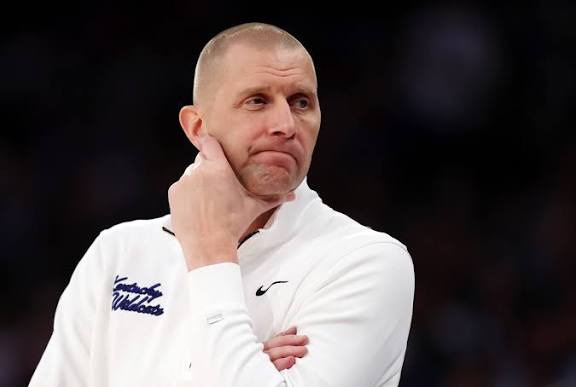
There are moments in a college basketball season when the final score doesn’t tell the full story. When the real issue isn’t shooting percentages, turnovers, or defensive schemes. When the loss hurts not because of the margin, but because of what fans saw — or didn’t see — on the court. That is exactly where Kentucky basketball finds itself today. Not in a crisis of talent. Not in a crisis of coaching strategy. But in something far more concerning, far more alarming, and far more difficult to repair: a crisis of effort. The question now echoing across Big Blue Nation — in the stands, on social media, in national media circles, and in living rooms all across Kentucky — is simple, painful, and unavoidable: Will this team’s effort issues ever get fixed?
For the past month, Kentucky’s struggles have moved from frustrating to embarrassing to downright alarming. Losing is one thing; Kentucky fans can handle losses if the team fights. But what unfolded in Nashville against Gonzaga was not just a loss — it was a collapse of identity. Kentucky didn’t just get beat; they got steamrolled. They didn’t just struggle to score; they looked lifeless. They didn’t just get punched early; they stayed down. Gonzaga walked into Nashville, punched first, punched harder, and kept punching while Kentucky faded into a shell of itself.
The result? A 35-point humiliation that left the fanbase stunned, the players deflated, and national analysts openly questioning whether this team even cares. That’s not hyperbole — it’s the reality Kentucky now faces.
Everyone expected a tough matchup. No one expected Kentucky to look this uninterested.
If you want to measure effort, you can usually see it in the opening minutes. And on Friday night, it took Kentucky nearly nine minutes to make its first field goal. Nine minutes — an eternity in today’s fast-paced game. But that stat wasn’t just about missed shots. It was about everything else: body language, urgency, communication, and belief. Kentucky didn’t look ready. They didn’t look focused. They didn’t even look engaged. They looked beaten before the scoreboard reflected it.
Fans in Nashville noticed. The boos weren’t for the score. They were for the energy — or the lack of it.
Kentucky played like a team going through the motions, not a team fighting for pride, for growth, or for the Kentucky name. And that is the part Big Blue Nation cannot stomach.
This is not brand-new behavior, either. The signs have been there. The struggles have been repeating themselves. And the national media has finally reached a boiling point. Analysts who normally tiptoe around bashing college athletes didn’t hold back. They didn’t sugarcoat it. They didn’t excuse it. They called it what they believed it was: a team with a heart problem.
CBS Sports’ Matt Norlander described Kentucky’s product as lifeless and questioned the team’s competitive spirit. Jeff Goodman went a step further, calling Kentucky’s on-court product a “shit-show,” something he rarely says even about bad teams, let alone Kentucky. Rob Dauster, on The Field of 68, delivered maybe the harshest commentary of all, boiling the effort crisis down to players acting like “mercenaries trying to find their next check.”
These weren’t small criticisms. These were national alarms sounding at full volume.
Dauster’s comments about Otega Oweh were especially pointed. While he wasn’t attacking Oweh’s talent, he was very clear in calling out his body language, defensive effort, and consistency. Whether fans agree or not, the fact that national analysts are naming individual players is proof of how glaring the effort issue has become.
When Dauster said, “It really bothers me when you get paid that amount to do a job and you don’t show up to even try,” it resonated across the country not because of the words, but because of the truth they reflected in this moment. When effort dies, everything else dies with it — defense, offense, chemistry, execution, and confidence.
Effort is the engine. Without the engine, nothing moves.
This raises the big, unavoidable question:
Why has Kentucky’s effort collapsed so dramatically?
To understand that, you have to look deeper than Friday night’s disaster. The effort issues didn’t start in Nashville. They’ve been building. And they’ve been showing up in the subtle cracks long before they became a full-blown structural collapse.
The Michigan State game? Same effort issues.
The early marquee matchups? Same energy dips.
The slow starts in nearly every big game? Same pattern.
The lack of communication, the empty possessions, the defensive breakdowns? All effort-related.
Mark Pope himself said weeks ago that his message wasn’t resonating with the players. And three weeks later, the evidence suggests that little has changed. When a coach publicly admits the team isn’t absorbing the message, that’s not a strategy problem — that’s a connection problem. Players hear him, but they’re not internalizing what he’s saying. They’re not executing it. And they’re not playing with the desperation a struggling team must show.
You can adjust tactics.
You can’t adjust desire.
Desire has to come from the players themselves.
The most concerning part of the effort issue is how it cuts across both ends of the floor. Kentucky’s offensive struggles are obvious — poor spacing, inconsistent shot selection, and no clear rhythm. But effort is what fuels defense, and Kentucky’s defense has now become a glaring problem.
Against Gonzaga, Kentucky didn’t rotate. Didn’t close out. Didn’t protect the paint. Didn’t sprint back. Gonzaga got layup after layup, wide-open shot after wide-open shot, and Kentucky rarely challenged them.
It wasn’t physical failure — it was a mental and emotional collapse.
When a team loses belief, they lose effort.
When they lose effort, they lose identity.
And when they lose identity, they lose games — badly.
So now Big Blue Nation is left facing the question no one wants to speak out loud:
Can effort actually be fixed this late in the season?
The answer depends on one thing: leadership from within.
Mark Pope can yell, adjust lineups, and change practice intensity, but the players must decide who they want to be. Coaches can inspire. Players must commit.
Kentucky desperately needs an internal voice — a teammate — to step forward. Someone who holds others accountable. Someone who demands the energy be fixed. Someone who refuses to let teammates sleepwalk through possessions.
This roster has talent. But it doesn’t yet have a clear emotional leader — or at least not one whose voice has shifted the culture.
That must change.
It’s also worth noting the emotional toll that an avalanche of losing takes. When a team keeps getting embarrassed, the enthusiasm drains. The confidence shrinks. The togetherness loosens. It is much harder to play hard when you don’t believe your effort will matter.
That’s what makes leadership essential. Leaders bring back the belief. Leaders restore confidence. Leaders ignite fight. Leaders set the tone.
Until a leader emerges, the effort issues will remain.
There’s another painful truth fans have discussed: some players may be playing for the next level, not for Kentucky. That’s not a moral failure — it’s the new reality in the NIL era. High salaries come with pressure, and pressure can either motivate or freeze players. Some players respond by elevating. Others respond by going into survival mode.
But Kentucky basketball doesn’t allow survival mode.
It demands attack mode.
And right now, too many players are just trying to get through the game.
That is what effort looks like when it disappears.
The good news? Effort can change overnight.
All it takes is one game where the team decides enough is enough. One moment when someone steps forward and sets the temperature. One stretch where players play not for the next step in their careers, but for the name on the front of the jersey and the fans who pour everything into this program.
Kentucky is not doomed. The season is not over. But the effort cannot stay like this — not for a single more week — or the hole will become too deep.
Change must begin immediately.
So will Kentucky’s effort issues get fixed?
Here’s the honest answer:
They can — but only if the players choose to fix them.
Not the coaches.
Not the fans.
Not the analysts.
Not the media.
The players.
If Kentucky wants to salvage the season, the identity must change now. The pride must return now. The fight must show up now. Someone must lead now.
Effort is the easiest part of basketball.
But right now, it is Kentucky’s hardest problem.
And until Big Blue Nation sees otherwise, this question will hang over every practice, every game, every timeout, and every huddle:
Will Kentucky’s effort problems ever get fixed — or will this be the season that breaks the program’s spirit?
The answer is coming soon.
And this team will determine it — not with words, but with effort.




