


The first month of the college basketball season is always a chaotic lab experiment: coaches testing rotations, stars rising or stumbling, and fan bases stressing over every substitution. But in today’s landscape — where NIL money, high-profile transfers and elite freshmen dominate the conversation — early lineup decisions matter more than ever. Minutes are earned, not promised, and the non-conference gauntlet has already exposed which teams made the right calls.
Several contenders have wasted no time tightening their rotations, and the results on the floor are telling. Across the SEC and ACC, coaching staffs are discovering which combinations elevate their ceilings, who brings winning value, and which young players are already ahead of schedule. Here’s a deep dive into the most important early-season lineup decisions — and why programs like Arkansas, Duke and Kentucky are thriving because of them.
ARKANSAS GOES DEFENSE-FIRST WITH PRINGLE — AND IT’S PAYING OFF BIG (GRADE: A)
John Calipari has never been shy about riding the hot hand or leaning on experienced, physical big men. And early on, Arkansas’ center battle between Pringle and Ewin looked like a classic offense-vs-defense tug-of-war. But through seven games, the numbers — and the tape — make the Razorbacks’ direction crystal clear.
Pringle is averaging roughly 24 minutes per game, compared with Ewin’s 14, and the impact on the Razorbacks’ defense is massive. Arkansas’ rim protection transforms when Pringle steps on the floor. He may not be the most explosive athlete, but he’s a rugged, positionally elite enforcer who anchors the paint and erases mistakes.
The defensive rating splits tell the entire story:
With Pringle on the floor: 86.9 points allowed per 100 possessions
With Pringle off: 109.5 points allowed
That’s not a small improvement — that’s a defensive identity forming in front of our eyes.
Ewin is a skilled offensive piece with intriguing flashes, but his defense remains unreliable, echoing concerns that followed him from Florida State. And with Calipari’s offense being heavily guard-driven behind Meleek Thomas and Darius Acuff Jr., the Razorbacks don’t need their big man to be a scorer. They need a stabilizer.
Pringle gives them exactly that. Arkansas is a staggering +40.5 in net rating when he’s on the court. Even if his six points and six rebounds per game don’t jump off the stat sheet, his value is far more important than counting stats.
Now, with a major showdown looming against Duke’s frontcourt trio — Cameron Boozer, Pat Ngongba and Maliq Brown — this is Pringle’s chance to deliver his most important performance yet. And based on everything so far, Calipari absolutely made the right call.
DUKE’S TWO-POINT GUARD SOLUTION IS A WINNER — AND IT’S JUST GETTING STARTED (GRADE: B+)
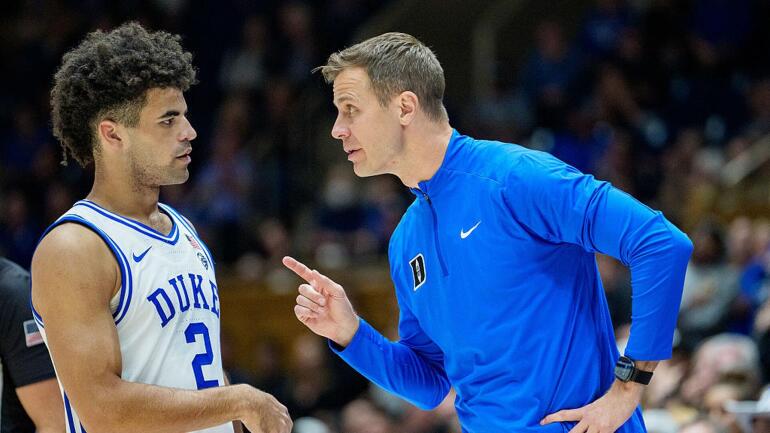
Entering the season, Duke’s biggest red flag was point guard depth and reliability. Would Cayden Boozer be ready from Day 1? Could Caleb Foster run the show? Would either of them give Duke enough consistency to chase a national title?
As it turns out, the answer is… both of them at once.
After barely sharing the floor in Duke’s opener against Texas, the Boozer-Foster pairing has quickly evolved into one of Jon Scheyer’s most trusted closing groups. Their breakout moment came against Kansas in the Champions Classic, where Duke leaned on the duo for the final seven minutes to secure a statement win.
The on-court impact is undeniable:
Duke’s net rating with Boozer and Foster together: +44 in 44 minutes
Foster has embraced a perfect complementary role — a 3-and-D weapon hitting over 45% from deep while playing suffocating point-of-attack defense. Boozer, meanwhile, has been poised and steady, boasting a 4-to-1 assist-to-turnover ratio.
They aren’t the offensive engines of this team, but they’re dependable, smart, and composed. Most importantly, Scheyer trusts them together.
With Arkansas’ explosive guard tandem of Acuff and Thomas next on the schedule, expect to see even more of the Boozer-Foster combo. It’s one of Duke’s most effective defensive backcourt looks — and it might become a staple by conference play.
KENTUCKY’S FRONTCOURT SHAKEUP IS THE RIGHT CALL — AND MORE CHANGES ARE COMING (GRADE: A)
It didn’t take long for Kentucky to hit the reset button on its center rotation. Freshman Malachi Moreno has overtaken junior Brandon Garrison for the starting job, and the Wildcats look significantly sharper because of it.
Moreno has quickly become the glue of Kentucky’s system, offering:
Superior defensive metrics (over eight points per 100 possessions better
Smart decision-making
Excellent processing in the Wildcats’ backdoor-heavy offense
He’s not just holding down the paint — he’s elevating the entire unit.
And the most exciting part? Reinforcements are coming.
When elite freshman Jayden Quaintance returns, Kentucky has the potential to roll out lineups featuring both Moreno and Quaintance — a pairing that brings size, mobility, rim protection and next-level upside. It’s a frontcourt combination that could overwhelm opponents come SEC play.
For now, though, Kentucky’s quick pivot to Moreno is already paying dividends. The Wildcats are more cohesive, more dynamic, and more disciplined with him anchoring the interior.
FINAL THOUGHT
Early-season lineup decisions don’t just shape rotations — they shape ceilings. Arkansas has found its defensive heart. Duke has unlocked the power of two point guards. Kentucky has discovered a fast-rising freshman star.
And the scary part? All three teams are just beginning to scratch the surface of what these rotations can be.
If these early trends continue, we may look back on these first few weeks as the moment each program charted its path toward March.




