


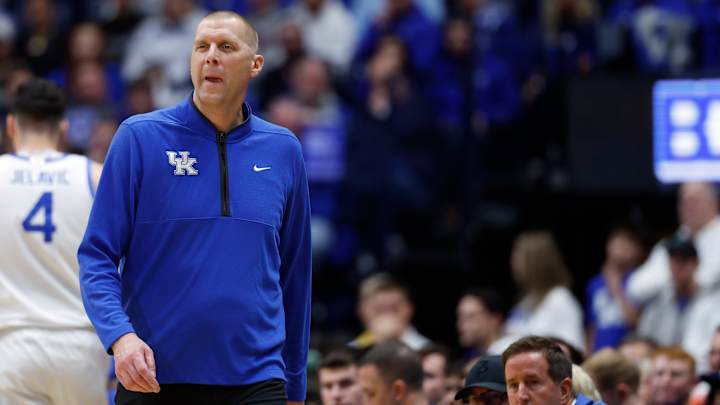
It is rare—almost unheard of—for a Kentucky basketball coach to issue a mid-December confession that sounds more like a season’s obituary than a routine course correction. Yet that is exactly what happened when Mark Pope sat behind the microphone on his radio show and finally said what the entire Big Blue Nation had been watching unfold with growing dread: the Wildcats are a mess. Not flawed, not adjusting, not working through normal bumps. No, Pope went much deeper, using words like “major overhaul,” “reconstruction,” “emotional,” “ugly,” “violent,” and “reconsidering everything.” For a program built on dominance, swagger, and national expectations, this wasn’t just honesty—it was an alarm bell echoing through every loyal Kentucky fan who once believed this season could be a rebirth. And as December ticks forward and the losses pile up, Pope’s admission has fans asking a terrifying question: is Kentucky already out of time?
Kentucky basketball entered this season with dreams of rewriting the narrative that had hung over the program for the past several years—an era defined by March collapses, stunning upsets, and far fewer banners than expected. The arrival of Pope came with energy, optimism, and a roster constructed with a deliberate shift in philosophy: toughness over finesse, defensive-minded wings, physicality, length, and a commitment to effort that would supposedly separate Kentucky from the run-and-gun, defense-light identity of recent seasons. But nine games in, Kentucky looks like the opposite of what was advertised. The roster designed to survive rock fights is getting pushed around. The team built to defend is leaking points. The veteran voices meant to steady the ship have gone silent. And the overall product looks disjointed, fragile, and nowhere near ready for the brutal stretch that lies ahead.
Pope’s decision to publicly admit that he is tearing the team down to the studs was both refreshing and alarming. Coaches usually preserve their cards until March. They talk about tweaks. They hint at adjustments. They don’t use words like “overhaul” before Christmas. So when Pope did just that, it was both a moment of transparency and a moment of truth: what Kentucky is right now cannot survive the next three months without drastic intervention. But the harder question is whether that intervention has arrived too late. With Kentucky sitting at 5–4, winless against real Power Four competition, and fresh off a 35-point demolition that barely resembled a competitive basketball game, the Wildcats no longer have the luxury of slow-paced rebuilding. Every game from here on out carries weight, and every loss threatens to bury their NCAA Tournament hopes before the calendar even hits February.
Pope’s issue isn’t that he is panicking—it is that it took this long to acknowledge a crisis that was evident weeks earlier. Fans saw the poor defensive rotations. They saw the body language wilt after every run by an opponent. They saw the lack of communication on the floor, the stagnant possessions, the turnovers, the jogging in transition, and the baffling stretches where Kentucky looked disengaged from the most basic fundamentals. Effort—something that should never be negotiable—became a question for this team. Chemistry, the very glue of Pope’s system, never materialized. And as the losses mounted, that lack of urgency became the program’s most unsettling flaw.
The Wildcats’ résumé has already taken major hits. Four losses to Power Four opponents. A blowout that was supposed to be a statement game but turned into an embarrassment. A neutral-court humiliation that felt like a home game because of the sea of blue—and yet Kentucky still got steamrolled. All of this happened before the season’s halfway mark, leaving Kentucky with almost no wiggle room. When Pope says he is reconsidering everything—from rotations to usage to defensive schemes to accountability—he is admitting that the foundation of this roster wasn’t built right. And rebuilding it now, with the SEC looming, is far more complicated than breaking down film on a Tuesday afternoon.
Even if Kentucky wins its upcoming buy games, those victories mean nothing in the eyes of the NCAA Tournament committee. They don’t fix the flaws. They don’t change how the team responds to adversity. They don’t show whether the Wildcats can defend elite competition or execute in pressure moments. The real test begins with Indiana and continues with St. John’s—two games that will determine whether Kentucky enters SEC play with momentum or with a record that leaves them in desperate need of a miracle.
If Kentucky enters SEC play at 8–5 or even 9–4, the margins become razor-thin. With the SEC weaker than usual this year, the opportunities for quality wins shrink. Every loss counts double, every late-game collapse becomes more damaging, and every missed chance to build confidence chips away at a team that is already emotionally fragile. To reach the NCAA Tournament comfortably, the Wildcats likely need 12 SEC wins. To be in the conversation at all, they need at least 10. And based on everything we’ve seen in the first nine games, nothing about this team suggests they are ready to suddenly transform into a consistent, disciplined, motivated group capable of ripping off a 12–6 conference run.
Pope’s public frustration also hints at deeper issues inside the locker room. He mentioned emotional practices, violent clashes, and the stress of trying to rebuild the team’s identity on the fly. He talked about reworking everything, suggesting that the problems extend far beyond simple lineup inefficiencies. This is the language of a coach who knows his team has fundamental issues—issues that go beyond Xs and Os and point to culture, buy-in, leadership, and competitiveness. Injuries have not helped, with key players missing time and the rotation constantly shifting. But injuries cannot explain poor effort. They cannot explain the lack of fight. They cannot explain why, after being punched in the mouth early, this team rarely swings back.
What Kentucky faces now is not just a basketball problem—it is a psychological one. When the Wildcats get down, they get quiet. When shots stop falling, so does their confidence. When a game gets physical, they shrink instead of responding. These habits are not fixed with a drill. They are not solved with minutes distribution. They require a cultural reboot, something that even great coaches struggle to pull off mid-season.
Still, there are flashes of hope. Pope’s willingness to acknowledge the truth is the first step toward rebuilding. Some coaches hide behind excuses long after the writing is on the wall. Pope did not. He took accountability. He admitted the approach is failing. He accepted that effort and discipline are non-negotiable. And he made it clear that the next few weeks will look very different—because they must.
The question is whether these changes can take hold quickly enough to save the season. There is talent on this roster. There are defensive weapons. There are playmakers. But talent without chemistry is just noise. And effort without identity is just chaos. If Kentucky is to turn this around, the Wildcats must become a team that embraces toughness, communication, and selflessness—not in practice, not in interviews, but in real games against real opponents.
That begins with Indiana. A win wouldn’t fix everything, but it would shift momentum. It would show that the overhaul has traction. It would restore belief to a fanbase that desperately needs something to hold onto. The same applies to St. John’s, another opponent that can expose Kentucky’s weaknesses or highlight their growth.
If the Wildcats pull off two straight wins, Pope’s overhaul will look visionary. If they don’t, the season could spiral into something Big Blue Nation has never seen before—a year where Kentucky, the gold standard of college basketball, fails to find its identity altogether.
This moment—this December admission—marks the first true crisis of the Mark Pope era. It doesn’t define his future, but it will shape it. Fans will remember how he responded, how quickly he acted, and whether the team showed signs of life or signs of collapse. And if the overhaul fails, the consequences go beyond one season. They impact recruiting, trust, momentum, and the belief that Kentucky remains one of the sport’s elite programs.
Right now, Pope is standing at the crossroad of a season that has already slipped dangerously close to disaster. He has pushed the emergency button. He has blown the whistle on his own team. And he has promised a transformation that must happen fast, must be real, and must lead to results—because Kentucky basketball no longer has the luxury of time.
The Wildcats are in a fight for their season. The next few weeks will decide whether this becomes a comeback story or another chapter in a growing book of disappointment. And as Kentucky fans wait, hope, and brace themselves, one truth remains: this December admission was the warning no one expected—but perhaps the one Kentucky needed most.




