


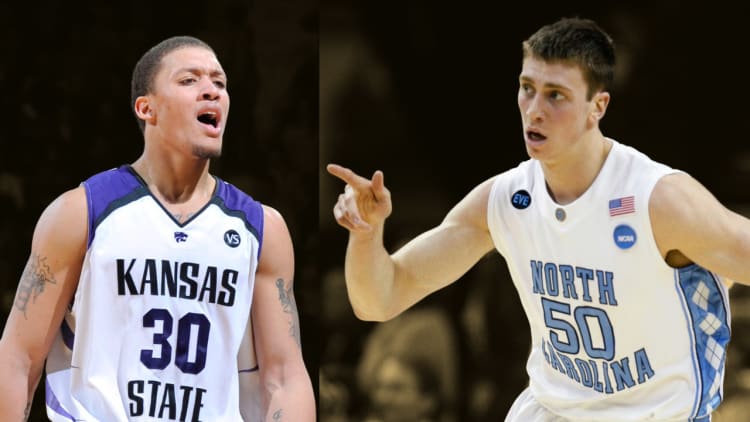
College basketball is full of legends, unforgettable moments, and debates that never die. For UNC fans, Tyler Hansbrough’s name is synonymous with dominance, grit, and championships. But behind the glow of accolades and national titles lies another story—one that involves a generational talent who, despite staggering stats and jaw-dropping performances, felt overshadowed in the spotlight. Michael Beasley, who lit up the college game at Kansas State with averages of 26.2 points and 12.4 rebounds as a freshman, has finally opened up about the frustration, the emotions, and the burning anger he carried about not being recognized as the nation’s top player. What he said will make you see that era of college basketball in a brand-new, revealing light.
Beasley’s College Journey: A Star Before the NBA
Michael Beasley arrived at Kansas State with the hype of a generational talent. Scouts, analysts, and fans immediately recognized his raw potential. At 6-foot-9 with a scoring instinct that felt unnatural, Beasley dominated almost every aspect of the game. He could score in the post, face up from mid-range, and drive to the basket with ferocious athleticism. Even more impressively, he grabbed rebounds like a man twice his age, showcasing a tenacity and motor that demanded attention.
From the first tip-off, it was clear Beasley wasn’t just good—he was transcendent. In his freshman season, he averaged 26.2 points and 12.4 rebounds, putting him in elite company statistically. College basketball fans began debating his place among the greatest freshmen ever. His scoring bursts could make the floor shake, his athletic plays drew gasps, and his versatility left opponents scrambling.
Yet, despite these remarkable achievements, Beasley was dealing with a narrative that gnawed at him quietly but fiercely—he was being compared to Tyler Hansbrough and being told that Hansbrough was somehow the bigger story that year.
The Tim Duncan Blueprint: What Beasley Wanted
Beasley’s college intentions were clear: he wanted to stay at Kansas State, refine his game, and leave a legacy similar to Tim Duncan at Wake Forest. Duncan’s journey was iconic—a player who stayed four years, grew into an NBA-ready superstar, earned a degree, and left with a sense of completion.
Beasley openly admitted his desire to follow that blueprint:
“I wanted to stay. All four (years). I wanted to Tim Duncan.”
That statement tells a lot about Beasley’s mindset. Unlike many modern stars chasing the one-and-done NBA path, he was willing to grow, learn, and evolve at the college level. Staying all four years would have allowed him to polish his game, work on his defense, and solidify his leadership skills.
However, external pressures and professional advice eventually persuaded him to enter the NBA draft after just one season. While his talent was undeniable, Beasley’s journey highlights a tension that still exists in college basketball today: the balance between development and opportunity.
The Snub That Still Stings: Naismith vs. Newell
Even after dominating statistically, Beasley faced a crushing disappointment: he was not officially recognized as the Naismith College Player of the Year. Instead, that honor went to Tyler Hansbrough, despite Beasley’s superior numbers.
“I was Pete Newell Big Man Award. That sh-t pissed me off. Tyler Hansbrough wasn’t better than me that year. That sh-t pissed me the f–k off.”
The intensity in Beasley’s voice is palpable even years later. He recalls the moment with the same fire and emotion as if it were yesterday. To Beasley, the decision seemed unfair, even confounding. Statistically, he had outperformed Hansbrough, yet team success often carried more weight in award voting. North Carolina’s Tar Heels were on a different stage, and Hansbrough’s team had the advantage of visibility and championships.
This moment, while frustrating for Beasley, provides a rare glimpse into the psychology of a generational talent—someone so gifted that even accolades and national recognition sometimes fail to capture the full picture.
Beasley vs. Hansbrough: More Than Stats
The narrative that Tyler Hansbrough “outshined” Beasley has lingered for years, but Beasley’s perspective reminds fans to look beyond superficial comparisons. Hansbrough’s strength lay not only in his scoring but in his durability, leadership, and ability to elevate UNC into national title contention. Beasley, on the other hand, had the talent and scoring prowess but lacked the team context and the narrative advantage that Hansbrough enjoyed.
It’s a subtle but important distinction. Beasley’s anger wasn’t about ego—it was about recognition for what he had accomplished individually. For a player of his caliber, being statistically better and still overlooked was a source of real, lasting frustration.
Why the NBA Path Made Sense for Beasley
Even with the snub, Beasley’s decision to enter the NBA draft was logical. Kansas State was not a perennial national title contender, and his individual potential far outstripped the team’s ceiling. Staying multiple years would have provided personal growth and development but might not have changed his professional trajectory.
Entering the draft allowed Beasley to capitalize on his generational talent while pairing him with elite coaching and NBA resources. His destination, the Miami Heat, was a franchise steeped in culture, professionalism, and championship pedigree.
“The Miami Heat, known for their unassailable franchise culture, couldn’t have been a more perfect destination for Beasley. He had a future Hall of Famer as a teammate, Dwyane Wade, so he had a chance to learn under his wing.”
Learning from Dwyane Wade, alongside guidance from Heat President Pat Riley, was an opportunity few players receive. Beasley’s natural scoring ability could thrive, and his potential as a star was nurtured in a way that college alone could not provide.
The Challenges That Followed
However, raw talent can only take you so far. Beasley’s story reminds fans that skills alone do not guarantee a long career. Despite his scoring prowess, he admitted to struggling with the secondary skills required to become a consistent second or third option in the NBA.
Financial advice and professional mentorship, while offered by Pat Riley and others, were not fully embraced by Beasley. Over time, the gap between potential and realized success became apparent. His athleticism and scoring instincts remained elite, but the finer points of the game—defense, teamwork, off-ball movement—were areas that never fully matured.
The result? An 11-season NBA career that ended without the sustained impact many expected from someone of his talent.
A Lesson for UNC Fans and College Basketball in General
Beasley’s story offers UNC fans a nuanced reflection on college basketball greatness. It’s a reminder that while statistics, scoring, and individual dominance matter, legacy is a combination of performance, opportunity, and timing.
Tyler Hansbrough, staying in college, winning championships, and earning national recognition, represents one path. Michael Beasley, leaving early, dominating individually but lacking the team accolades, represents another. Both are valid, both are remarkable, and both shaped the game in unique ways.
For fans watching current Tar Heels stars, Beasley’s reflections are a lesson: talent alone is not enough. How you navigate recognition, opportunity, and development defines the career.
Why the Beasley-Hansbrough Debate Still Resonates
Seventeen years after that freshman season, the conversation still ignites passionate debate. UNC fans, especially, feel the weight of Hansbrough’s legacy, and Beasley’s anger gives insight into the “other side” of history—how a superstar outside the Tar Heel spotlight felt during that era.
This isn’t just nostalgia—it’s about perspective. Beasley’s reflections remind fans that behind every headline, every award, and every stat line, there’s a human story, full of pride, disappointment, ambition, and emotion.
Conclusion: Talent Opens Doors, But Habits Define Careers
Michael Beasley’s journey is a reminder of the delicate balance between talent, opportunity, and preparation. He was undeniably gifted, arguably a “generational talent,” yet his story also underscores the importance of habits, discipline, and growth.
UNC fans celebrating Hansbrough’s legacy might see one side of the story, but Beasley offers the other. He shows the passion, the frustration, and the drive that only someone of his caliber could feel when left in the shadows, despite being statistically dominant.
“In hindsight, leaving college early did not derail Beasley’s development. In fact, it was a chance for him to build on what he had and become a star.”
For college basketball fans, Beasley’s reflections are more than a personal grievance—they’re a lesson: potential opens the door, but what comes after determines how long you stay in the spotlight.
And for UNC fans, it’s a story that provides perspective on why every era, every award, and every narrative carries weight beyond the scoreboard.




