


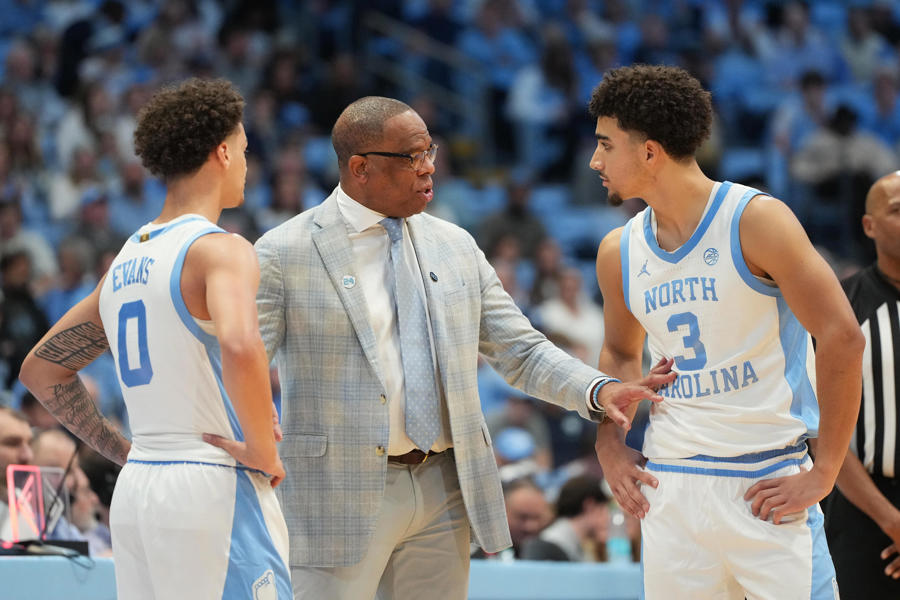
It’s early December in Chapel Hill, and the excitement around UNC basketball is electric. Fans have already been treated to stunning performances, thrilling victories over top-ranked opponents, and glimpses of a team that could make a serious run this season. Yet, amid the celebration, head coach Hubert Davis is quietly keeping his team grounded, reminding them that championships aren’t won on talent alone—they’re won on effort, discipline, and mastering the little details that separate good teams from great ones. During his recent radio appearance at Top of the Hill Restaurant and Brewery, Davis shared insights into the statistics he loves seeing and one area where he knows the Tar Heels can still grow. For UNC fans, it’s a fascinating peek into the metrics shaping the team’s identity, a look at what’s already working, and a window into the areas that could define the season ahead.
Defensive Excellence: A Foundation to Build On
Defense has always been a cornerstone of elite basketball, and Davis has made it clear that it’s non-negotiable for his Tar Heels. “For us to get to where we want to become, we have to be great defensively,” Davis said during his radio show. And through the first nine games, his team has delivered in impressive fashion. The Tar Heels have held opponents to just 36.8% shooting from the field, well below the 40% target Davis set at the beginning of the season. That’s a remarkable improvement compared to last year, especially considering the quality of competition Carolina has faced so far, including top-25 victories over Kansas and Kentucky.
UNC’s commitment to defense is visible not just in statistics but in style of play. Opponents are forced into contested shots, turnovers are created through aggressive pressure, and the Tar Heels’ length and versatility make scoring difficult in any area of the floor. Even when the paint is threatened, Carolina has shown resilience. Against Georgetown, the Hoyas scored 22 points in the paint in the first half, but the Tar Heels tightened up after halftime, allowing just 10 points the rest of the game. Similarly, Kentucky tallied 42 paint points in the first half of their matchup, only to be limited to 14 after halftime adjustments. These performances illustrate a team learning to adapt and respond mid-game—a critical skill for success in March.
Davis emphasized that defense isn’t just about individual effort—it’s about understanding positioning, communication, and anticipating opponents’ movements. Players like Caleb Wilson, Henri Veesaar, and R.J. Davis are key to this approach. Their ability to read screens, rotate defensively, and close out on shooters exemplifies the Tar Heels’ commitment to disciplined, team-oriented defense. It’s no surprise that UNC currently ranks 21st in overall defensive efficiency according to KenPom, fourth in effective field-goal percentage defense, and third in two-point defense. These numbers are more than just stats—they reflect a team that has bought into the process and is executing with intent.
Rebounding: Dominating the Glass as a Team
Another area where Davis is seeing success is rebounding, a skill often overlooked by casual fans but essential to controlling games. Last season, UNC averaged 36.7 rebounds per game with a margin of +2.9. This season, through nine games, the Tar Heels are averaging 43.4 rebounds per contest with a margin of +9.9—a significant jump. It’s not just the volume of rebounds that matters; it’s the impact on tempo and second-chance opportunities.
Offensive rebounds, in particular, have been a focus for Davis. By crashing the glass aggressively, UNC creates extra possessions and scoring opportunities while also sending a message about toughness and effort. Players like Veesaar and Wilson are central to this strategy, using their size, positioning, and timing to dominate the boards. But it’s not just the bigs—guards contribute by boxing out, anticipating missed shots, and securing long rebounds to ignite fast breaks. The collective effort ensures that UNC not only limits opponents’ second chances but also maximizes their own scoring opportunities.
Protecting the Paint: The Next Frontier
While defense and rebounding have been points of pride for Davis and the team, there is one area where the coach still sees room for growth: protecting the paint. Last season, UNC allowed 40 or more points in the paint in seven games, finishing with a 2-5 record in those situations. High paint-point totals often coincided with losses, emphasizing the importance of interior defense.
This season, UNC has made strides but has not completely solved the challenge. Against Michigan State, the Spartans scored 46 points in the paint in a 74-58 victory over Carolina—a stark reminder that elite opponents will test the interior. Yet, in games like Georgetown and Kentucky, the Tar Heels showed that adjustments and awareness can limit paint scoring and swing momentum in their favor. Davis’s focus on protecting the paint is about more than stopping points—it’s about forcing opponents to take difficult perimeter shots, controlling the tempo, and asserting physicality in the post.
Players are buying in, and the coaching staff is adjusting schemes to address weaknesses. Whether it’s doubling post threats, anticipating cutters, or rotating more efficiently, Carolina is learning how to turn the paint into a defensive stronghold. As the season progresses, protecting the paint will likely remain a key indicator of the team’s championship potential.
Caleb Wilson: A Player Who Embodies Defensive Growth
One player who has embraced both defensive responsibility and team growth is Caleb Wilson. Known for his scoring ability, Wilson has also developed his court vision and adaptability, particularly when facing double teams. Against Georgetown, he calmly navigated traps, finding open teammates and maintaining offensive flow. His maturity on both ends of the court reflects the team’s overall philosophy: smart, adaptable, and disciplined basketball.
Wilson’s growth mirrors the team’s evolution in rebounding, paint protection, and defensive execution. His willingness to trust teammates and share the ball demonstrates that UNC’s statistical success is rooted in teamwork rather than individual brilliance. When players like Wilson buy into the system, it elevates everyone on the roster and makes Carolina a more balanced, difficult-to-defeat team.
Building a Season Around Metrics
For Hubert Davis, statistics aren’t just numbers—they’re a roadmap. Limiting opponents to under 40% shooting, controlling rebounds, and protecting the paint are not arbitrary goals; they are benchmarks for competitiveness, efficiency, and ultimately, winning games. As Davis said during his radio appearance, “Every day, [the team is] understanding more and more how important it is to get after it defensively. And also, rebounding the basketball. That’s something that we desperately wanted to improve on from last year, especially offensive rebounding.”
UNC’s record of 8-1 through the first nine games shows that these benchmarks are translating to success on the court. Top-25 wins over Kansas and Kentucky highlight how meeting—or exceeding—statistical goals can directly lead to results. Yet, the Tar Heels are not content. Davis continues to emphasize the need for improvement, particularly in paint defense, signaling that the team is always chasing excellence.
Looking Ahead: USC Upstate and Beyond
After the 20-point win against Georgetown, UNC has a brief pause before returning to action on December 13 against USC Upstate. While the Tar Heels are heavily favored in this matchup, Davis will likely use it as an opportunity to reinforce metrics, experiment with rotations, and fine-tune interior defense. Every game is a chance to refine systems, instill habits, and prepare for the inevitable challenges of ACC play and postseason tournaments.
For fans, the key takeaway is clear: UNC is a team on a mission. Defensive efficiency, rebounding dominance, and protecting the paint are not just stats—they are a reflection of culture, effort, and preparation. As the season unfolds, these metrics will serve as guideposts for both players and coaches, helping the Tar Heels navigate the highs and lows of a demanding schedule while staying true to their identity.
The Fan Perspective: Why This Matters
For UNC fans, statistics like defensive efficiency, rebounding margin, and paint protection are more than numbers—they are a promise of competitiveness and consistency. Watching the Tar Heels limit opponents to sub-40% shooting, dominate the glass, and make smart in-game adjustments provides confidence that this team can contend at the highest level. The combination of talent, coaching, and adherence to metrics makes Carolina not just a team with potential, but a program with a blueprint for sustained success.
Fans can celebrate the wins and highlight-reel moments, but the real excitement comes from understanding the process. When a team commits to controlling the game through effort, rebounding, and defensive intelligence, every victory feels earned, every stat becomes meaningful, and every improvement a sign of future triumphs. UNC’s early-season performance is proof that discipline, focus, and adherence to key metrics can shape not only results but also identity—and that’s something every fan can get behind.
Conclusion: Metrics, Growth, and a Season to Watch
As the Tar Heels continue their 2025-26 campaign, the numbers will tell a story, but the effort and execution behind them are what truly define the team. Hubert Davis’s focus on defense, rebounding, and paint protection is already yielding results, yet there is still room to grow. With players like Caleb Wilson leading by example, teammates buying in, and a coaching staff committed to improvement, UNC is well-positioned to turn statistical success into tangible victories.
Fans have plenty to be excited about: a team that defends with intensity, controls the boards, and adapts intelligently during games. At the same time, they know there is more work to do, particularly in protecting the paint. Every game offers a chance to refine skills, reinforce habits, and continue building a Tar Heel identity rooted in toughness, teamwork, and excellence.
For UNC basketball fans, the story of this season is unfolding not just in wins and losses, but in the metrics and habits that will define greatness. As the Tar Heels chase perfection, every rebound, every defensive stop, and every successful adjustment brings them closer to a season that could be remembered for years to come. And if Davis gets his team to continue excelling in these key areas, UNC may not just reach its goals—they may surpass them in spectacular fashion.




