


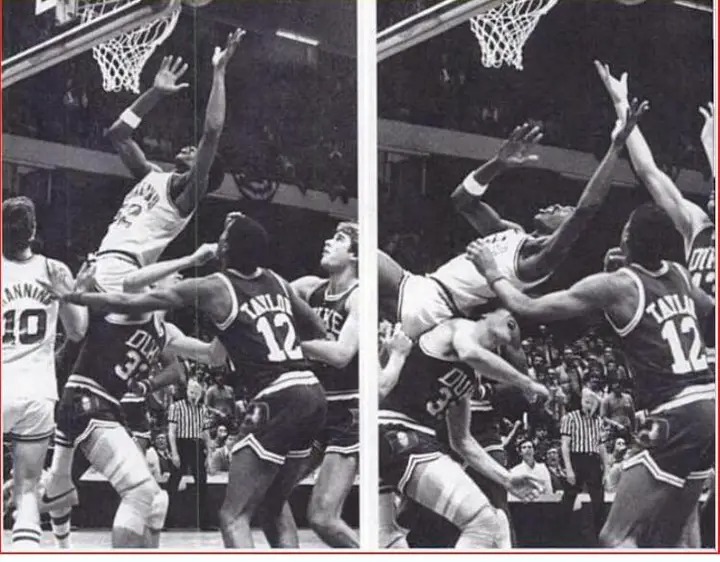
THE BUZZER ROBBERY: Inside the 1980 ACC Tournament No-Call Maryland Fans Still Call the Greatest “Rip-Off” in League History
GREENSBORO, N.C. — More than four decades have passed, thousands of ACC games have been played, and countless whistles have echoed through packed arenas — but for Maryland fans, one moment remains louder than all of them. A moment defined not by a whistle… but by the deafening absence of one.
To this day, the final seconds of the 1980 ACC Championship between Duke and Maryland stand as one of the most controversial endings in conference history. Some call it a missed call. Others call it a bad break. Terrapin fans call it something much stronger:
“The greatest ref rip-off of all time.”
And if you ask anyone who watched it live — or any Terps fan who grew up hearing the story — they’ll tell you the same thing: the ending didn’t just sting. It shaped a legend, fueled a rivalry, and planted the earliest seeds of what Maryland fans would one day label the “Tobacco Road whistle.”
Today, we revisit the play that has never died.
THE SETUP: Duke Up One. Maryland Needing a Miracle. The Clock Bleeding Out.
The 1980 ACC title game had everything: two heavyweights, a punishing defensive battle, and a final minute filled with chaos. Duke, led by Mike Gminski and Gene Banks, had clawed out a one-point edge. Maryland, behind the smooth scoring of Albert King and the relentless effort of Buck Williams, refused to fold.
And then came the moment.
With seconds left, Maryland pushed the ball up the floor. Albert King, ice in his veins, pulled up for a jumper that could win the championship. It rattled off.
But Buck Williams — the toughest man on the floor — rose for the cleanest tip-in opportunity Maryland could’ve dreamed of.
What came next remains one of the most replayed, debated, and disputed seconds in ACC history.
THE COLLISION: Kenny Dennard Comes Flying In
As Williams elevated for the game-winning tip, Duke’s Kenny Dennard came crashing into him from behind. To Maryland fans, it was a blatant undercut — as obvious as a foul gets. Williams was thrown off balance, the tip attempt disrupted.
The ball bounced away.
The buzzer sounded.
Duke celebrated.
And the officials?
Silent. No whistle. No foul. No chance for Maryland.
The game — and the championship — were over.
THE AFTERMATH: “HOW IS THAT NOT A FOUL?”
TV announcers hesitated. Fans in the arena froze. Maryland players looked at officials in disbelief. Buck Williams himself raised his arms, stunned, waiting for the call that never came.
Every replay told the same story: contact. Elevation altered. Shooter undercut.
In today’s game, it’s not even a debate — it’s a foul 100 times out of 100. Likely two free throws. Likely a different champion.
But 1980 was a different era. Officials often swallowed whistles in the final seconds. Physicality ruled. And Duke — fairly or unfairly — already carried a reputation for getting borderline calls in crucial moments.
For Maryland fans, this wasn’t borderline.
THE LEGACY: The Birth of the “Tobacco Road Whistle”
This moment didn’t just cost Maryland an ACC Championship.
It became part of the program’s identity, a wound that never fully healed. For decades afterward, whenever a close call went Duke’s way, Maryland fans went right back to the same place:
“This is 1980 all over again.”
Fans still swear the play represents a larger pattern:
- The ACC favoring Duke and UNC
- Maryland being treated as an outsider before leaving for the Big Ten
- A history of big moments shifting because of small whistles — or none at all
Whether fair or exaggerated, that belief fueled one of college basketball’s fiercest atmospheres at Cole Field House and later the Xfinity Center. The bitterness wasn’t just rivalry fire — it was born from a championship they believe was stolen.
THE PLAY THAT WON’T GO AWAY
The ACC has had controversial finishes since then — questionable charges, missed goaltends, clock malfunctions, and replay debates.
But ask long-time Maryland supporters which moment they’d change if they could rewrite history, and they don’t hesitate:
“Give Buck Williams the foul he earned.”
It’s more than nostalgia. It’s more than anger. It’s a reminder of how one moment — one silent whistle — can define a tournament, alter a legacy, and echo across generations.
The 1980 Duke–Maryland ending is not just a highlight clip.
It’s a scar.
A myth.
A rallying cry.
And for Maryland fans?
It will always be the buzzer robbery.




