


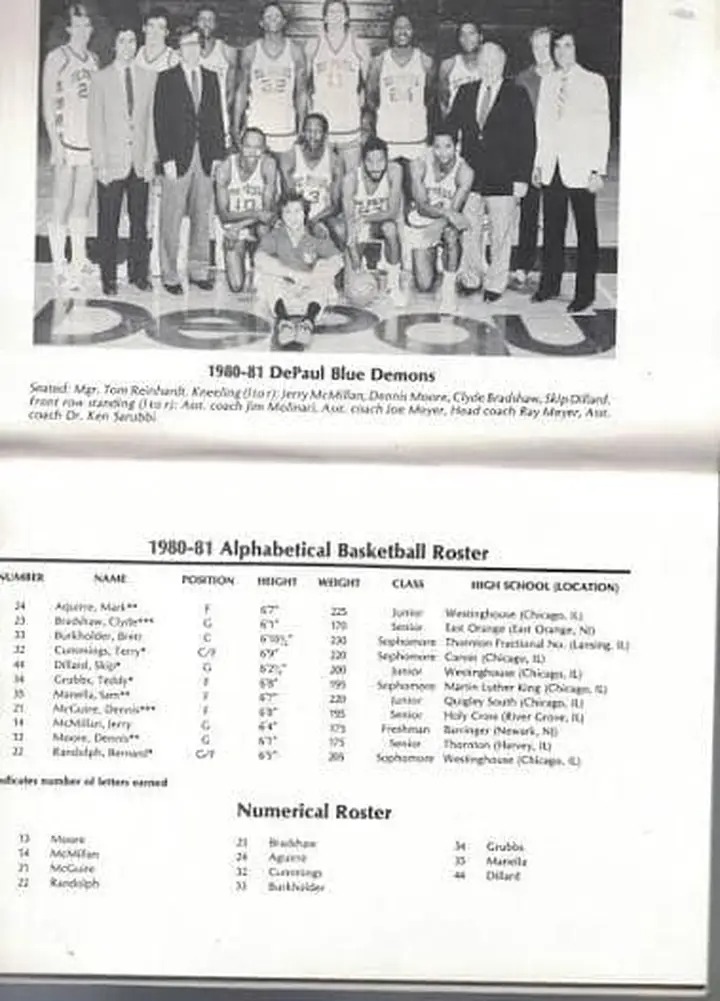
How Does a Near-Perfect Team Fall Overnight? The 1980–81 DePaul Mystery That Still Sparks Heated Debates 40 Years Later… #1 in America… But Gone in Round One? The Unbelievable 1981 DePaul Story That Historians Still Can’t Agree On. Elite or Overrated? Was This the Best Team to Never Win?
CHICAGO — More than four decades later, the 1980–81 DePaul Blue Demons remain one of college basketball’s most fascinating paradoxes: a team that dominated the nation from November to March, only to vanish from the NCAA Tournament in a single stunning afternoon. At 27–1 in the regular season, ranked #1 in both the final AP and UPI polls, and armed with one of the deepest, most polished rosters in program history, DePaul seemed destined for a Final Four coronation.
Instead, the season ended not with a championship celebration, but with a question that still divides historians, fans, and former players:
“How can a team that good lose that fast?”

A Year of Dominance That Felt Unbreakable
Coached by the legendary Ray Meyer, the Blue Demons were the epitome of discipline, balance, and experience.
- Mark Aguirre, the junior phenom, was already a national star.
- Terry Cummings, a rising interior force, complemented Aguirre perfectly.
- Dallas Comegys, Clyde Bradshaw, and a seasoned supporting cast gave DePaul a lineup few teams in the country could match for efficiency and chemistry.
They ran Meyer’s system to perfection — precise cuts, smart possessions, and unwavering defensive poise. Their lone regular-season loss came early, in December, and only sharpened their edge. By mid-February, national analysts were calling them:
“The least flawed team in America.”
Every poll agreed. Every bracket projection placed them in the Final Four. And Chicago, starved for college basketball supremacy, embraced them as the city’s crown jewel.
Then Came St. Joseph’s — And The Moment That Changed Everything
March 14, 1981.
Bonsall Hall, Dayton, Ohio.
The opening round of the NCAA Tournament.
St. Joseph’s arrived as a dangerous but unheralded opponent. Their 23–8 record didn’t intimidate many, but their style should have: disciplined, physical, patient, and coached by the sharp, fearless Jim Boyle.
From the opening minutes, it was clear DePaul was not in rhythm. St. Joe’s slowed the pace to a crawl. They clogged Aguirre’s driving lanes. They forced DePaul into long possessions, uncomfortable shots, and late-clock decisions.
Still, the Blue Demons held a narrow lead in the final minute.
And then came the sequence that would haunt the program for the next 40 years.
The Missed Opportunity
With seconds on the clock and DePaul clinging to a two-point lead, freshman reserve John Smith missed the front end of a one-and-one — a mistake that swung the door wide open for the Hawks.
The Shot That Echoed Through History
St. Joe’s guard John Smith (no relation) drove the lane, drawing the defense before kicking the ball to Lonnie McFarlan, who scored the game-winning layup with seconds remaining.
DePaul’s last-second prayer missed.
The scoreboard told the story nobody expected:
St. Joseph’s 49, DePaul 48.
In one of the most shocking upsets in NCAA Tournament history, the team that spent the entire season atop the rankings was out — before most fans even filled out their brackets.

Was DePaul a Victim of the Format — or Their Own Brilliance?
This is where the debate begins, and it has not slowed down since 1981.
1. The “They Peaked Too Early” Theory
Some historians believe DePaul suffered from being too polished too soon. They were the most consistent team in America — but their style left little room for improvisation when things broke down.
2. The “Tournament Rust” Argument
Back then, as the No. 1 seed, DePaul had a long layoff before their first game. St. Joe’s played recently and was sharp, loose, and confident. DePaul looked tight from the tip.
3. The “Meyer’s System Was Outdated” Critique
Others argue Ray Meyer’s methodical offense worked wonders in the regular season but stumbled in a win-or-go-home environment where teams dared DePaul to play faster, more physical basketball.
4. The “St. Joe’s Was Underrated” Explanation
Only in hindsight do people fully appreciate how well the Hawks were coached — and how fearless they were.
One former ACC coach once put it this way:
“DePaul didn’t choke.
St. Joe’s walked in believing they were supposed to win.”
The Legacy: Best Team to Never Win?
Perhaps the most enduring question: Where does this team rank all time?
Some analysts still insist the 1980–81 Blue Demons were a top-ten team of the pre-shot-clock era. Others say they were a product of a slow, structured system that couldn’t adapt in March.
But even critics acknowledge the magnitude of their dominance:
- #1 in every major poll entering the tournament
- A national player of the year candidate in Aguirre
- One of the most complete frontcourts in the country
- A season free of true weaknesses
And yet the tournament — cruel, unpredictable, unforgiving — reduced their masterpiece of a season to a footnote.
Forty Years Later, the Debate Only Grows Louder
Every March, when bracket-busters emerge, the 1981 DePaul team resurfaces in conversation.
For Chicago fans, it remains a wound.
For historians, it remains a case study.
For college basketball diehards, it remains a legend.
The Blue Demons were almost perfect.
And maybe that’s why their fall — sudden, shocking, unforgettable — still echoes across generations.
Elite? Overrated? Misunderstood?
Forty years later, the only consensus is this:
The 1980–81 DePaul Blue Demons remain one of the greatest enigmas in college basketball history.




