


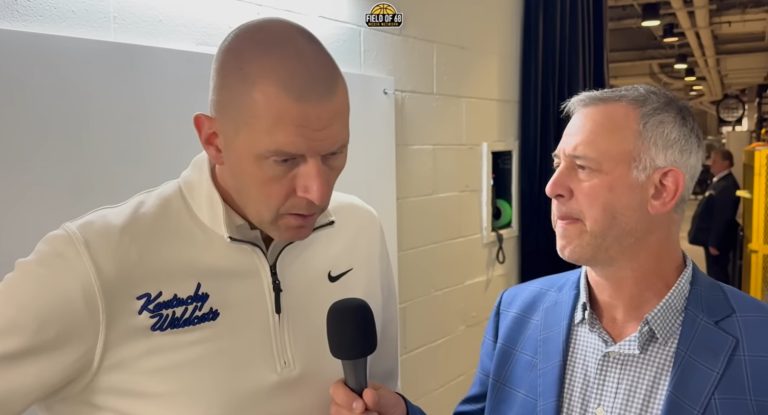
Every college basketball season comes with its own wave of opinions, reactions, and overreactions — but few things get the Big Blue Nation buzzing like an outside analyst handing Kentucky a grade that feels lower than the reality fans see on the floor. That’s exactly what happened this week when The Field of 68 rolled out their early-season evaluations and threw a surprisingly blunt assessment at Mark Pope’s Wildcats. It wasn’t meant to insult the players. It wasn’t meant to drag the program. In fact, buried beneath the harsh grading was something much bigger — a message about potential, expectations, and what people believe Kentucky should be capable of becoming. And that’s what makes this moment so fascinating for BBN: not the grade itself, but what it says about the standard Kentucky holds in the national spotlight.
What followed was a conversation that spread across social media, sports shows, and fan groups within minutes. Analysts debated it. Fans pushed back. Some agreed. Some rolled their eyes. But one thing everyone could agree on was this: Kentucky basketball is being watched closely — and even in a season full of ups and downs, the world still expects greatness from the blue and white.
And that expectation is exactly where this story begins.
The National Spotlight Never Leaves Kentucky — Even at 6–4
When Tyler Hansbrough looked straight into the camera on The Field of 68 and said, “I give ’em an F,” it wasn’t a shot at the program’s talent. It wasn’t a claim that the season was doomed. It was an emotion-filled reaction to something he, and many others, believe Kentucky hasn’t shown consistently yet: the fight, competitiveness, and hunger that define the greatest Wildcats teams.
Hansbrough, who has been on both sides of elite college basketball battles, wasn’t grading Kentucky’s skill or their coaching staff. He was grading something deeper — the expectation that Kentucky, regardless of who is on the roster, should always bring a certain level of toughness, energy, and urgency to the floor.
His exact words:
“It’s total failure when you don’t come out and you don’t play hard and you don’t compete and you don’t play basketball the right way. You get the result that you’re getting.”
Whether fans agree or disagree, the comment wasn’t made from a place of insult — it was made from a place of respect. The reason analysts speak this strongly about Kentucky is simple: they believe the Wildcats can be better.
And in college basketball, belief is a powerful thing.
Why Matt McCall’s “D” Grade Meant Something Different
While Hansbrough delivered the most dramatic letter, analyst Matt McCall offered a calmer but equally honest perspective. He gave Kentucky a D, but instead of focusing on frustration or disappointment, he focused on urgency.
McCall warned that Kentucky is in a dangerous zone — not because they’re a bad team, but because they’re inconsistent in areas that matter most when March rolls around. In simple terms:
Kentucky has the talent.
Kentucky has the coaching.
Kentucky has flashes of greatness.
But Kentucky hasn’t yet put together a full identity.
That, McCall argued, is what puts the Wildcats at risk of falling behind the pack in a season where the rest of college basketball is more balanced than usual.
It wasn’t a harsh message — it was a reality check, the kind most analysts reserve only for programs they expect to bounce back quickly.
And that tells you something important:
The basketball world still views Kentucky as a heavyweight, even when the record doesn’t show it yet.
The Heart of the Issue: Kentucky’s Potential Is Higher Than Their Current Output
Here is where this story becomes less about grades and more about expectations.
Most programs would celebrate a 6–4 start with high-scoring games, big individual performances, and a roster filled with fresh talent adjusting to a new system. But Kentucky is not “most programs.” This is a place where Final Fours are expected, banners are part of the culture, and early frustration doesn’t erase long-term belief.
The Field of 68’s grading wasn’t centered on the record — it was centered on the standard.
And if we’re being honest, even Mark Pope said nearly the same thing after the NC Central game when he admitted:
“We just have a standard we have to live up to, and we’re not… We’re going to learn. We’re learning fast.”
That sounds less like a coach panicking and more like a coach who knows what this team is capable of becoming.
The analysts weren’t judging Kentucky as a mid-tier program.
They were judging Kentucky as Kentucky.
And that’s why the grades came in lower than fans expected.
The Emotional Rollercoaster of This New Era
What makes this season different is that Kentucky is not simply adjusting to a new roster — they’re adjusting to a brand-new philosophy under a brand-new coach with a brand-new system.
Mark Pope is building something fast-paced, modern, and team-first. It’s fun, it’s ambitious, and it’s designed to make Kentucky dangerous when all the pieces finally click.
But new systems take time.
New chemistry takes time.
And turning a group of new faces into a hardened, competitive unit takes even more time.
However, the beautiful part of Kentucky basketball — something no analyst can ever fully measure — is that this fanbase understands growth. They understand the process. They understand the journey.
And more importantly, they understand that the team they see in December is not the team they’ll see in February or March.
Kentucky teams under new leadership almost always follow the same pattern:
Early inconsistencies
Mid-season identity shift
Late-season surge
And each time, the national media reacts like they’ve never seen it before.
That’s why the conversation around these early-season grades is more about perception than performance.
Why the Grades Might Actually Help Kentucky
Sometimes teams need a spark.
Sometimes players need a challenge.
Sometimes criticism — even if fans disagree with it — can become fuel.
There’s a reason moments like these often come before a turning point:
A locker room wakes up.
Leaders step forward.
Practice intensity shifts.
The team embraces the underdog label internally.
Mark Pope is the kind of coach who thrives on motivation.
He is the kind of coach who uses criticism not as a weapon, but as a tool.
And he is definitely the kind of coach who sees grades like this as an opportunity to reset the narrative.
Because what matters most is not how Kentucky starts — it’s how Kentucky finishes.
And nothing motivates a team more than being told they’re underachieving when they know they’re capable of more.
The Bigger Picture: Kentucky Still Controls Their Own Story
Despite a mixed start, the numbers tell the real story:
The offense is explosive.
The bench is deeper than most expected.
The young players are showing flashes of star potential.
The defensive errors are fixable.
And the team’s best basketball is still ahead of them.
An early-season grade doesn’t write the final chapter — it simply highlights the opening pages.
This team has shown they can score with anyone.
This team has shown they can run, share, and create mismatches.
This team has shown they have the raw tools to turn into something dangerous.
And that is the true heart of what the analysts were saying:
Kentucky is better than a 6–4 record.
They just haven’t shown it consistently yet.
BBN’s Role in the Journey
What makes Kentucky special is not just the blue on the jersey — it’s the blue in the stands.
This fanbase pushes the program, lifts the players, and sets the standard the rest of the country reacts to.
The national media knows it.
The coaches know it.
The players feel it.
And when they finally start stringing consistent performances together, no one will be surprised if the same experts who handed out low grades are suddenly praising Kentucky for their turnaround.
Because that’s how this program operates.
Pressure.
Expectations.
Growth.
Breakthrough.
March.
It happens every time.
The Bottom Line: The Grade Wasn’t an Insult — It Was a Challenge
When The Field of 68 gave Kentucky those low marks, they weren’t saying the season is over.
They were saying the season hasn’t begun yet.
They see potential.
They see talent.
They see coaching.
They see flashes of greatness bursting through the cracks.
And they believe — just like the fans — that Kentucky can still become a force.
Grades can change.
Momentum can flip.
Teams can grow fast.
When the season ends, nobody will remember December criticism.
They’ll remember how this team responded.
And if Mark Pope’s message is any indication:
Kentucky isn’t backing down.
Kentucky isn’t lowering the standard.
Kentucky isn’t finished.
They’re just getting started.




