


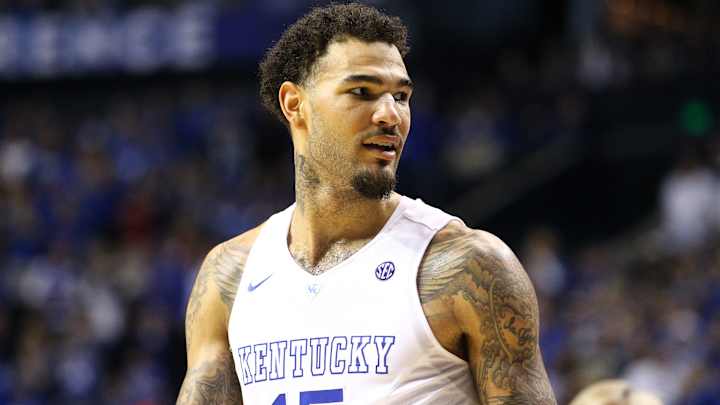
When a program as storied as Kentucky basketball sputters, everyone notices. Opposing fanbases notice. Analysts notice. Exhausted message-board warriors notice. And—often the sharpest critics of all—former Kentucky stars notice.
This time, it wasn’t a subtle critique. It wasn’t measured, diplomatic, or wrapped in layers of “coach speak.” Instead, it came straight from Willie Cauley-Stein, a former Wildcat whose energy, grit and defensive intensity once helped define what Kentucky basketball was supposed to be.
And he didn’t whisper it.
He said the quiet part out loud.
In a post that ricocheted across Kentucky Twitter, Facebook groups, Reddit threads and local radio shows, Cauley-Stein pulled zero punches about what he sees as the real issue facing Kentucky hoops—and frankly, most of high-level college basketball—in the era of Name, Image and Likeness (NIL).
> “(Expletive) tough to be hungry when you got players showing up in benzos and designer,” he wrote.
> “It’s a new era of navigating professional student athletes… Trying to win ships ain’t the fuel anymore.”
In one sharp, unfiltered message, he summarized something many fans suspect, many coaches worry about, and many players quietly acknowledge: the motivation structure in college basketball has changed. Not shifted slightly. Not evolved gently.
Changed.
And Kentucky, a program once built on relentless hunger, is now navigating unfamiliar terrain.
The Rise of the ‘Professional Student Athlete’
Let’s start with the obvious: NIL is not going anywhere. College sports has entered an era where athletes can finally profit from their names, images, and brands—a long-overdue change in many ways. But with that change comes a new reality for programs like Kentucky, which once thrived on the impossible-to-replicate hunger of players chasing NBA dreams, glory, and generational change.
Now? Players are showing up already wealthy. Already famous. Already branded.
“Kids walking into practice with luxury cars” used to be a metaphor. Now it’s literal.
Cauley-Stein and DeMarcus Cousins—two former Kentucky bigs who played with unmistakable edge—aren’t saying NIL is bad. They aren’t arguing players shouldn’t get paid. What they are saying is much more complicated:
How do you keep players starving for success when they’ve already eaten?
In the pre-NIL era, most college athletes needed to play for their futures. Scholarships, draft stock, and national exposure were the currency that mattered. Now, for many top recruits, the financial reward arrives before the proving ground.
That shifts everything.
Motivation. Culture. Expectations. Pressure. Even team chemistry.
Cauley-Stein isn’t criticizing players for having money; he’s pointing out that incentives shape behavior. When the reward structure changes, the psychology of the game changes.
And Kentucky fans are seeing that in real time.
Kentucky’s Effort Problem Isn’t Just a Kentucky Problem
This is important: Cauley-Stein isn’t singling out Kentucky because the Wildcats are uniquely lazy or unfocused. He’s pointing out a growing issue across college basketball.
The modern athlete is:
More financially secure
More brand-conscious
More aware of their personal value
More protected by layers of handlers, agencies, and NIL partners
More connected to a social-media-driven world where highlight plays are rewarded more than defensive rotations
And again—none of this makes them “bad.” But it does make them *different*.
The real issue, Cauley-Stein argues, is that hunger is no longer a given. Effort is no longer assumed. Sacrifice is no longer automatic.
The calculus has changed.
And Kentucky, a school that built its identity on blue-collar dominance wrapped inside a powerhouse brand, now has to build a new identity without the guarantee of collective urgency.
This is a national trend, but programs like Kentucky feel it more sharply because expectations are sky-high, attention levels are intense, and the smallest cracks become front-page stories.
The Heart of the Criticism: It’s Not About Talent
When Cousins and Cauley-Stein talk, fans listen. Current players listen. Coaches listen.
But perhaps the most revealing part of both men’s comments is what they didn’t complain about.
Nobody is saying Kentucky lacks talent. In fact, the consensus around the program is that Mark Pope has assembled a roster with enough offensive firepower and enough versatility to beat almost anyone.
What’s missing is the day-to-day obsession with excellence.
Not highlight plays.
Not scoring bursts.
Not the occasional big win.
But the possession-by-possession intensity—the kind that used to make Kentucky exhausting to play against. Cauley-Stein’s teams didn’t just beat opponents. They suffocated them. Smothered them. Intimidated them.
That is the part he feels slipping: the constant, unrelenting commitment to do anything necessary to win.
The dives on loose balls.
The extra box-out.
The defensive rotations that aren’t glamorous but win games.
The willingness to bleed for 40 minutes, not 15.
That’s where NIL complicates things. Because when players are rewarded before they’ve ever proven anything, the incentive to earn status through sweat becomes weaker.
The NBA chase once unified Kentucky’s teams. But in the NIL era, players are getting draft-level compensation without needing draft-level focus.
It’s not bad. It’s not wrong.
But it’s different.
The ‘Hustle Bonus’ Idea: Half Joke, Half Genius
One part of Cauley-Stein’s message that really caught fire was his sarcastic-sounding, yet surprisingly logical suggestion:
“Imagine if they gave bonuses for hustle plays like steals, blocks, rebounds, assists… take points off the chart and give the game bonus to ‘winning plays.’”
It was delivered with a mix of frustration and humor, but it highlights a real issue:
If points already equal NIL money and personal brand value… what motivates a player to do everything else?
The answer used to be:
Pride
Team-first identity
Championship pursuit
Draft stock
Legacy
But legacy doesn’t hit your bank account.
And pride can’t outbid a shoe company.
And “team-first” gets complicated when every player has their own business interests.
Cauley-Stein’s idea, exaggerated or not, reflects a deeper truth: winning plays don’t get the same public reward as flashy plays. A player can have 18 points and be praised online even if they missed defensive rotations all game.
But the teammate with 4 points, 9 rebounds, 3 steals, 2 blocks, 6 deflections, and 11 winning plays? Social media doesn’t make them a star.
NIL doesn’t boost their value.
And yet those players win championships.
Cauley-Stein is essentially begging the sport to recalibrate what it rewards—not with money, but with recognition.
Because if you praise hustle, players chase hustle.
If you praise clout, players chase clout.
Reward structures matter.
Mark Pope’s Challenge: Coaching in a Different Kentucky
When Mark Pope took the Kentucky job, he walked into one of the most demanding roles in American sports. Not because Kentucky fans are impossible to please—but because the standard of success is so incredibly high.
He promised energy. Passion. Modern basketball. A return to national relevance and championship contention.
His vision is bold.
But even he will admit—publicly or privately—that the job he now has is not the job John Calipari had when Cauley-Stein, Cousins, Anthony Davis, John Wall, and that era’s hungry-to-the-bone players came through Lexington.
Pope isn’t coaching:
pre-NIL teenagers
who need college to reach the NBA
who rely on the program for exposure
who have to earn their platform through performance
He’s coaching professionalized teenagers.
Cauley-Stein called them “professional student athletes”—a phrase that should not be dismissed lightly. It acknowledges the reality coaches face: these players now have agents, brand deals, appearance obligations, endorsement expectations, and businesses to run.
Coaches are no longer just basketball teachers.
They’re culture architects.
Mentors.
Motivators.
Managers of ego, brand, and chemistry.
Balancing both performance and NIL demands.
Pope must take a room full of individually valuable, financially secure young men and convince them that college basketball is still about something bigger than themselves.
Legacy used to be automatic.
Now it must be sold.
Marketed.
Explained.
That is the job.
And it’s harder than ever.
The Voices of the Past Are Guiding the Future
What makes Cauley-Stein’s and Cousins’ comments powerful is not that they’re criticisms—it’s that they’re warnings.
They aren’t saying Kentucky is doomed.
They aren’t saying the players don’t care.
They aren’t saying NIL ruined basketball.
They’re saying: Championship habits don’t appear on their own anymore. They must be built. Reinforced. Demanded. Taught.
This is the message they’re sending to the locker room:
“Talent isn’t enough.
Money isn’t enough.
Brands aren’t enough.
And if Kentucky is going to raise banners again, it needs hunger. The real kind. The kind you can’t fake.”
When players hear that from NBA veterans who actually lived the Kentucky standard, it hits differently.
It’s not old-man yelling.
It’s not nostalgia.
It’s not jealousy.
It’s a reminder.
A challenge.
A plea.
So… Is Willie Cauley-Stein Right?
Short answer: Yes—painfully so.
Long answer: He’s right about the problem, and he’s right about the stakes, but the solution isn’t as simple as hustle bonuses or speeches about pride.
The deeper truth is this:
College basketball has handed young athletes unprecedented opportunity.
But with opportunity comes distraction.
With money comes independence.
With fame comes noise.
Programs like Kentucky must now build effort from scratch, not assume it will appear.
They must:
Create cultures where legacy still matters
Teach players that defensive effort is as valuable as scoring
Celebrate the dirty work players used to do instinctively
Make the community part of the team identity
Build accountability structures stronger than NIL incentives
If they do, Kentucky can still be Kentucky.
If they don’t?
They’ll look like what Cauley-Stein sees now—a talented team lacking the edge that once made the Wildcats terrifying.
The Bottom Line: The Fuel Must Return
Cauley-Stein’s message wasn’t about pointing fingers. It was about lighting a fire.
The NIL era isn’t a problem to solve—it’s a landscape to adapt to.
College athletes aren’t selfish—they’re navigating a new world.
And Kentucky basketball isn’t broken—it’s evolving.
But evolution requires awareness.
Awareness requires honesty.
Honesty requires voices like Cousins and Cauley-Stein.
Because they know what Kentucky looks like when it’s at its best.
They lived it.
They breathed it.
They bled for it.
And now, they’re challenging today’s Wildcats to find that hunger again.
As Cauley-Stein put it, “trying to win ships ain’t the fuel anymore.”
But it can be.
It has to be.
Because at Kentucky, banners
aren’t decoration.
They’re the standard.
And standards don’t disappear.
They wait—patiently—for the next team hungry enough to reach them.




