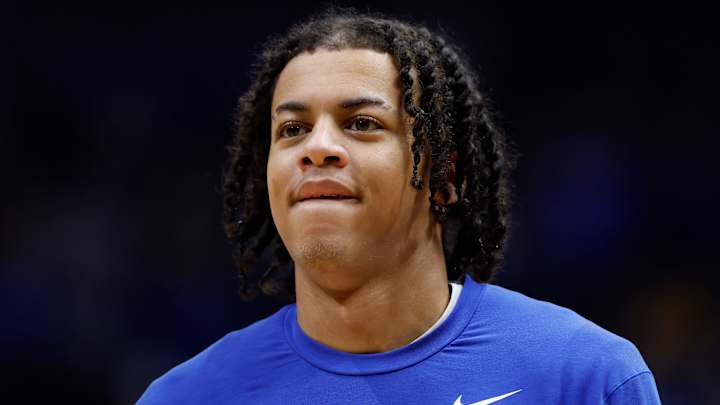
In the modern era of college basketball an era defined by transfer portals, NIL, extended eligibility, and unprecedented roster movement — one decision can alter the entire trajectory of a young player’s career. And for Kentucky head coach Mark Pope, few decisions feel heavier, riskier, or more layered than the one hanging over freshman guard Braydon Hawthorne.
On the surface, it seems simple: redshirt him, or play him.
But in 2025, nothing about this choice is simple. And if Pope’s latest update is any indication, Kentucky is navigating that decision with a mix of curiosity, caution, and a genuine desire to do right by the player — even when the short-term roster needs are tempting.
When asked whether the Wildcats were getting any closer to finalizing Hawthorne’s redshirt status, Pope didn’t bother hiding behind vague language or coach-speak.
“The answer is no,” he said plainly.
That bluntness caught some off guard. But behind those three words lies an entire ecosystem of competing priorities. Pope knows what Hawthorne could bring today — and he knows what he could become tomorrow. He also understands how one short-sighted decision could cost Hawthorne a full year of future opportunity in an unforgiving system that rarely rewards patience.
The freshman is improving. The team could use him. The staff likes him.
But is that enough?
That’s where the tension lies — and where Pope’s curiosity-driven, philosophical side begins to show.
A Special Talent, Stuck Between Two Realities
When Pope speaks about Braydon Hawthorne, the tone shifts. It’s not the tone he uses when discussing tactical adjustments or scouting reports. Instead, it’s reflective — even protective.
“Braydon is getting so much better every day,” Pope said. “There’s certainly space where he could help us.”
But then comes the phrase that has framed the entire discussion:
“In college basketball right now, it’s really expensive to burn a year or two.”
The word expensive is doing heavy lifting here. Pope isn’t referring to money, nor is he talking about wins and losses. He’s talking about something far more valuable in today’s environment:
Flexibility. Future options. Long-term leverage.
A freshman year used to be just that — a freshman year. Players developed, waited their turn, learned the system, and bided their time. Redshirts were common. Transfers were rare. Four-year careers were normal.
Not anymore.
Now, a single wasted season can push a player into the transfer portal. It can erode trust. It can create frustration. It can close future paths.
And Pope knows it.
The Nightmare Scenario Pope Wants to Avoid
Pope didn’t hesitate to explain his biggest fear — the scenario that keeps him from making a rushed decision.
“There’s that fear of you put him on the court for three minutes and he never plays again,” Pope said. “And you’re like, ‘Man, coach, you just burned his year and there wasn’t a ton of payoff.’”
It’s a scenario that has played out across college basketball dozens of times in recent years:
A freshman plays in a few early games.
He gets lost in the rotation.
He doesn’t have enough minutes to build a résumé.
He can’t redshirt.
He can’t transfer without losing ground.
He loses an entire year with nothing to show for it.
Pope refuses to put Hawthorne in that position.
“I’m very sensitive,” he said. “I want to make sure we take care of him. He’s a special talent. He’s got a huge future, so we’ve got to do it right.”
That phrase do it right became the theme of Pope’s entire update.
Why Modern Redshirting Has Become a Strategic Minefield
In earlier eras, redshirting was straightforward: a player sat for a season, got stronger, learned the system, and emerged more prepared. The decision was usually made before the season even began.
Today, the calculus is far more complicated.
1. The Transfer Portal Changed the Stakes
Players leave quickly and often. A young player who loses a year of eligibility without meaningful minutes might feel pushed out — even if unintentionally.
2. NIL Adds a Layer of Market Value
Every year of eligibility now has monetary implications. A lost year could cost a player tens of thousands in future opportunities.
3. COVID Extra Years Permanently Altered Timelines
Some players are in their fifth or sixth college season. The age gap between freshmen and upperclassmen has never been wider.
4. Coaches Are Fighting Two Seasons at Once
The immediate season
and
the long-term construction of next season’s roster.
A wasted year complicates both.
This is why Pope’s hesitation makes sense. The world has changed — and redshirting is no longer just a developmental tool. It’s a strategic safeguard.
Hawthorne Is Fully Bought In — No Drama, No Doubt
One thing Pope wanted to make absolutely clear is that Hawthorne himself is not pushing for immediate playing time*. He’s not restless. He’s not frustrated. He’s not second-guessing the staff.
“He’s all in, by the way,” Pope said.
That may be the single biggest reason Kentucky feels comfortable taking its time. Hawthorne’s maturity, patience, and understanding of the situation have given the staff space to think clearly, without emotional pressure.
He’s practicing hard.
He’s improving quickly.
He’s staying ready.
But he’s also realistic.
The maturity is remarkable for an 18-year-old, and Pope has noticed.
—
## **Kentucky Will ‘Just Keep Dancing’**
Pope described the ongoing evaluation using a phrase that perfectly fits his personality:
“We’ll just keep dancing.”
It’s a poetic way of describing a highly fluid situation. Each week brings new information:
How is Hawthorne trending?
Does the roster need shift?
Do injuries emerge?
Does a rotation spot naturally open?
Is the long-term plan still aligned with the short-term?
Nothing is fixed. Nothing is guaranteed.
It’s a dance — adjusting tempo, rhythm, and timing without losing balance.
—
## **Why Pope Wants Eligibility Rules Changed — Permanently**
Few coaches in America have been louder or clearer about wanting reform to redshirt rules than Pope. He doesn’t just think change is needed — he thinks it’s overdue.
College football has already created a blueprint: players can appear in up to **four games** and still preserve their redshirt.
Pope believes basketball should adopt the same model — or go even further.
“I’m on the side where I’d just like to make it five for five,” he said. “Five years to play five years. Just get rid of all the exceptions, all the arguments, all the negotiations, all the stuff. Or for that matter just go four for four and let it be.”
Either model would eliminate the dilemma he’s facing right now. It would allow him to develop Hawthorne in real games without risking his entire freshman year.
Instead of trying to read the future, coaches could simply evaluate players naturally.
“You could just play the kid,” Pope said. “Let him grow.”
Until that reform becomes reality, Kentucky — and every other program — has to live in the gray.
—
## **The Potter Factor: Another Big-Picture Decision**
Kentucky isn’t just managing Hawthorne’s situation.
Another newcomer, **Reece Potter**, is already confirmed for a redshirt season as he works through a long-term health matter.
Pope praised Potter emphatically:
“He’s a really good basketball player,” Pope said. “He does some things better than anyone on the roster.”
Potter’s situation underscores why Kentucky is taking a patient, future-oriented approach. The staff is clearly investing in long-term development — not just short-term depth.
If Potter redshirting strengthens future teams, the same logic may apply to Hawthorne.
—
## **Why This Decision Matters So Much for Kentucky’s Future**
Pope isn’t building Kentucky for a one-year splash.
He’s building an ecosystem.
One that prioritizes:
player development
roster balance
multi-year planning
continuity
patience
psychological maturity
sustainable identity
Hawthorne fits into that ecosystem.
He’s not an afterthought.
He’s not a bench filler.
He’s not a project.
He’s a piece of the future.
Playing him now might solve a small problem today — but cost Kentucky a major advantage later.
This is why Pope keeps repeating that he wants to “do it right.”
What Would Push Kentucky to Remove the Redshirt?
Several scenarios could force the staff’s hand:
1. Injuries
If the backcourt takes unexpected hits, Hawthorne becomes a necessary piece.
2. A Rotation Shake-Up
Sometimes roles shift late in December or January. A spot could open naturally.
3. Hawthorne Makes a Leap So Big It’s Impossible to Ignore
If he starts dominating practices, the staff may decide his immediate value outweighs the long-term downside.
4. A Must-Win Situation Emerges
Certain games — SEC matchups, rivalry games, or résumé opportunities — may require extra firepower.
5. Hawthorne Himself Feels Ready
While he’s “all in” right now, players evolve. His readiness, confidence, or goals could shift.
For now, none of these thresholds have been met.
The Moment of No Return
The most important detail in this entire saga is simple:
The second Hawthorne checks into a game, there is no going back.
No exceptions.
No do-overs.
No retroactive redshirts.
One second of game time equals one full year of eligibility.
That is the weight of the decision.
And that is why Kentucky continues to wait.
A Curious Story Still Being Written
Mark Pope’s handling of Braydon Hawthorne reveals much more than a single roster decision. It reveals:
his coaching philosophy
his long-term vision
his player-first mindset
his understanding of the modern game
his sensitivity to the pressures young athletes face
his willingness to resist short-term temptation
It also reveals a curiosity-driven coach who thinks deeply before acting.
Some might see indecision.
But in reality, they’re seeing intentionality.
Pope is studying the problem from every angle.
He’s thinking about Hawthorne at age 19 — and at age 23.
He’s thinking about this roster — and the next two.
He’s trying to future-proof a career before it begins.
That kind of thinking is rare.
That kind of patience is rarer.
And for Hawthorne, it may be priceless.
For now, the freshman will remain in the bullpen, growing quietly, improving steadily, and preparing for whenever — or if ever — the moment arrives.
The only certainty is that when the decision is finally made, it won’t be rushed, careless, or accidental.
It
will be thoughtful.
It will be intentional.
And in Pope’s words —
It will be done right.