


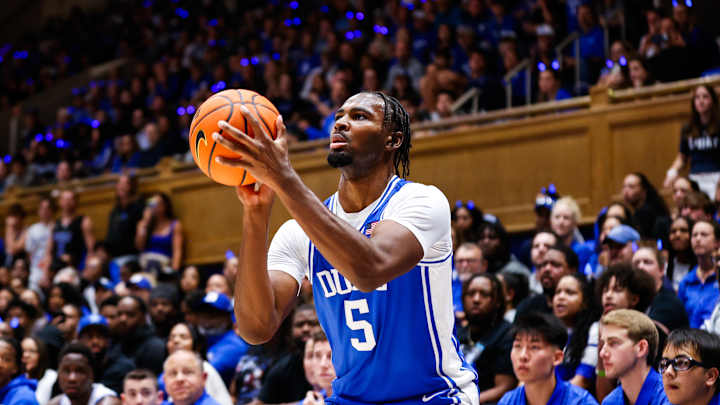
Not every important moment in a college basketball season comes during a game. Some of the most meaningful decisions happen quietly, away from packed arenas and television cameras, rooted in long-term vision rather than short-term urgency. That is exactly the case with Duke head coach Jon Scheyer’s decision to redshirt freshman wing Sebastian Wilkins, a move that reflects patience, trust, and a strong belief in development over immediacy.
The decision, revealed earlier this season and recently explored in depth through Duke Basketball’s Blue Planet video series, offers a revealing look at how the Blue Devils are thinking not just about winning now, but about sustaining success for years to come. For Wilkins, a talented four-star recruit who reclassified from the 2026 class to join Duke a year early, the redshirt season represents both a challenge and an opportunity.
Duke’s roster construction in 2025-26 played a major role in the decision. Scheyer currently has the luxury of depth, experience, and versatility, particularly on the wing. The Blue Devils boast a nine-man rotation filled with high-level contributors, along with several experienced seniors providing leadership from the bench. With established players already handling most of the meaningful minutes, there simply was not a pressing in-game role for Wilkins this season.
Rather than forcing limited minutes or placing the freshman in an inconsistent role, Scheyer and his staff chose a different path. The idea was not about holding Wilkins back, but about allowing him to grow without pressure, refine his game, and physically mature while adjusting to the demands of college basketball.
Wilkins’ journey to Duke already sets him apart. Originally part of the 2026 recruiting class, the Boston native made the bold decision to reclassify and enroll early, accelerating his development timeline. At 6-foot-8 and 220 pounds, he possesses the size, athleticism, and versatility that modern college basketball covets. However, as Scheyer noted, Wilkins realistically could still be finishing his high school career this season.
That context matters. When a player arrives on campus a year ahead of schedule, the adjustment curve can be steep. The speed of the game, the physicality of practices, and the mental demands of competing with elite talent every day all require time. Scheyer acknowledged this reality when he explained how the conversation about redshirting unfolded.
According to the Duke head coach, the discussion was rooted in honesty and mutual respect. Scheyer made it clear that redshirting was an option, not a mandate. He emphasized belief in Wilkins’ potential and outlined how taking a developmental year could position him for a larger impact down the road. Importantly, Scheyer wanted Wilkins to fully own the decision, ensuring that it was something the player believed in as well.
Wilkins ultimately agreed that redshirting was the best path forward. While it may not have been his expectation upon arriving at Duke, the decision came after thoughtful conversations with the coaching staff and his family. For a young player, that level of maturity and self-awareness speaks volumes.
Rather than sulking or disengaging, Wilkins has embraced his role behind the scenes. By all accounts, he has become an integral part of Duke’s daily practice environment. One of Scheyer’s most telling comments was about Wilkins regularly guarding Cameron Boozer in practice, a challenge that forces him to compete against one of the most highly regarded young players in the country.
Those matchups are not just beneficial for Boozer. They are invaluable for Wilkins. Every practice rep sharpens his defensive instincts, footwork, and physical toughness. Going against elite talent on a daily basis accelerates growth in ways game minutes against lesser competition sometimes cannot.
Scheyer emphasized that Wilkins has been getting better every single day. That steady improvement is exactly what the coaching staff hoped to see. The redshirt year allows Wilkins to focus on skill development, strength training, and learning Duke’s system without the pressure of immediate performance.
Perhaps most importantly, the decision preserves a year of eligibility. By redshirting now, Wilkins gives himself and the program flexibility. Instead of burning a season in a limited role, he positions himself to potentially play four meaningful years at Duke, beginning with his redshirt freshman campaign in 2026-27.
Wilkins’ own perspective adds another layer to the story. He openly admitted that he did not expect to redshirt when he arrived on campus. Like most competitors, he came to Duke eager to play. However, as circumstances became clearer and conversations deepened, his outlook evolved.
After speaking with the coaching staff and his family, Wilkins recognized the long-term benefits. He understood where he currently stands as a player and where he could realistically reach with focused work. That clarity allowed him to fully commit to the process rather than viewing the redshirt as a setback.
This mindset is critical. Redshirting can be mentally challenging, especially for highly competitive athletes. It requires patience, humility, and an ability to find motivation without the immediate reward of game action. Wilkins appears to have embraced that challenge, channeling his energy into daily improvement and team support.
His teammates have noticed. Freshman standout Cameron Boozer spoke glowingly about Wilkins’ impact, emphasizing that value extends far beyond the box score. Boozer highlighted Wilkins’ role in preparing the team for games, pointing out the competitive edge he brings to practice.
That comment underscores a broader truth about winning programs. Championship teams need more than just the players who log minutes. They need practice competitors, energy bringers, and teammates who elevate the standard every day. Wilkins has clearly carved out that role, and it has not gone unnoticed.
Nikolas Khamenia echoed those sentiments, focusing on Wilkins’ consistency and positivity. According to Khamenia, Wilkins’ energy never wavers, whether it is a Monday practice or a Sunday walkthrough. His upbeat attitude, strong presence in the locker room, and genuine joy for the game contribute to team chemistry in meaningful ways.
Khamenia also shared a personal connection, noting that Wilkins is his dorm roommate. That close relationship provides further insight into Wilkins’ character. Being the same person every day, especially during a redshirt season, reflects emotional maturity and resilience.
From a program perspective, the redshirt decision aligns with Scheyer’s broader philosophy. Since taking over as head coach, Scheyer has emphasized development, culture, and long-term sustainability. While Duke will always be judged by wins and losses, the staff clearly prioritizes putting players in positions to succeed, even if that means delaying gratification.
The timing of the decision is also notable given Duke’s strong start to the season. The Blue Devils have surged to an undefeated record, climbing to No. 2 in the NCAA NET Rankings after a hard-fought road win against Michigan State. With the team performing at such a high level, the temptation to rush development or shorten the bench simply is not there.
Instead, Duke has stayed committed to its rotation, allowing younger players to grow organically while veterans and established contributors handle the bulk of the responsibility. In that context, redshirting Wilkins feels less like an omission and more like a strategic investment.
Looking ahead, the potential payoff is significant. A more physically developed, confident, and experienced Sebastian Wilkins entering the rotation in 2026-27 could give Duke another versatile weapon on the wing. With his size and athleticism, Wilkins projects as a player who can guard multiple positions, attack the rim, and impact the game on both ends of the floor.
By the time he officially debuts, he will already have a full year of college practices, strength training, film study, and system familiarity under his belt. That kind of foundation often separates contributors from role players and stars from specialists.
The decision also sends a message to recruits and current players alike. Duke is not afraid to think long term. The staff is willing to have honest conversations, prioritize development, and trust players to buy into a shared vision. For young athletes navigating the complexities of college basketball, that transparency matters.
As Duke continues its season with a home matchup against Lipscomb, Wilkins will once again be on the sideline, cheering, learning, and preparing. While fans may not see his impact in the box score, it is clear that his presence is felt daily within the program.
In the modern era of college basketball, where immediate results and rapid roster turnover are often the norm, Duke’s approach with Sebastian Wilkins stands out. It is a reminder that sometimes the smartest move is patience, and that the best versions of players are often built long before they ever step onto the court.
For Wilkins, the redshirt year is not a pause. It is a launchpad. And if Jon Scheyer’s long-term vision proves correct, Duke fans may one day look back on this quiet decision as the beginning of something special.




