


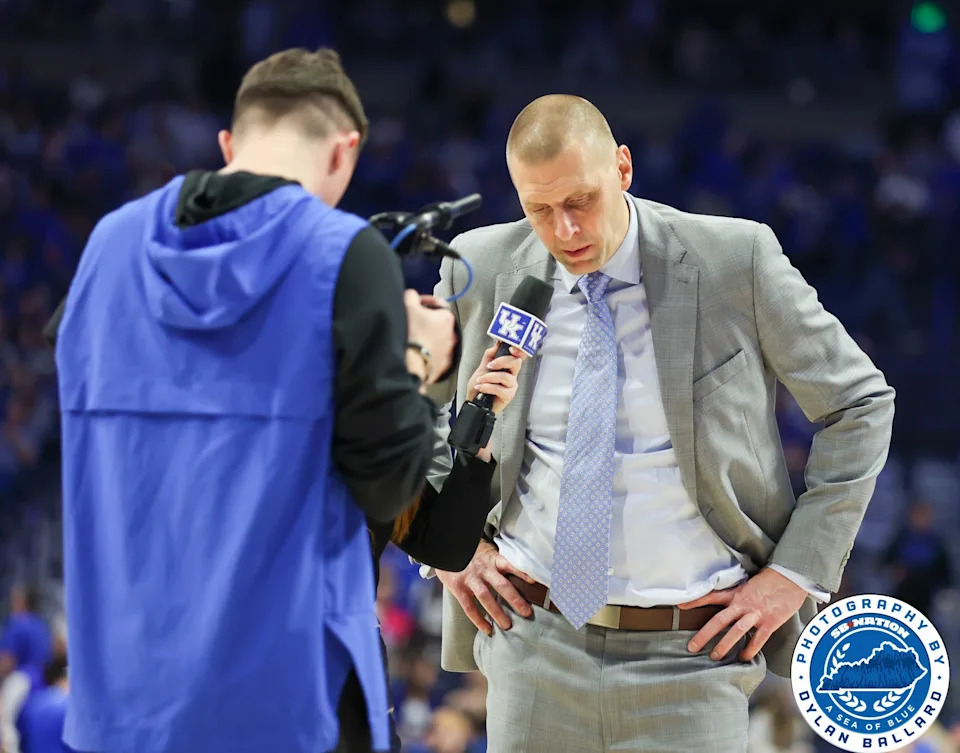
Mark Pope is living the same impossible job description every high-major college basketball coach is trapped in right now. He’s expected to build and rebuild a roster year-round, manage egos and expectations, design game plans, recruit high school stars, re-recruit his own locker room every spring, navigate NIL negotiations, and stay compliant with a rulebook that feels like it changes by the week.
And on Friday, Pope all but admitted what everyone inside the sport already knows: this model is broken.
Pope confirmed that Kentucky is deep into conversations about hiring a true general manager for its basketball program — someone whose full-time job would be contracts, NIL structures, roster math, and calendar chaos. He acknowledged he’s had “long discussions” with potential candidates and made it clear that adding a GM isn’t optional long-term.
“It’s somewhere we’ve got to get,” Pope said.
That admission matters because it shows Kentucky understands where college basketball is headed — even if it hasn’t crossed the finish line yet.
A CLEAN SPLIT: COACHES COACH, GMS HANDLE THE MONEY
Pope’s vision is simple and modern. In the new world of college basketball, the head coach should coach. A general manager should function like a front-office executive.
In that structure, conversations are clean. When an agent wants to talk money, NIL terms, or contract structure, they call the GM. When a player or family wants to talk basketball — playing time, roles, development, fit — they call the head coach.
Right now, those lines are blurred.
Across the country, programs are scrambling to create “one degree of separation” between coaches and NIL money. Collectives, third-party partners, and corporate middlemen exist largely to protect schools from pay-for-play accusations. On paper, that provides legal insulation. In practice, it often turns communication with players into a confusing mess.
“I think sometimes it can be less beneficial for the student-athlete,” Pope said. “I think sometimes it can be a little bit problematic communication-wise. Believe it or not, these student-athletes still matter.”
That’s the balance Kentucky is trying to strike. Pope knows the job has grown too big for a traditional coaching staff. But he’s also watched programs rush into GM hires that blew up locker rooms, created power struggles, or walled off players from the people they trust most.
“We’ve seen places where it’s been an epic disaster,” Pope said. “And we’ve seen places where it’s been functional. When it lands right, we’ll do it. But it’s not something we want to rush into. There’s a real do-no-harm vibe.”
WHY KENTUCKY IS DIFFERENT — AND WHY IT’S WAITING
Kentucky isn’t starting from zero. Pope is already operating with something resembling a front office thanks to athletic director Mitch Barnhart and the school’s partnership with JMI Sports. He described having an entire team working behind the scenes on contracts, timelines, and NIL possibilities, singling out JMI’s Paul Archey and Kim Shelton for grinding through late nights to get deals done.
Pope even joked that someone should write a “30-page New Yorker article” on Barnhart’s leadership in this chaotic era.
But even with that infrastructure, everyone involved is playing without a stable rulebook.
“One of the complicated things right now is there’s not a clear interpretation of what the rules are,” Pope said. “It’s dynamic every single day, and we’ll always err on the side of legality — even though nobody knows exactly what’s legal right now.”
That uncertainty is precisely why a true GM matters.
THE GM AS A SHIELD — AND A TRANSLATOR
In Pope’s ideal setup, a Kentucky basketball GM would live inside the gray area so the head coach doesn’t have to. That person would know the numbers on every roster spot, the market rate for a stretch five in the portal, and how the latest NCAA guidance actually applies in real life.
The GM would tell an agent, “Here’s what we can do financially.” Pope would tell the same player, “Here’s how we see you fitting next to Jasper Johnson and Trent Noah.”
No crossed wires. No mixed messages. No guessing which conversation matters more.
But Pope’s biggest fear is hiring the wrong person — or putting the right person in the wrong place. If a GM becomes a wall instead of a bridge, the program loses the one thing Pope keeps circling back to: connection.
The entire arms race is about winning — on the court, in the portal, and in recruiting. But if players feel filtered, managed, or disconnected from the coaching staff, you’ve just traded one problem for another.
THE FUTURE IS OBVIOUS — THE TIMING ISN’T
So for now, Kentucky waits. Pope leans on Barnhart, JMI, and an internal team he clearly trusts. He continues operating in a world where his phone still rings about money and minutes — even though he’d prefer those be two separate conversations.
“In dynamic times, landing on exactly the right spot is my job,” Pope said.
The direction is obvious. The future of college basketball belongs to programs where the head coach gets back to being a coach — and a GM takes the heat, the calls, and the chaos that comes with everything else.
Kentucky knows it. Pope knows it.
They’re just making sure they get it right — because in this era, getting it wrong can cost you everything.




