


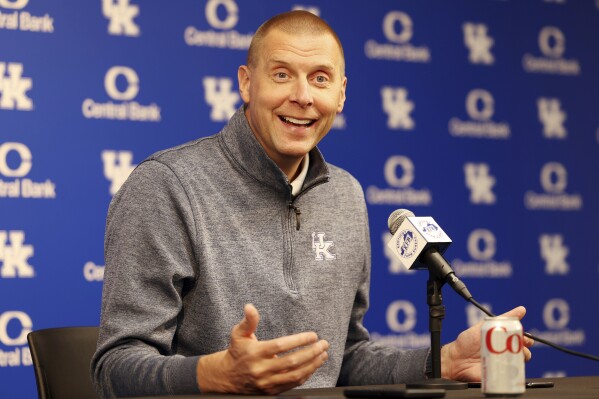
For the first time in a while, Mark Pope walked into the postgame media room Saturday night with a sense of release. Not relief exactly, and certainly not satisfaction, but something closer to validation. Kentucky’s 72–60 win over Indiana wasn’t just another result on the schedule. It was a response. To doubt. To criticism. To weeks of uneven performances that left questions lingering about identity, direction, and belief.
Inside Rupp Arena, the Wildcats looked like a team that finally understood what the moment required. After a disjointed first half that saw Indiana control the pace and confidence swing toward the visitors, Kentucky emerged from the locker room with urgency and clarity. The second half belonged almost entirely to the Wildcats, who outscored Indiana by 19 points and turned a tight rivalry game into a convincing double-digit victory.
When Pope sat down to address the media, his words reflected both pride and perspective. He spoke about effort, growth, and the importance of staying connected when things aren’t going well. He also made it clear that one win does not define a season, but how a team responds in moments like this can shape everything that follows.
The first half, Pope acknowledged, looked familiar in all the wrong ways. Kentucky played hard, but execution lagged behind intent. Offensive possessions stalled. Shots came late in the clock. Defensively, the Wildcats were a step slow in rotations and allowed Indiana to dictate stretches of the game.
Indiana led at halftime, and the building felt restless. Pope admitted the locker room conversation was direct but composed. There was no panic, no raised voices for the sake of noise. Instead, the focus turned to clarity and trust.
Pope emphasized that yelling rarely produces better basketball. What matters is helping players see the game more clearly and empowering them to act decisively. That philosophy has followed him throughout the season, even when external criticism questioned his demeanor on the sideline.
In the second half, Kentucky played with a different rhythm. Ball movement improved. Defensive pressure increased. Rebounding became a strength rather than a concern. The Wildcats didn’t just play faster; they played more connected.
One of the most notable differences came from personnel. Mouhamed Dioubate and Jaland Lowe, both returning after extended absences due to injury, provided immediate impact. Pope spoke glowingly about their preparation, noting that while they hadn’t been available on game nights, their work behind the scenes never stopped.
Dioubate’s stat line told part of the story. Fourteen points, twelve rebounds, and five steals reflected his physical presence and defensive instincts. But Pope focused more on Dioubate’s energy. His ability to ignite possessions with hustle plays changed the tone of the game.
Rebounding, Pope noted, is often the clearest indicator of a team’s intent. In the second half, Kentucky controlled the glass, turning stops into opportunities and opportunities into momentum. Dioubate was central to that shift, tracking the ball, fighting through contact, and setting a standard for effort.
Lowe’s contribution came in a different form. After missing six games, his return added composure to the backcourt. Pope highlighted Lowe’s decision-making and willingness to let the game come to him. His thirteen points were timely, but just as important were his five rebounds and ability to settle the offense during critical stretches.
Pope stressed that neither player was asked to do too much. Instead, they were placed in roles that allowed them to succeed naturally. That, he explained, is often the challenge when players return from injury. The temptation is to immediately lean on them. The smarter approach is to let the game unfold.
The second half also showcased Kentucky’s defensive growth. Pope praised his team’s communication and discipline, noting how quickly effort can compound when players trust each other. Indiana struggled to find clean looks as Kentucky tightened passing lanes and closed out with purpose.
The Wildcats forced turnovers, converted in transition, and gradually wore Indiana down. What had been a competitive contest turned into a test of endurance and execution, and Kentucky passed.
Still, Pope was careful not to overstate the significance of the win. He acknowledged lingering issues, particularly in half-court offense and shooting consistency. Growth, he reminded reporters, is rarely linear.
What mattered most to him was how the team responded when faced with adversity. The first half could have spiraled. Instead, Kentucky regrouped, adjusted, and executed.
Pope also addressed the broader narrative surrounding his coaching style. In recent weeks, commentators and analysts questioned whether his intensity was translating effectively. Pope didn’t shy away from that discussion. He reiterated his belief that coaching is about teaching, not theatrics.
Players, he said, don’t suddenly improve because of volume. They improve when they understand why something works and feel trusted to execute it. Saturday’s second half was an example of that philosophy taking hold.
Kentucky’s lack of a single dominant superstar has been another recurring talking point. Pope acknowledged the absence of a go-to bailout option but framed it as an opportunity rather than a limitation. This team, he said, must win collectively.
Against Indiana, that approach was evident. Scoring was balanced. Contributions came from multiple positions. The Wildcats didn’t rely on one hot hand. They relied on shared responsibility.
Pope emphasized that identity matters more than star power. When teams know who they are, they can weather cold shooting nights and tough matchups. Saturday, Kentucky showed signs of discovering that identity.
The environment inside Rupp Arena played a role as well. Pope credited the crowd for staying engaged, even during the first-half struggles. Energy, he noted, flows both ways. When players feel supported, confidence follows.
From Indiana’s perspective, the loss reflected missed opportunities. Pope acknowledged their physicality and preparation, giving credit to the Hoosiers for their first-half execution. But he also noted how quickly momentum can shift when effort and focus align.
For Kentucky, the win offered more than a confidence boost. It provided evidence that adjustments are taking hold. That returning players can reintegrate smoothly. That defensive intensity can become a foundation rather than a response.
Pope spoke about patience, both for himself and for his team. Building consistency takes time, especially with injuries disrupting continuity. Saturday’s performance didn’t erase previous struggles, but it did reframe them.
The season, Pope said, is about accumulation. Each practice. Each adjustment. Each response to adversity adds to the whole. Against Indiana, Kentucky added something meaningful.
As he concluded his media session, Pope returned to the theme of belief. Not blind optimism, but earned confidence rooted in preparation and effort. The Wildcats, he said, are learning how to trust their work.
Whether this win marks a turning point will be determined in the weeks ahead. Tough tests remain. Consistency will be challenged. But for one night, Kentucky showed what it can look like when pieces come together.
For Mark Pope, that mattered. Not because it silenced critics or solved every problem, but because it confirmed that the path forward is real. The process is working. The growth is happening.
Saturday night wasn’t the end of the story. But it may have been the chapter where Kentucky began to recognize itself again.




