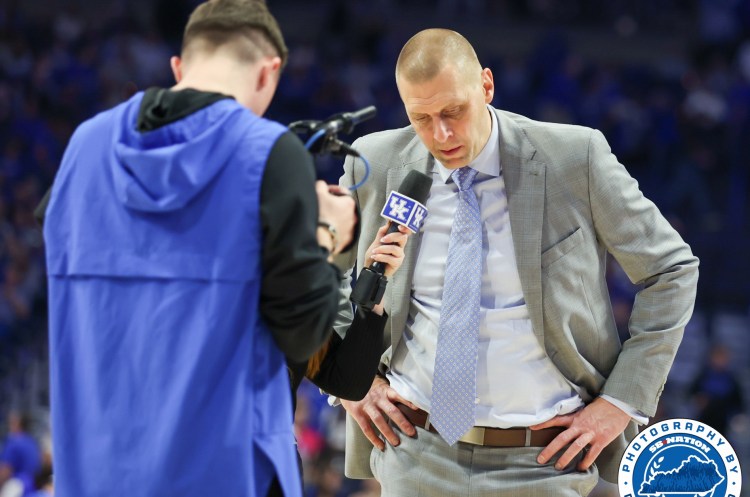
There was a moment during Mark Pope’s recent comments that quietly captured just how much college basketball has changed. It wasn’t a complaint, and it wasn’t a headline-grabbing quote. It was an admission. Pope spoke like a coach who understands that the job he signed up for no longer exists in the form it once did. In today’s game, winning isn’t just about drawing up plays or developing players. It’s about navigating contracts without contracts, rules without clarity, and responsibilities that stretch far beyond the court. And when Pope acknowledged that Kentucky basketball is actively discussing the idea of hiring a general manager, he wasn’t just talking about staffing. He was revealing the pressure points of an entire sport in transition.
At a place like Kentucky, where expectations never pause and scrutiny never fades, the idea of adding a basketball general manager feels both inevitable and overdue. Yet the fact that it hasn’t happened already tells a deeper story. One that reflects not hesitation, but caution. Not resistance, but reality.
Mark Pope is living the modern coaching paradox. He is expected to be a strategist, a motivator, a recruiter, a public spokesperson, and now, whether he likes it or not, a pseudo–front office executive. He has to build a roster in an environment where rosters can change overnight. He has to manage relationships with players who are also navigating agents, collectives, and brand opportunities. He has to keep pace with NIL rules that shift constantly, often without firm interpretation.
On Friday, Pope all but confirmed what many inside the sport already know. The traditional model is broken.
He revealed that Kentucky has already had long discussions with potential candidates to fill a true general manager role on the basketball side. Someone whose job would focus on contracts, NIL structures, compliance gray areas, timelines, and roster math. Someone who could absorb the noise that now surrounds every high-level program.
Still, Pope was careful. He did not announce a hire. He did not promise a timeline. Instead, he emphasized patience.
That hesitation is where the real story begins.
The vision Pope laid out is straightforward, almost old-fashioned in its clarity. Coaches coach. General managers manage. In this structure, conversations about money, NIL expectations, and financial frameworks are handled by a designated front office figure. Conversations about roles, development, minutes, and fit stay with the coaching staff.
Clean lines. Clear responsibilities.
Right now, those lines are blurred everywhere in college basketball, including at Kentucky.
In theory, third-party collectives and corporate partnerships are supposed to provide separation between coaches and pay-for-play accusations. In practice, they often complicate communication. Players and families hear messages from different voices. Agents operate in parallel lanes. Coaches are left trying to align expectations they don’t directly control.
Pope acknowledged that reality openly.
He admitted that while the system is designed to protect schools, it can sometimes be less beneficial for the student-athlete. Messages get delayed. Intentions get lost. Trust can erode when communication feels indirect.
That is not a minor concern at a program like Kentucky, where player relationships have always been central to success.
The solution, in Pope’s mind, is not rushing into a hire. It’s getting the right hire.
Across the country, programs have experimented with the GM model. Some have succeeded. Others have failed spectacularly. Pope referenced both outcomes, noting that when it works, it can stabilize everything. When it doesn’t, it can fracture a locker room and undermine the head coach’s authority.
That’s why he keeps returning to a simple principle: do no harm.
At Kentucky, that principle carries extra weight. This is not a program looking to experiment recklessly. It is a brand that cannot afford internal confusion. The Wildcats operate under a microscope, where every move is dissected by fans, media, and rivals.
Pope understands that adding a GM is not just about efficiency. It’s about structure. And structure, once set, is hard to undo.
Part of what makes Kentucky’s situation unique is that, unlike many schools, it already operates with something close to a front office. Through its partnership with JMI Sports and the leadership of athletic director Mitch Barnhart, Kentucky has built an ecosystem that supports NIL efforts without placing the full burden on the coaching staff.
Pope spoke appreciatively about that support system. He mentioned long nights, constant communication, and the behind-the-scenes work required to get deals finalized. He specifically praised individuals who grind through deadlines and uncertainty to keep the program moving forward.
In many ways, Kentucky is ahead of the curve.
And yet, even with those resources, Pope made it clear that the job is still overwhelming.
One of the biggest challenges, he said, is the lack of a stable rulebook. NCAA interpretations shift. Legal landscapes evolve. What feels permissible one week can feel questionable the next. Coaches are expected to operate perfectly in an environment where no one can say with certainty what “perfect” looks like.
That uncertainty is exhausting.
It’s also where a true general manager becomes more than a luxury. In Pope’s vision, a GM would live inside that gray area full-time. He would track market values. Monitor rule changes. Maintain relationships with agents. Understand exactly what each roster spot costs and what flexibility exists.
Most importantly, he would absorb the pressure so the head coach doesn’t have to.
In that structure, Pope can focus on basketball. He can spend his time in the gym, in film sessions, and in player development. He can recruit without simultaneously negotiating. He can lead without constantly switching roles.
But here’s the catch.
If that GM becomes a barrier rather than a bridge, the system collapses.
Pope’s greatest fear is losing direct connection with his players. College basketball, despite all its changes, is still about relationships. Players want clarity. They want honesty. They want to feel seen.
If a GM handles money and NIL in a way that feels transactional, while the coach handles basketball in isolation, players can feel divided between two worlds. That is when trust erodes.
That is why Pope refuses to rush.
Kentucky is not avoiding the GM model. It is studying it. Learning from others. Watching where it has gone wrong. Evaluating where it has worked.
In the meantime, Pope continues to operate in a hybrid role. His phone still rings with questions about money and minutes. His staff still balances recruiting conversations with compliance considerations. The workload remains heavy.
But the direction is clear.
The future of college basketball belongs to programs that adapt intelligently, not impulsively.
For Kentucky, that means acknowledging reality without surrendering identity. It means embracing innovation while protecting culture. It means finding a GM who understands that his role is to support the program, not redefine it.
Pope’s comments were not a complaint. They were a roadmap.
He knows the job description has changed. He knows the system is unsustainable as currently structured. And he knows that Kentucky, of all places, must get this right.
The question of why Kentucky doesn’t already have a GM is not about resistance or denial. It’s about precision.
Because in this era, the wrong hire can be more damaging than no hire at all.
When Kentucky eventually adds a basketball general manager, it will not be because the trend demanded it. It will be because the program found someone who fits its values, understands its pressures, and enhances its ability to compete.
Until then, Mark Pope will keep juggling the impossible job description that modern coaches live with. Not because he wants to, but because the sport hasn’t fully caught up to itself yet.
And that reality, more than anything, explains why the answer to this question says so much about college basketball today.