


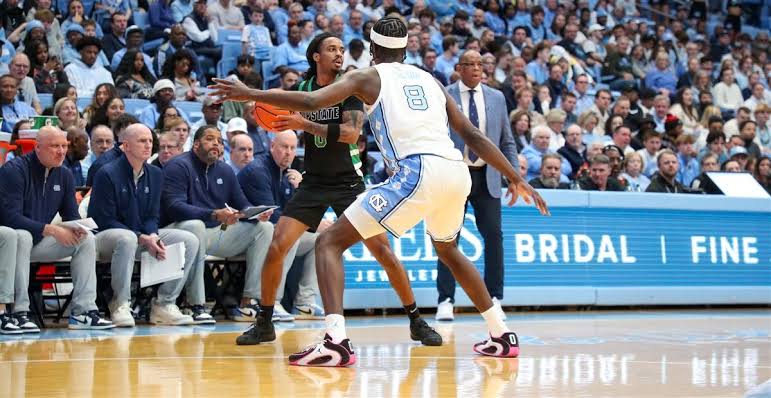
The Post-Game Confession That Explains It All: One Quiet Admission From UNC’s Top Scorer Rewrote the Entire Game We Thought We Watched
From the opening tip, there was a strange disconnect between the box score and the eye test.
North Carolina’s offense still had structure. The tempo was familiar. The scoreboard told a story of production. Yet anyone who has followed UNC closely this season could sense it immediately — something wasn’t quite right with the Tar Heels’ leading scorer. The usual explosiveness was muted. The aggressive downhill attacks came in bursts, not waves. Even when he scored, it felt measured rather than instinctive.
It was subtle. Easy to miss. But unmistakable.
And then, after the game, came the revelation that quietly changed everything.
The Comment That Reframed the Night
Speaking with reporters following the final horn, UNC’s top scorer acknowledged something he hadn’t previously shared publicly: he’s been dealing with a foot injury and was limited in practice throughout the week leading up to the game.
There was no dramatic announcement. No excuses offered. Just a calm, almost understated admission — the kind that can slip past headlines but resonates deeply with anyone who understands how elite basketball players operate.
In that moment, the puzzle pieces snapped into place.
Why the Game Looked “Off” in Real Time
Rewatch the game now with that context in mind, and the differences become glaring.
The hesitation before attacking closeouts.
The preference for pull-ups instead of full-speed drives.
The way he picked moments to explode rather than living in attack mode.
This wasn’t a lack of confidence.
It wasn’t poor decision-making.
It was adaptation.
Playing through a foot issue forces a scorer to rethink everything — how they plant, how they decelerate, how often they push off their dominant side. And yet, despite those limitations, UNC’s top option still managed to shoulder the responsibility of being the focal point of the offense.
That’s not just toughness. That’s basketball intelligence.
The Hidden Cost of Limited Practice
Being limited during the week matters more than fans often realize.
Practice reps aren’t just about conditioning — they’re about rhythm, timing, and trust. When a player misses full-speed reps, it impacts how aggressively they feel they can play once the lights come on. Every cut, every drive, every landing carries a calculation.
And still, when the game arrived, UNC’s leading scorer didn’t step aside. He didn’t fade into the background. He competed.
That context transforms how his performance should be judged.
Why This Changes the Bigger Picture
The most important takeaway isn’t about one game — it’s about what this reveals moving forward.
If this was the production level while limited, what does UNC look like when he’s fully healthy?
If defenses struggled to contain him even at less than 100 percent, how dangerous does this offense become when the burst returns?
And how much respect should be given to a performance that now clearly came under physical constraint?
Suddenly, what some may have labeled as “off night” basketball reads very differently.
Not an Excuse — A Statement
What makes this revelation resonate isn’t the injury itself. It’s how it was handled.
There was no attempt to rewrite the outcome. No effort to soften expectations. Just honesty — delivered after the work was done.
And in doing so, UNC’s top scorer didn’t just explain his night.
He reframed it.
Because now, the game isn’t remembered as one where something felt missing — it’s remembered as one where a player adjusted, endured, and still found a way to lead.
Sometimes the truth doesn’t scream.
Sometimes it shows up quietly after the buzzer — and once you hear it, you can never watch the game the same way again.




