


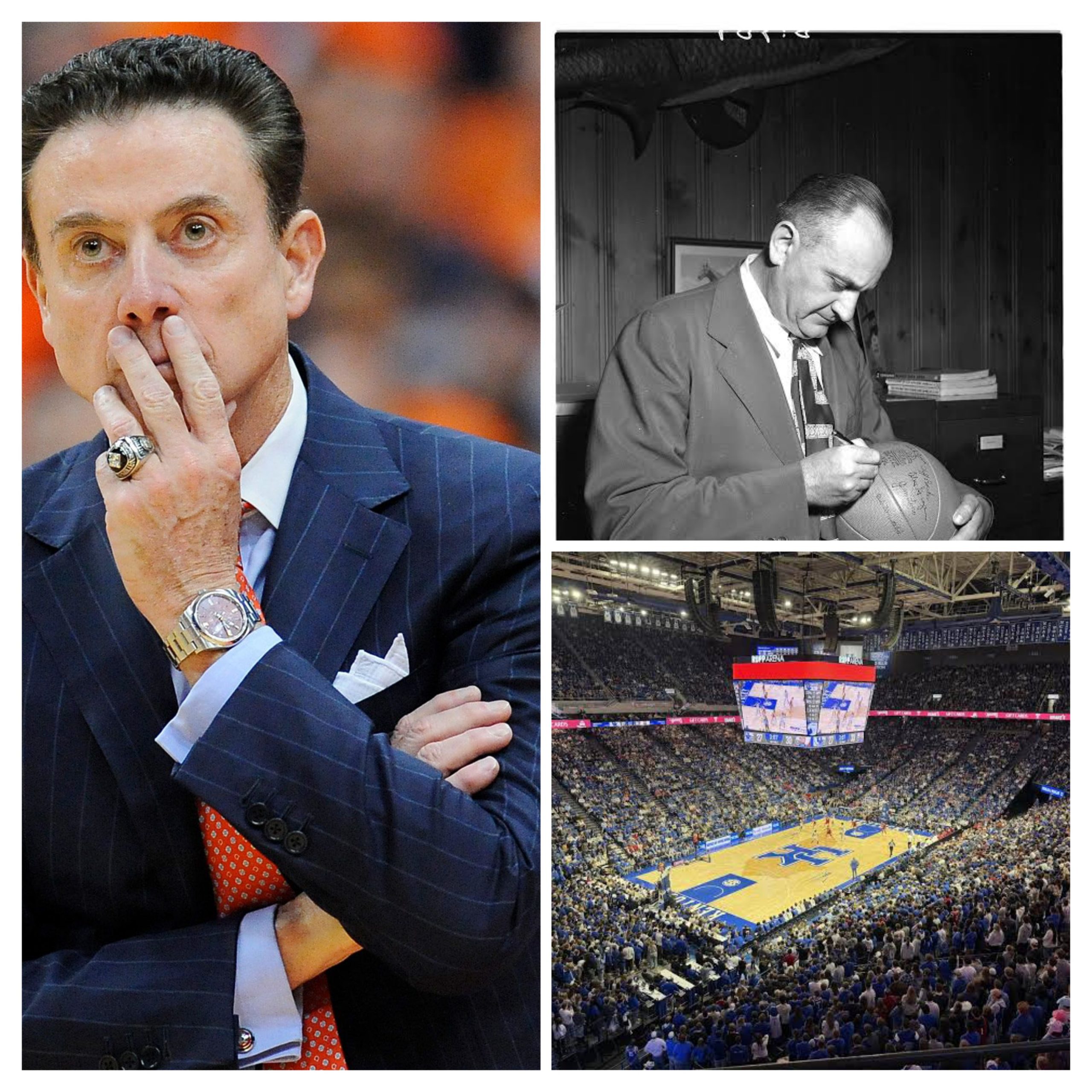
In the long, storied history of Kentucky basketball, only a handful of names rise above generations, eras, and debates. Adolph Rupp sits alone at the summit, his shadow stretching across decades of banners and expectations. But beneath him, the arguments begin. John Calipari has the longevity, the wins, and the Final Fours. Rick Pitino has the transformation, the innovation, and the fire. And for many, Pitino’s legacy at Kentucky is the most complicated of all — because the man who rebuilt the program also became one of its most polarizing enemies.
Pitino did not just coach Kentucky. He resurrected it.
When he arrived in Lexington in 1989, the program was crawling out of NCAA probation, stripped of scholarships, postseason bans, and pride. Kentucky basketball was wounded, uncertain of what it still was or could be. Pitino turned that despair into defiance. He played fast when others played slow. He pressed relentlessly. He demanded conditioning, toughness, and belief. Within two seasons, Kentucky was back in the Final Four. Within seven, the Wildcats were national champions again.
By the time Pitino left for the NBA’s Boston Celtics in 1997, his winning percentage at Kentucky stood at an astounding 81.4 percent, second only to Rupp himself. He had restored Kentucky to national relevance, raised expectations back to championship standards, and laid a foundation so strong that future coaches would inherit a powerhouse rather than rebuild one.
And then, impossibly, he became the enemy.
Pitino’s return to college basketball in 2001 would have been seismic no matter where he landed. But when he resurfaced at Louisville, Kentucky’s in-state rival, the shift felt almost personal. The man who once stalked Rupp Arena’s sidelines as a savior now stood across from it as a villain. The cheers became boos. The gratitude curdled into resentment. Every meeting between Kentucky and Rick Pitino carried layers of emotion no box score could capture.
Over time, those emotions gave birth to some of the most memorable games in modern college basketball history. Not just because of the scores, but because of what they symbolized. Legacy versus loyalty. Gratitude versus betrayal. Past versus present.
Dec. 29, 2001: Kentucky 82, Louisville 62
This was the day everything changed.
Pitino’s first return to Rupp Arena as Louisville’s head coach was never going to be ordinary. The atmosphere was venomous, charged with years of unresolved feelings. Pitino later admitted it was the toughest day of his coaching career. He tried to hide it. He failed.
The boos were relentless. The crowd did not see a legend returning home; they saw a traitor walking into enemy territory. Though Louisville hung close in the first half, trailing only 36-32 at the break, the second half was a release of emotion for Kentucky. The Wildcats surged, fed by the crowd’s energy, overwhelming the Cardinals and delivering a 20-point defeat.
The score mattered, but the message mattered more. Kentucky had drawn a line. Pitino’s past contributions would not shield him from the rivalry he helped inflame.
Jan. 2, 2010: Kentucky 71, Louisville 62
By the time John Calipari arrived in Lexington, the rivalry had evolved again. Calipari and Pitino were already deeply intertwined, having faced each other at UMass, Memphis, Louisville, and even in the NBA. But this game marked their first collision in the Commonwealth’s most sacred series.
It was chaos.
Five technical fouls. Thirty-seven combined turnovers. A game dripping with hostility and emotion. It was basketball stripped of elegance, reduced to raw will. In the middle of it all stood freshman DeMarcus Cousins, imposing his will with 18 points and 18 rebounds. Patrick Patterson and John Wall added 17 points apiece, and Kentucky improved to 15-0.
This game was not just about Kentucky beating Louisville. It was about Calipari establishing control of the rivalry. It was about Kentucky reminding Pitino that while he helped build the house, he no longer owned it.
March 31, 2012: Kentucky 69, Louisville 61
No rivalry game before or since has matched the magnitude of this one.
Kentucky and Louisville met in the Final Four. One state. One winner. One chance to play for a national championship. History demanded it, and the stage delivered.
This was the second Final Four meeting between Pitino and Calipari. Sixteen years earlier, Pitino’s Kentucky had beaten Calipari’s UMass en route to a national title. This time, the roles were reversed.
Anthony Davis dominated the night, posting 18 points, 14 rebounds, and five blocks while altering countless other shots. Louisville owned the offensive glass, outworking Kentucky for second chances, but the Wildcats were tougher when it mattered. After Louisville clawed back from a double-digit deficit to tie the game late, Kentucky made the decisive plays.
When the final horn sounded, Kentucky advanced to the national championship game for the first time since 1998. Louisville was left heartbroken. Pitino, again, was left on the wrong side of history against the program he once ruled.
Dec. 29, 2012: Louisville 80, Kentucky 77
For Pitino, this game was validation.
Calipari had dominated the early years of the rivalry, winning his first four matchups against Louisville. The Cardinals needed a breakthrough, and they found it at home in a game that meant far more than bragging rights.
Russ Smith exploded for 21 points. Chane Behanan added 20. Peyton Siva poured in 19. Louisville held off Kentucky to snap a four-game losing streak in the series and regain confidence in the rivalry. The Cardinals would go on to win the national championship that season, a title later vacated but still emotionally claimed by many in Louisville.
The night also carried a quieter, more human moment. Gorgui Dieng’s parents watched him play in person for the first time, sitting just rows behind the Louisville bench. In a rivalry defined by bitterness, it was a reminder that these games also shape lives beyond the scoreboard.
Jan. 2, 2016: Louisville 73, Kentucky 70
Though often overlooked, this game may have been one of Pitino’s most satisfying wins over Kentucky. Louisville entered Rupp Arena and stunned the Wildcats, snapping Kentucky’s momentum in a tense, late-game battle.
The unlikely hero was Quentin Snider.
In his two previous games against Kentucky, Snider had failed to score a single point. On this night, he erupted for a career-high 22 points, delivering clutch baskets and silencing the crowd. The game featured ten ties and nine lead changes, a true heavyweight fight that ended with Louisville celebrating on Kentucky’s home floor.
Less than ten months later, Pitino would be dismissed amid scandal. Unbeknownst to anyone at the time, this was his final Battle of the Bluegrass. It was fitting, in a strange way, that it ended not with dominance, but with defiance.
The Numbers and the Meaning
Across his career coaching against Kentucky, Rick Pitino faced the Wildcats 18 times and won six. Kentucky held a 12-6 edge. Against Calipari-led teams, Kentucky went 8-2. The numbers tell one story. The emotions tell another.
Pitino’s relationship with Kentucky is impossible to simplify. He is both builder and antagonist. Savior and rival. His imprint on the program remains undeniable, even as his later choices complicated how he is remembered.
Now, with Pitino guiding St. John’s and preparing to face Kentucky once again — this time against Mark Pope, a former captain on Pitino’s 1995-96 national championship team — the layers grow even deeper. Teacher versus student. Past versus present. Legacy versus evolution.
These games are never just games.
They are reckonings.
For Kentucky fans, beating Rick Pitino has always meant more than beating an opponent. It is about ownership of identity. About proving the program is bigger than any one man, even one who helped restore it.
For Pitino, every matchup against Kentucky is a reminder that greatness does not grant immunity. That history can love you and still turn against you. That no matter how far he runs, some games will always follow.
The architect became the enemy. And in college
basketball’s most emotionally charged rivalry, those games will never be forgotten.




