


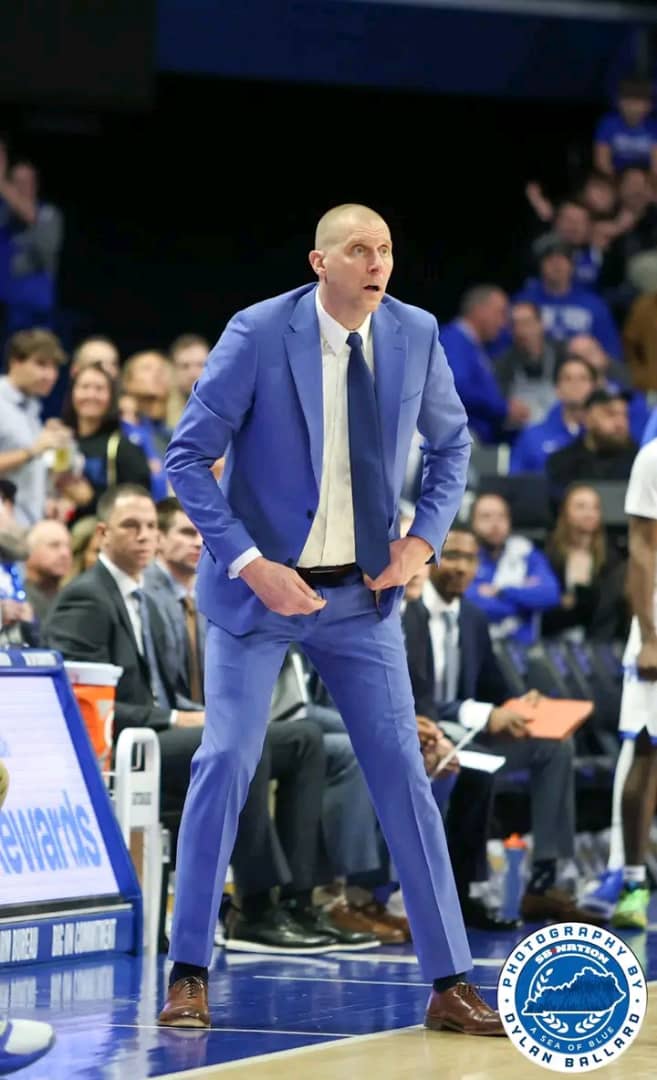
For most of the season, Mark Pope has been exactly who Kentucky basketball expected him to be. Methodical. Analytical. Process-driven. A coach who believes deeply in the idea that if you consistently make good decisions, the results will eventually follow. Even when the crowd groaned, even when the eye test screamed otherwise, Pope trusted the numbers.
Lineup data mattered. Minute distribution mattered. Efficiency margins mattered. Kentucky played deep rotations, shuffled combinations relentlessly, and leaned into a long-term vision rooted in analytics rather than emotion. It was modern basketball thinking applied to one of the most tradition-heavy programs in the sport.
And then came Indiana.
Saturday night at Rupp Arena didn’t just feel like another rivalry game. It felt like a pressure point. Kentucky entered the matchup searching for traction, sitting on a record that didn’t match its advanced metrics. The Wildcats were 7–4, yet still hovered around the KenPom top 20, a statistical contradiction that fueled endless debate. Were they better than their record? Or were the numbers lying?
By halftime, things looked bleak. Kentucky trailed by seven. The offense was stuck in mud. Indiana dictated the tone, controlled the paint, and looked far more comfortable in the moment. It felt like another night where Kentucky would point to the data afterward and promise better days ahead.
Instead, Mark Pope did something he hadn’t done all season.
He changed.
The quiet pivot that changed everything
There was no dramatic timeout speech broadcast on television. No visible argument on the sideline. No obvious declaration of philosophy. But when the second half began, something was unmistakably different.
The rotation tightened.
Gone was the 11- or 12-man shuffle. Gone were the constant lineup experiments. Pope stopped treating the game like a long-term study and started treating it like a fight he needed to win immediately.
And Kentucky responded.
Over the final 20 minutes, the Wildcats outscored Indiana 40–21. What had been a grind turned into a statement. What had looked disjointed suddenly felt connected. The game flipped not because Kentucky found a new offense, but because it found an identity.
This wasn’t a spreadsheet victory. This was a feel game.
Minutes that told a story
The clearest evidence of Pope’s shift showed up in the second-half minutes distribution.
Otega Oweh played nearly 20 minutes after the break. Mouhamed Dioubate logged over 13. Jaland Lowe, Kam Williams, and Brandon Garrison all stayed on the floor for extended stretches. The bench shortened. Roles clarified. Trust concentrated.
There was no democracy. Pope rode the players who were competing, defending, and rebounding. Not because the data said they should, but because the game demanded it.
And the results were immediate.
Kentucky held Indiana to just 21 second-half points. The Wildcats dominated the glass, finishing the game with 14 offensive rebounds. They forced 18 turnovers and turned chaos into control. Suddenly, Kentucky wasn’t just surviving possessions — it was imposing itself.
For the first time in weeks, the Wildcats looked tough.
From theory to reality
Pope’s Kentucky has always looked better on paper than on the scoreboard. Efficiency metrics loved the Wildcats. Shot quality numbers suggested progress. Defensive ratings hinted at potential. The argument was always the same: stay patient, trust the process.
That logic wasn’t wrong. But it was incomplete.
What the Indiana game exposed was the gap between optimal theory and competitive reality. Basketball is not played in spreadsheets. It’s played in moments, matchups, and momentum swings that don’t always align with pregame projections.
In the second half, Pope coached the moment.
Oweh stayed on the floor because he was disruptive, relentless, and fearless. He attacked the ball, crashed the glass, and made Indiana uncomfortable. Dioubate stayed because he turned the paint into a wrestling match, battling for rebounds and loose balls like every possession mattered. Lowe stayed because he injected downhill pressure Kentucky had been missing, forcing Indiana to react rather than dictate. Garrison stayed because he anchored the rim, finished inside, and brought physicality that shifted the tone.
These weren’t efficiency decisions. They were survival decisions.
And they worked.
The power of fewer voices
There’s a reason most elite teams shorten rotations when games tighten. Rhythm matters. Chemistry matters. Confidence builds when players know they won’t be yanked after a single mistake.
Kentucky’s deep rotation all season had created opportunity, but it had also created uncertainty. Players came in and out quickly. Roles shifted nightly. Accountability was spread thin.
Against Indiana, Pope simplified everything.
A smaller group. Clear expectations. Longer leashes.
The result wasn’t prettier basketball — it was harder basketball. Kentucky rebounded with purpose. Defended with urgency. Made Indiana feel every cut, every screen, every drive.
It looked like a team that finally knew who it was supposed to be.
What Pope didn’t say — and why it mattered
After the game, when asked about lineup decisions and why certain players didn’t see the floor, Pope didn’t offer philosophical explanations or reference long-term development.
He leaned into something simpler.
We do what we need to do to win.
That sentence mattered.
It signaled flexibility. It suggested growth. And it hinted that Pope understands the stakes are changing. Kentucky isn’t in October anymore. It’s not a laboratory. It’s a program searching for momentum, belief, and edge.
The Indiana game wasn’t just a win. It was proof that Pope is willing to adapt.
Is this the new normal?
That’s the question Kentucky fans are asking now.
Will Pope continue to tighten rotations when games demand it? Will analytics remain a guide rather than a rulebook? Or was this just a one-night adjustment born of desperation?
Pope didn’t promise permanent change. And he shouldn’t have. A coach who abandons his core philosophy entirely risks losing structure. Analytics still matter. Data still informs good decisions over time.
But Saturday provided a powerful data point of its own.
When Pope trusted his gut, Kentucky got tougher.
As the roster gets healthier and more bodies become available, the temptation to go deep again will always exist. Development matters. Long-term ceilings matter. But so does urgency.
The Indiana game showed that when the screws tighten, this team responds better with clarity than with chaos.
A season pivot hiding in plain sight
College basketball seasons don’t always turn on buzzer-beaters or viral moments. Sometimes, they pivot quietly, in decisions that don’t show up in box scores.
If Kentucky’s season turns around from here, Saturday night may be remembered as the inflection point. The night Mark Pope stopped trying to win the margins and started trying to win the game.
It was the night Kentucky stopped feeling like a project and started feeling like a team.
The Wildcats didn’t suddenly become flawless. There are still offensive questions. Still consistency issues. Still lessons to learn.
But they found something more important: a backbone.
Why this matters beyond one game
Indiana was a rivalry. It was emotional. It was loud. But the lesson extends far beyond that matchup.
Kentucky’s roster is built on versatility, athleticism, and effort. It thrives when roles are defined and energy is rewarded. It struggles when players feel interchangeable rather than indispensable.
Pope’s willingness to adapt doesn’t weaken his philosophy. It strengthens it. The best coaches evolve. They blend preparation with perception. They let data inform decisions, not override reality.
Saturday was a reminder that numbers don’t play defense. Players do.
And for one half, Mark Pope trusted the players who were ready to fight.
What comes next
The challenge now is consistency. One adjustment doesn’t redefine a season unless it becomes part of the identity. Opponents will adjust. Scouting will tighten. Expectations will rise.
But Kentucky now has proof of concept.
They know what works when the game demands toughness. They know who can be trusted when possessions matter. And perhaps most importantly, they know their coach is willing to meet the moment rather than hide behind the process.
For a program built on expectation, that matters.
Because sometimes, the most important analytics decision a coach can make is knowing
when to ignore them.
And on Saturday night, for one half, Mark Pope did exactly that — and Kentucky looked like it finally found its way.




