


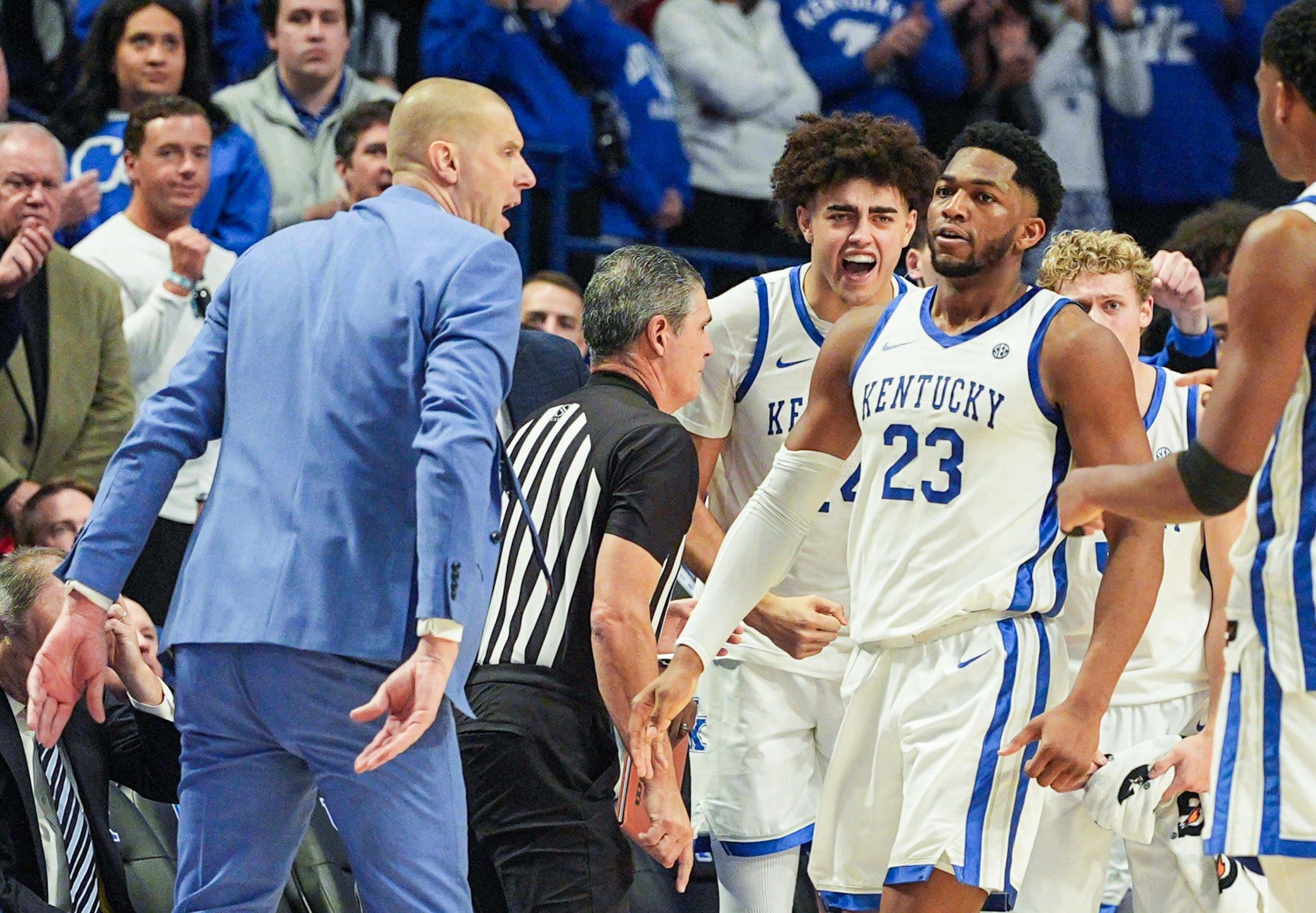
Kentucky basketball has never been a program that exists quietly. Every win is examined. Every loss is magnified. And every comment — especially from one of its own legends — carries weight far beyond a single game. That reality came crashing down on Mark Pope and his Wildcats after a humiliating blowout loss to Gonzaga, a night that left Rupp Arena restless, the fan base fractured, and the program searching for answers.
Just days later, Kentucky responded with a gritty 72–60 victory over Indiana, a win that may not have been pretty on the stat sheet but carried far more meaning than the final score suggested. At the center of that response was a blunt, uncomfortable truth delivered publicly by former Wildcat star DeMarcus Cousins — and the way Pope chose to confront it behind closed doors.
This was not just another postgame storyline. It was a defining moment in a young tenure already under scrutiny.
A Program on Edge After Gonzaga
The loss to Gonzaga was more than just another mark in the loss column. It was a collapse that cut into the identity of Kentucky basketball. The Wildcats were overwhelmed physically, mentally, and emotionally. They didn’t just lose — they looked disconnected, hesitant, and passive.
By the final buzzer, frustration inside Rupp Arena had boiled over. Fans booed as the team left the court, a rare and sobering moment for a roster still learning how to carry the weight of the Kentucky jersey. For Mark Pope, it was his first real taste of what the job can demand when expectations clash with results.
Kentucky dropped to 5–4 after the Gonzaga loss, and murmurs grew louder. Was this team soft? Was the coaching approach too experimental? Was the program drifting from its standard of toughness and accountability?
Then came DeMarcus Cousins.
DeMarcus Cousins’ Comment That Lit the Fire
Cousins, one of the most dominant big men to ever wear Kentucky blue, didn’t sugarcoat his feelings. Watching from afar, he took to X and delivered a message that cut straight to the heart of the program.
“Can’t lie… this uk team has no heart! This is hard to watch smh.”
It was just one sentence, but in Lexington, it landed like a thunderclap.
Cousins isn’t just any former player. He is a symbol of Kentucky’s edge — a competitor who played with emotion, physicality, and fire. When someone like Cousins questions a team’s heart, it resonates differently. Fans echoed it. Analysts debated it. And players, whether they wanted to or not, felt it.
Many coaches would have dismissed the comment, deflected responsibility, or shielded their players from it. Mark Pope chose a different path.
Mark Pope’s Honest Approach Behind Closed Doors
After the Indiana win, Pope revealed how the team handled Cousins’ remark — and his words offered a window into his leadership philosophy.
“I don’t shy away from the truth, even when it hurts,” Pope said. “We might as well own it, so we tried to own it as a team. Like, we talked about it, and just like, listen, this is no time to deflect comments like that from people that love this program.”
That sentence matters. Pope didn’t frame Cousins as an outsider taking shots. He framed him as family.
“DeMarcus loves this program,” Pope continued. “Like, he is proud of this place, man. He’s like, he wants these guys to represent, so you own it.”
Rather than arguing whether the criticism was fair, Pope used it as a mirror. The message inside the locker room wasn’t defensive. It wasn’t emotional. It was reflective.
Do we play like we care?
Do we compete when things get hard?
Do we represent what Kentucky basketball is supposed to be?
That internal conversation became the emotional backdrop for the Indiana game.
Indiana Game: Ugly, Gritty, Necessary
On paper, Kentucky’s win over Indiana wasn’t a masterpiece. The Wildcats shot just 37.9 percent from the field, went a dismal 3-of-15 from three-point range, and still struggled to generate offensive rhythm for long stretches.
But the difference was in the effort, especially after halftime.
Down seven at the break, Kentucky responded by outscoring Indiana 40–21 in the second half. They defended with urgency. They attacked the glass. They forced turnovers. They turned the game into a physical contest rather than a shooting exhibition.
It wasn’t pretty basketball — and Pope acknowledged that openly.
“The chances of us playing a game right now where we are just firing on all cylinders and making every shot? That’s probably not where we are in our confidence and courage and spirit right now,” Pope said.
Instead, Kentucky leaned into something far more important at this stage: fight.
“Right now, to tip the needle and bring back some belief and consolidate ourselves as a team? It’s probably going to be like gross, beautiful basketball like it was tonight,” Pope added. “I think this is probably how we had to find our way.”
Those words reveal a coach adjusting not just tactics, but expectations. Pope understands his team is not built to win with finesse alone — at least not yet.
Why This Win Meant More Than the Record
The victory improved Kentucky to 7–4 and marked their second consecutive win since the Gonzaga loss. In a vacuum, that record might not impress. At Kentucky, it certainly doesn’t satisfy championship expectations.
But context matters.
This was a team playing under pressure, questioned publicly by its own legend, and still trying to develop chemistry under a new head coach. The Indiana game was not about style points. It was about identity.
Kentucky showed it could:
• Respond to criticism instead of shrinking from it
• Win without shooting well
• Play connected basketball when confidence is fragile
• Compete for 40 minutes instead of waiting for shots to fall
Those traits don’t show up in box scores, but they define seasons.
Pope on Confidence, Courage, and Growth
One of the most revealing parts of Pope’s postgame comments was his honesty about where his team stands mentally.
Confidence, he admitted, is still shaky.
That vulnerability is rare in high-level coaching, especially at a place like Kentucky where bravado often replaces transparency. Pope didn’t pretend his team had turned a corner overnight. He didn’t sell false hope.
Instead, he framed the Indiana win as a step — not a solution.
Confidence, Pope understands, is built through shared adversity. Through winning games you aren’t supposed to win. Through surviving ugly nights and learning to trust each other.
This approach may frustrate fans looking for immediate dominance, but it reflects long-term thinking.
Analytics vs. Identity
One underlying theme of Pope’s early tenure has been his reliance on analytics, deep rotations, and process-driven decision-making. Against Indiana, he tightened his rotation and leaned into players who were defending, rebounding, and competing.
It wasn’t a rejection of analytics — it was an acknowledgment that numbers alone can’t measure heart.
The Cousins comment may have accelerated that realization. Sometimes, the data doesn’t tell you who is willing to fight when the season starts slipping.
What This Moment Says About Mark Pope
Moments like these define coaches more than wins do.
Pope could have brushed off Cousins’ comment.
He could have defended his players publicly.
He could have framed the criticism as unfair.
Instead, he owned it.
That doesn’t guarantee success. But it establishes trust — within the locker room and with the broader Kentucky community.
By acknowledging the pain, by recognizing Cousins’ love for the program, and by challenging his team to respond rather than react, Pope showed emotional intelligence that often separates good coaches from great ones.
The Road Ahead Gets Tougher
Kentucky’s schedule offers no mercy. Next up is a neutral-site matchup against No. 22 St. John’s in Atlanta, followed by a trip to Tuscaloosa to open SEC play against No. 12 Alabama.
These games will test whether the Indiana win was a one-night response or the beginning of a cultural shift.
Better teams will punish poor shooting.
Better teams will challenge Kentucky’s defensive discipline.
Better teams will expose any lingering lack of confidence.
But now, Kentucky enters those games with something it lacked weeks ago: belief.
A Program Looking in the Mirror
DeMarcus Cousins’ comment may have hurt — but it also may have helped.
It forced Kentucky to confront uncomfortable questions early in the season rather than late. It reminded players that wearing the Kentucky jersey comes with expectations beyond effort statistics and efficiency metrics.
Heart matters here.
Fight matters here.
Representation matters here.
Mark Pope didn’t hide from that reality. He embraced it.
And for a program searching for its footing, that honesty — combined with a gritty win over Indiana — might just b
e the foundation Kentucky needs to build forward.
The season is far from saved. But something more important may have been restored.
Belief.




