


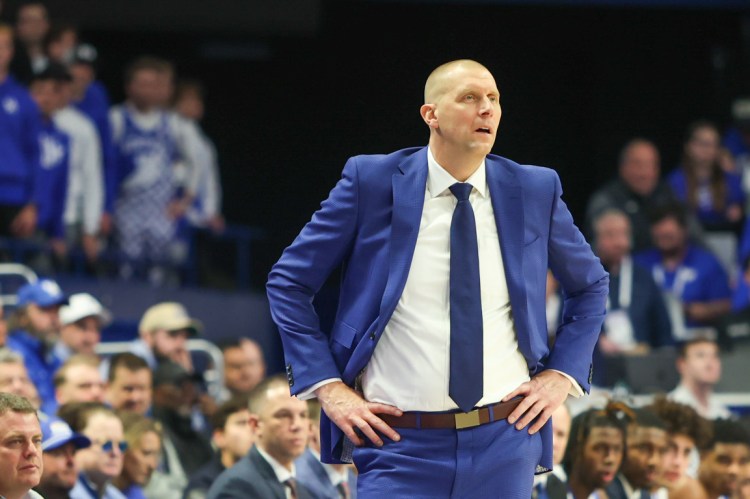
By the time Mark Pope cracked a joke about being told to lower his voice, the message behind the humor was impossible to miss. This wasn’t just about vocal strain or a temporary inconvenience. It was a glimpse into how intense, emotional, and demanding the opening stretch of Kentucky basketball’s season has been — not only for a roster still learning itself, but for a head coach pouring everything he has into accelerating that process. When a coach known for energy and constant communication is ordered to keep things at a conversational volume, it becomes a symbol of just how loudly this season has begun.
Kentucky basketball head coach Mark Pope revealed on his Monday radio show that he has been instructed not to speak above a normal conversational level for several days after straining his voice. The cause was no mystery. Between nonstop teaching in practice, animated coaching during games, and the emotional grind of navigating early-season struggles, Pope quite literally talked himself hoarse.
“It’s been a pretty emotional several weeks, and it’s been taxing on my voice,” Pope said.
On the surface, it sounds like a lighthearted anecdote. Dig a little deeper, and it tells a much bigger story about where Kentucky basketball is right now — a program in transition, guided by a first-year head coach managing expectations, pressure, and a brand-new roster while searching for traction in one of the most unforgiving environments in college sports.
The Wildcats’ early-season resume has been uneven. Through their first four major matchups, Kentucky struggled to land a signature win. Defensive lapses, offensive inconsistency, and the natural growing pains of a team still learning how to play together defined that stretch. For a fan base accustomed to dominance and immediate results, patience has been tested.
Pope, however, has not backed away from the challenge. Instead, he has leaned into it with his trademark intensity.
From the first day of practice, Pope made it clear that communication would be central to his coaching philosophy. He teaches on the fly. He corrects in real time. He demands engagement on every possession. That approach, while effective, requires constant vocal investment — especially with a roster that is still learning terminology, rotations, and expectations.
Kentucky’s current team is, in many ways, starting from scratch. New faces, new roles, and new responsibilities have created a steep learning curve. Pope has been vocal about that reality, often emphasizing that growth is not linear and that setbacks are part of the process.
But understanding that intellectually does not make living through it any easier.
Each missed rotation, each breakdown in transition defense, each possession where the offense stalls has prompted immediate feedback. Pope has been relentless, not because he lacks patience, but because he understands what it takes to win at Kentucky. Every detail matters. Every habit compounds.
That urgency has been evident on the sideline. Pope has been animated, demonstrative, and deeply involved in every sequence. He is not a coach who sits quietly and observes. He is constantly directing traffic, calling out coverages, encouraging effort, and holding players accountable.
It is no surprise, then, that his voice eventually gave out.
The timing is notable. Kentucky is coming off a much-needed win against Indiana — a victory that did more than just add a notch in the win column. It provided validation. It offered proof of concept. It showed glimpses of what this team can become when effort, execution, and confidence align.
That win did not magically erase the struggles that preceded it, but it shifted the emotional temperature around the program. For Pope, it was a reward for weeks of grinding, teaching, and pushing.
And yet, even in that moment of relief, the toll of the journey was apparent.
Pope’s admission about vocal strain humanized the process. Coaches often speak about effort, toughness, and sacrifice in abstract terms. Losing your voice because you refused to stop teaching makes those concepts tangible.
This is not a coach pacing himself. This is a coach fully immersed.
Kentucky’s defensive issues, in particular, have demanded Pope’s constant attention. Defensive communication, rotations, and physicality are non-negotiable in his system. When those elements slip, he responds immediately and loudly. Defense, after all, is built on habits, and habits are built through repetition and accountability.
Offensively, the learning curve has been just as steep. Timing, spacing, and decision-making take time to develop, especially with a roster still defining roles. Pope has emphasized ball movement, unselfishness, and trust — concepts that require continual reinforcement.
All of that teaching adds up.
In another program, early-season inconsistency might be tolerated quietly. At Kentucky, every game is scrutinized, every possession analyzed, every quote dissected. Pope stepped into one of the most demanding jobs in college basketball knowing that reality. What he may not have fully known — because no one ever truly can — is how quickly that realization becomes physical.
The pressure to win, to develop, to reassure, and to lead does not pause.
Pope’s coaching style has always been rooted in energy. As a player, he was vocal. As an assistant, he was known for engagement. As a head coach, he has not changed. The volume of his voice is an extension of his belief in urgency and presence.
Being told to dial that back, even temporarily, is an adjustment.
Still, Pope made it clear that while his voice may need rest, his message has not changed. He continues to preach toughness, accountability, and daily improvement. Those themes have been consistent from the moment he took the job.
He believes the investment now will pay dividends later.
That belief is critical, especially for a young team navigating adversity. Players feed off their coach’s conviction. Seeing Pope invest so deeply — even at the cost of his voice — reinforces the idea that this season matters, that growth is worth the discomfort.
There is also an element of leadership in vulnerability. By sharing this moment publicly, Pope subtly acknowledged the emotional toll of the job. He did not frame it as a complaint. He framed it as a consequence of caring.
In many ways, that resonates with the fan base.
Kentucky fans demand effort above all else. Wins matter, but how a team competes matters just as much. Pope’s strained voice is evidence that effort is not lacking at the top.
As the season progresses, the Wildcats will continue to evolve. Lineups will change. Roles will solidify. Confidence will grow or be challenged. Through it all, Pope’s presence will remain central.
The early weeks have been loud, chaotic, and exhausting. They have also been necessary.
Every program undergoing transition experiences turbulence. What defines success is how that turbulence is navigated. Pope has chosen to confront it head-on, voice raised, expectations clear, and standards uncompromising.
The Indiana win offered a glimpse of what that approach can produce. It does not guarantee smooth sailing ahead, but it provides a foundation.
For now, Pope may have to communicate a little more quietly. But anyone who thinks that means Kentucky’s urgency is fading misunderstands both the man and the moment.
Sometimes, the loudest message is the one delivered through sacrifice.
Mark Pope’s voice may be strained, but his commitment to Kentucky basketball has never sounded clearer.




