


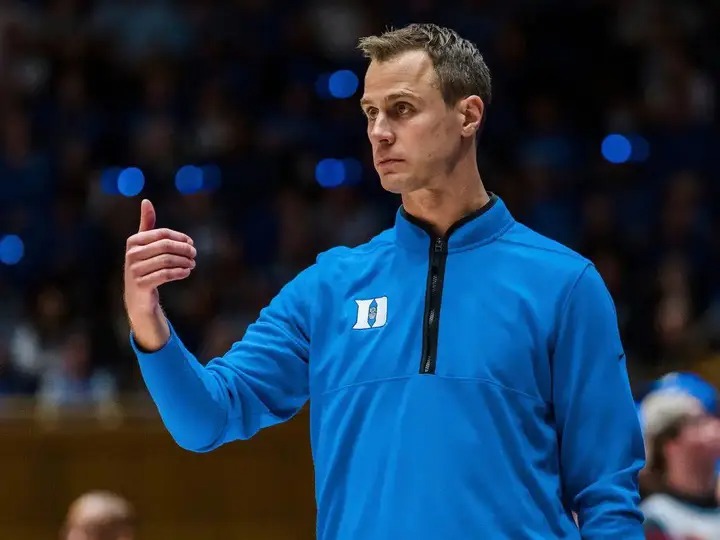
From Sloppy to Historic in One Night: Duke Blue Devils Shook Off Finals Rust, Survived a Wild Start, and Turned Chaos Into a Milestone Night for Jon Scheyer—And What Happened Early (and What Comes Next at Madison Square Garden vs Texas Tech) Has Everyone Talking
For a stretch Tuesday night, Cameron Indoor Stadium didn’t feel like a launching pad for history. It felt uneasy. Disconnected. Almost confused. After ten days away from competition because of finals week, Duke didn’t merely look rusty—it looked human in a way it hadn’t all season. Passes sailed. Decisions lagged. Turnovers piled up at a rate rarely associated with a Jon Scheyer–coached team.
And yet, by the end of the night, Duke walked off the floor with a 97–72 win, an 11–0 record, and a landmark achievement that further cemented Scheyer’s astonishing start as head coach. The contrast between the opening chaos and the closing control is precisely why this game is echoing so loudly beyond the box score.
A First Half That Felt Wrong—But Told the Truth
From the opening tip, it was clear Duke was fighting timing as much as the opponent. The Blue Devils shredded their previous season-high for turnovers, often looking a step slow mentally despite being fresh physically. Spacing was inconsistent. Defensive communication broke down. For long stretches, Duke played like a team trying to remember who it was rather than one dictating terms.
Lipscomb sensed it. They pressed just enough, moved the ball freely, and played with the confidence of a group that understood the moment. With nothing to lose, they attacked Duke’s hesitation and forced the Blue Devils to solve problems on the fly.
In a strange way, it was exactly the kind of test elite teams need—because the answers don’t come easily.
The Turning Point: When Control Replaced Panic
Somewhere between frustration and focus, Duke found itself again.
The pace slowed. The ball stopped sticking. Defensive possessions began ending with rebounds instead of breakdowns. Once Duke reestablished its identity—pressure, balance, and physicality—the game tilted fast.
At the center of the shift was Cam Boozer, who delivered a performance that felt both dominant and calming. Boozer poured in 26 points and pulled down 13 rebounds, providing stability when the game threatened to spiral. His presence inside erased mistakes, punished switches, and anchored Duke through its most important stretch.
Around him, contributions stacked up. Maliq Brown brought energy and toughness, finishing just shy of a double-double. Darren Harris added timely scoring. Pat Ngongba posted a double-double of his own, asserting himself on the glass. Slim chipped in 16 points, helping stretch the defense as Duke finally pulled away.
The chaos didn’t vanish—it was conquered.
A Milestone That Almost Slipped By
Amid the turbulence, history quietly arrived.
With the win, Jon Scheyer recorded his 100th career victory as Duke’s head coach, making him the fastest coach in NCAA history to reach that mark. It’s an achievement that speaks not only to talent but to consistency—especially within a program where every game is played under a microscope.
What made the milestone fitting was the manner in which it came. Not in a flawless blowout. Not in a pristine performance. But in a game that demanded adjustments, patience, and internal leadership. Those are the nights that define coaches long after the record books are updated.
Scheyer’s response afterward was telling: the focus stayed on growth, response, and standard—not celebration.
Why This Game Matters More Than the Score
At 11–0, Duke’s resume remains spotless. But this game mattered because it exposed stress points—and then showed how quickly they can be corrected. Championship-caliber teams aren’t judged by how they look at their best; they’re judged by how they survive when they’re not.
Duke learned something about itself Tuesday night. It learned that it can absorb mistakes without unraveling. That it can reassert control mid-game. That leadership doesn’t disappear when rhythm does.
Those lessons matter—because what comes next won’t be forgiving.
Madison Square Garden Awaits
There’s no easing back into form. Duke now heads to Madison Square Garden for a high-profile showdown against Texas Tech, a ranked opponent built on physicality, discipline, and defensive pressure.
In that setting, early sloppiness won’t be a warning—it will be a liability. Ball security, execution, and focus will be non-negotiable. But if Duke brings the version of itself that emerged after the storm—connected, assertive, and composed—the stage won’t be too big.
Tuesday night wasn’t pretty.
It wasn’t smooth.
But it was revealing.
Duke turned disorder into dominance, rust into resolve, and a messy night into a historic one. And as the spotlight shifts to New York, one thing is clear: the Blue Devils now carry more than an unbeaten record—they carry proof that even chaos bends when they decide it’s time.




