


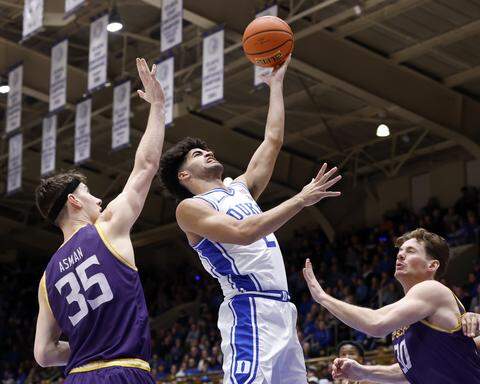
22 Turnovers and a 10-Point Deficit: It Looked Ugly, Felt Uncomfortable, and Still Ended Historic—Duke Blue Devils Survived a Shockingly Sloppy Night, Reached a Milestone for Jon Scheyer, and Revealed Something Fans Can’t Stop Debating
There are nights when the score tells the truth—and nights when it hides it. Duke’s 97–73 win over Lipscomb fell squarely into the second category. The final margin suggested control. The reality, for much of the evening, was chaos.
Twenty-two turnovers. A 10-point first-half deficit. A rhythm that never truly arrived until well after halftime. And yet, when the dust settled inside Cameron Indoor Stadium, Duke was still unbeaten, history had been made on the sideline, and a new conversation had quietly taken over Big Blue Devil circles.
This wasn’t a pretty win.
It was a revealing one.

When Rust Turned Into a Real Problem
Coming off a 10-day layoff due to finals week, Duke looked like a team trying to remember itself in real time. Passes were late. Dribbles were careless. Simple reads became adventures. For a program built on precision and pace, the opening minutes felt almost surreal.
Lipscomb didn’t just benefit from Duke’s mistakes—they forced them.
The Bisons attacked ball-handlers, crowded passing lanes, and played with a freedom that only underdogs possess. Duke coughed the ball up 16 times in the first half alone, turning what was expected to be a comfortable night into something far more uncomfortable. At one point, Lipscomb led by 10, and the murmurs inside Cameron weren’t disbelief—they were concern.
This wasn’t the kind of sloppiness that disappears on its own.
A Reminder That Talent Still Travels
And yet, talent has a way of stabilizing storms.
Slowly, Duke stopped bleeding. Defensive urgency increased. Rotations sharpened. The turnovers didn’t vanish, but the response improved. The Blue Devils didn’t panic—they adjusted.
At the heart of the turnaround was Cam Boozer, who delivered the kind of performance that anchors teams on their worst nights. Boozer finished with 26 points and 13 rebounds, imposing his will inside and providing the steady presence Duke desperately needed. When the game threatened to tilt, Boozer tilted it back.
Around him, contributions stacked up. Isaiah Evans hit timely shots and stretched the floor. Maliq Brown brought energy, toughness, and nearly a double-double. Darren Harris delivered a spark off the bench. Pat Ngongba muscled his way to a double-double, controlling the glass when Duke needed stops more than style.
The second half didn’t sparkle—but it suffocated. Duke held Lipscomb to 33.3% shooting after the break and methodically turned disorder into separation.
The Milestone That Almost Got Lost
Somewhere between turnovers and timeouts, history arrived quietly.
With the win, Jon Scheyer recorded his 100th career victory as Duke’s head coach, becoming the fastest coach in NCAA history to reach the mark. It’s an extraordinary achievement—especially at a program where every game is played under a microscope.
Fittingly, it didn’t come on a flawless night. It came on a night that demanded patience, adjustments, and trust. Scheyer spent much of the evening animated on the sideline, challenging officials, challenging his team, and challenging the moment itself.
Afterward, his message was clear: wins like this matter—not because they’re clean, but because they test standards.

What Fans Are Arguing About Now
This is where the debate begins.
Some see this game as a warning sign—a reminder that turnovers and focus lapses can become liabilities against elite competition. Others see it as proof of maturity: even when Duke plays poorly, it still finds a way to dominate the final outcome.
Both sides may be right.
Elite teams aren’t immune to ugly nights. But championship teams respond to them. Duke didn’t fold. It didn’t spiral. It tightened the screws and leaned on depth, talent, and composure.
That ability matters—especially with what’s coming next.
Eyes Already on the Bigger Stage
Duke now carries an 11–0 record into a marquee matchup against Texas Tech at Madison Square Garden. Under those lights, mistakes won’t linger quietly. They’ll be punished immediately.
The lessons from Lipscomb are fresh—and necessary. Ball security. Focus. Defensive communication. The margin for error is shrinking.
But if Tuesday night proved anything, it’s this: Duke doesn’t need perfection to win. It needs response.
And on a night defined by turnovers, discomfort, and debate, the Blue Devils showed that even when things go wrong, they still know how to finish strong—and how to turn chaos into history.




