


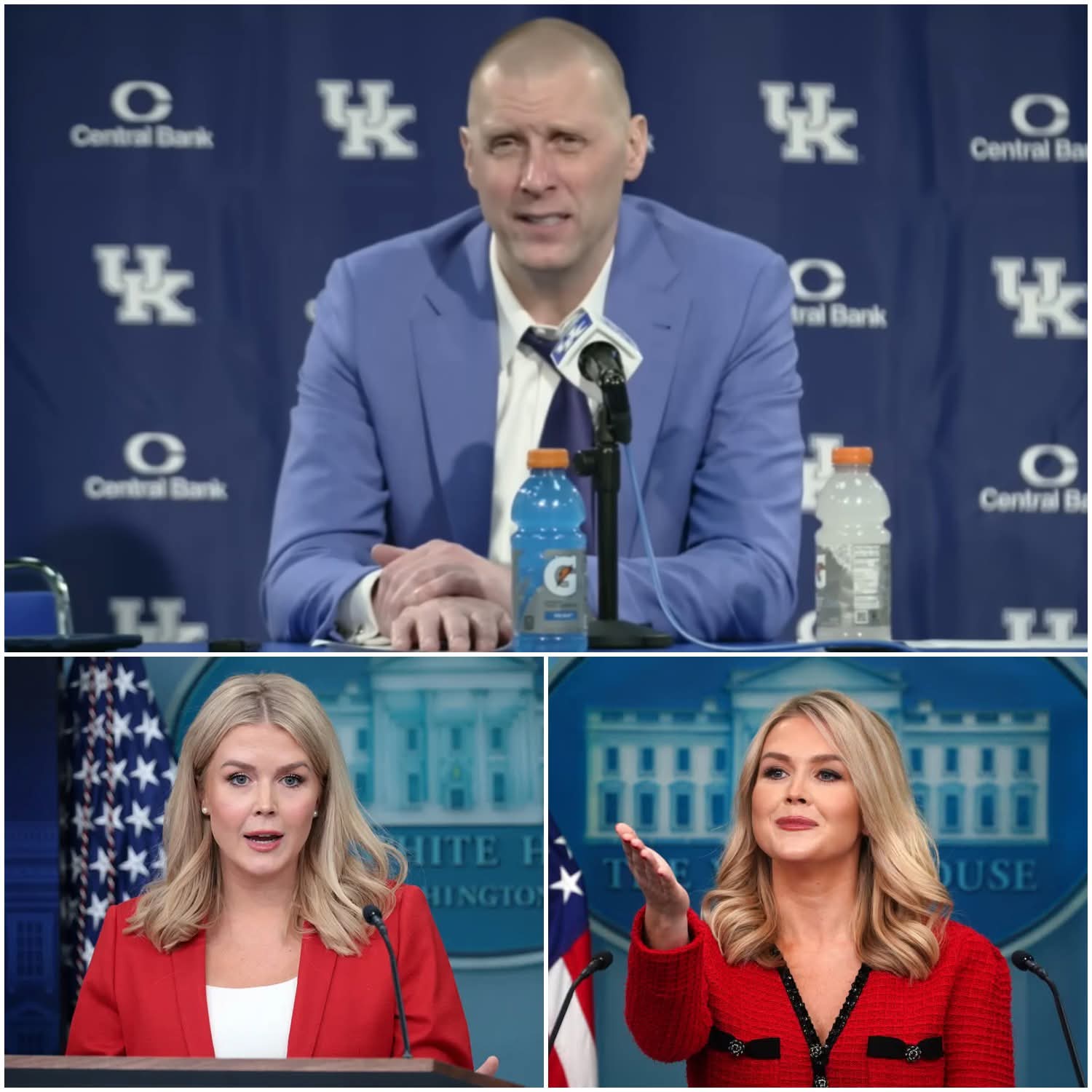
It started like so many viral moments do — with a quote that felt explosive, a headline that begged to be clicked, and a promise of live television drama that seemed almost too perfect to ignore. Within hours, timelines were filled with the same claim: Mark Pope had just delivered one of the calmest, most devastating responses ever seen on live TV after being attacked online by Karoline Leavitt. People shared it with confidence. Others reacted with awe. Very few paused to ask whether it was real.
The story checked every box for virality. A public figure accused of being “dangerous.” A demand that he be “silenced.” And then the twist — a composed, intelligent response delivered word for word on live television, leaving a stunned studio and a nation supposedly hanging on every sentence. Readers were told this moment had already become legendary. The only problem was that no one could actually find it.
That disconnect is where this story truly begins.
According to the viral narrative, Karoline Leavitt publicly attacked Mark Pope in a tweet, framing him as a threat and calling for his voice to be shut down. The story then claims Pope responded not with anger, but with precision — reading the tweet aloud on live television and dismantling it with logic and dignity. Comment sections described it as unforgettable. Posts insisted it was everywhere. Yet when curious readers went looking for the clip, the trail went cold.
No video surfaced. No broadcast transcript appeared. No major sports network or news organization referenced the moment. For something that allegedly unfolded on national television and “captured the attention of the entire nation,” the silence was impossible to ignore.
That silence is the first and most important clue.
In today’s media environment, genuinely viral live moments leave fingerprints everywhere. They are clipped within minutes, shared by verified accounts, debated by analysts, and archived across platforms. When something truly happens on air, it does not disappear. It multiplies. The absence of that multiplication tells us far more than any dramatic caption ever could.
Instead of evidence, what spread online were nearly identical write-ups filled with emotionally charged language. Phrases like “the room fell silent,” “the country hasn’t stopped talking,” and “the classiest clapback in television history” appeared again and again, often word for word. These descriptions created the illusion of consensus without providing a single verifiable fact.
That repetition is not accidental. It is a formula.
Viral misinformation often relies on a familiar structure: recognizable names, high emotional stakes, and a perfectly satisfying resolution. One person is cast as reckless or extreme. The other is portrayed as calm, principled, and victorious — not through volume, but through reason. The story flatters the reader’s sense of judgment and invites them to share it as proof of insight. By the time doubt enters the picture, the post has already done its job.
The pairing of Mark Pope and Karoline Leavitt also deserves scrutiny. Pope is firmly rooted in the world of college basketball, focused on coaching, recruiting, and rebuilding one of the sport’s most scrutinized programs. Leavitt is a political figure and media personality. While sports and politics sometimes intersect, there is no public record of a direct confrontation between these two, let alone one dramatic enough to dominate national television.
Just as telling is where the story originated. Many versions link back to obscure websites that prioritize clicks over credibility. These sites frequently lack clear authorship, sourcing, or editorial accountability. In some cases, similar articles can be found using the same language but swapping in different public figures — a clear sign of recycled content designed to trigger engagement rather than inform.
Social media does the rest of the work.
Once a story like this enters a Facebook group, WhatsApp chain, or trending feed, it gains momentum simply by being repeated. Each share adds a layer of perceived truth. Comments reinforce belief. Skepticism feels unnecessary when “everyone else” seems convinced. This is how rumors evolve into accepted narratives — not through evidence, but through volume.
There is also a deeper psychological appeal at play. Stories like this reward readers emotionally. Fans of Mark Pope see him elevated as thoughtful and unshakable. Critics of political rhetoric see a symbolic victory for reason over outrage. The story doesn’t just inform — it reassures. And reassurance is powerful enough to override doubt.
Yet one absence remains impossible to explain away. Mark Pope himself has never acknowledged such an incident. There has been no confirmation, no clarification, no reference from Kentucky basketball or from any broadcast partner. For a moment allegedly described as unforgettable, that silence speaks louder than any viral caption.
This does not mean readers were foolish for believing the story. It means the story was designed to be believed. In a digital ecosystem that rewards speed and emotion, verification often becomes an afterthought. Sensational claims travel faster than corrections, and by the time questions are asked, the narrative has already settled.
The Mark Pope story is not unique. It is part of a growing genre of internet myths — stories that feel real because they are emotionally precise, not because they are factually true. They blur the line between reporting and storytelling, between documentation and performance.
The takeaway is not cynicism. It is awareness.
Before sharing a story that feels perfectly crafted, it is worth pausing. Who reported this first? Where is the original source? Is there footage, audio, or independent confirmation? If the answer is no, the story may be serving emotion rather than truth.
In the end, the viral moment never happened — but the reaction to it did. And that reaction reveals far more about the modern media landscape than any fictional live television exchange ever could.
Sometimes the most important stories are not the ones that went viral, but the ones that teach us why they did.




