


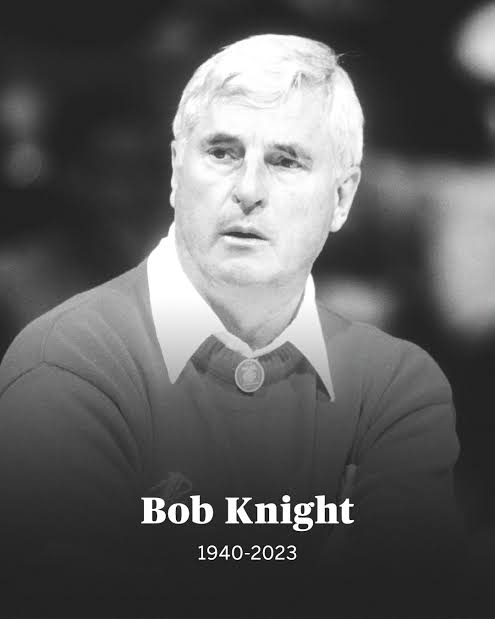
For Kentucky fans, the name Bob Knight usually brings an immediate and complicated reaction. Respect, resentment, admiration, frustration — sometimes all at once. Knight was the face of Indiana basketball, the sharp-edged counterweight to Kentucky’s own proud tradition, and a central figure in one of college basketball’s most intense rivalries. To many in Big Blue Nation, he was easier to dislike than to understand.
But every so often, history offers a moment that forces even the most hardened opinions to soften. One of those moments came not on the sideline, not in the heat of a rivalry game, but at a roast honoring Kentucky’s own Joe B. Hall. In that setting, Bob Knight revealed a side of himself that Kentucky fans rarely saw — thoughtful, humorous, self-aware, and deeply respectful of a coach he considered a friend.
To appreciate why that moment still resonates, it helps to understand the context of the era. The late 1970s were a golden age of college basketball, defined by towering personalities and future legends still writing their origin stories. The 1978 NCAA Tournament had just concluded with Kentucky defeating Duke in the national championship game, a victory that further cemented Joe B. Hall’s place in Wildcats history. College basketball was on the cusp of a transformation, with Magic Johnson finishing his freshman season at Michigan State and Larry Bird still starring at Indiana State, both not yet fully aware of how profoundly they would shape the sport.
Bob Knight, meanwhile, was only 37 years old. He had already won a national championship at Indiana in 1976 and was widely regarded as one of the sharpest minds in basketball. He was intense, demanding, and uncompromising, but at this point in his career, he had not yet become the caricature many fans would later fixate on. The bitterness, the public feuds, and the emotional explosions that would come to define his later years had not yet fully taken hold.
What existed instead was potential — and complexity.
Knight and Joe B. Hall shared more than a rivalry by proxy. They shared a genuine friendship, one built on mutual respect and time spent away from the court. They were fishing buddies, men who could set aside conference lines and competitive pressures to talk basketball, life, and the craft of coaching. That relationship formed the foundation for what made Knight’s appearance at Hall’s roast so memorable.
Roasts are revealing by nature. Stripped of playbooks and press conferences, coaches and players are forced into something resembling honesty. The best roasts are affectionate without being soft, sharp without being cruel. Bob Knight, known publicly for his cutting edge, showed that night he understood that balance better than most.
Instead of bitterness, Knight delivered wit. Instead of hostility, he offered warmth. His remarks were intelligent, layered, and genuinely funny — the kind of humor that comes from deep understanding rather than easy mockery. For Kentucky fans accustomed to seeing Knight as a rigid antagonist, it was jarring in the best possible way.
What stood out most was not just that Knight was funny, but that he was generous. He praised Joe B. Hall’s intelligence, his steadiness, and his role in guiding Kentucky through one of the most difficult transitions in program history. Hall had followed Adolph Rupp, an impossible act by any standard, and Knight understood exactly how heavy that burden was. Coaches recognize pressures that fans often overlook, and in that moment, Knight spoke as a peer, not a rival.
For Big Blue Nation, Joe B. Hall represents more than wins and losses. He represents stability during uncertainty, humility in the shadow of greatness, and integrity during an era when the sport was rapidly changing. Hearing Bob Knight — Indiana’s general, no less — articulate respect for Hall was both validating and disarming.
It also offered a glimpse of what Bob Knight himself could have been remembered as, had his career followed a different emotional arc. His brilliance was never in question. Knight was exceptionally well-read, deeply analytical, and capable of explaining basketball concepts with a clarity few coaches could match. In moments like the Hall roast, those traits were front and center.
There was no need for intimidation. No theatrics. Just confidence, intelligence, and humor.
That contrast is what makes the moment linger. For many fans, Bob Knight’s legacy is inseparable from his outbursts — the chair thrown across the court, the confrontations with players and officials, the alienation of people who cared about him. Those moments are real and cannot be erased. But they are not the whole story.
At the roast, Kentucky fans saw the other Bob Knight — the one who could laugh at himself, who understood the absurdity of the sport’s pressures, and who valued relationships as much as results. It was a reminder that rivalry does not require dehumanization, and that even the most polarizing figures contain multitudes.
There is also something uniquely Kentucky about the way that moment is remembered. Big Blue Nation has always valued basketball history, storytelling, and legacy. It is a fan base that understands continuity, that reveres its former coaches, and that appreciates moments where respect transcends competition. Seeing Joe B. Hall honored not just by Kentucky people, but by one of the sport’s fiercest competitors, reinforced the sense that Hall’s influence extended far beyond Lexington.
The timing of the roast adds another layer of poignancy. College basketball was still largely regional, still driven by personalities rather than television contracts and branding. Coaches were public intellectuals of the sport, shaping not just teams but philosophies. In that environment, conversations between figures like Knight and Hall carried weight.
For younger fans encountering this moment now through old footage or retellings, it can feel almost surreal. The game has changed. The culture has changed. Coaches today operate under constant scrutiny, with fewer opportunities to show vulnerability or humor in unscripted settings. That makes Knight’s performance at the roast feel even more valuable as a historical snapshot.
It is tempting to wonder how different Bob Knight’s legacy might be if moments like this had become the rule rather than the exception. If he had mastered his emotions as fully as he mastered strategy, the debate over the greatest coach in basketball history might look very different today. The tools were all there — intelligence, preparation, conviction, and yes, humanity.
Joe B. Hall, for his part, remains a symbol of grace under pressure. That Knight chose to honor him not with flattery, but with thoughtful humor, speaks volumes about the esteem in which Hall was held by his peers. Rivalries fade. Respect endures.
For Kentucky fans, revisiting this moment is not about rehabilitating Bob Knight’s image. It is about appreciating a rare intersection of rivalry and respect, and about recognizing the depth of Joe B. Hall’s impact on the sport. It is about understanding that history is rarely simple, and that even its most difficult figures can surprise us.
In the end, the roast stands as a reminder that college basketball, at its best, is about more than banners and box scores. It is about people — complicated, flawed, brilliant people — sharing a stage and, for one night, choosing laughter over anger.
For one brief moment, Bob Knight let his guard down. And Kentucky fans were better for seeing it.




