


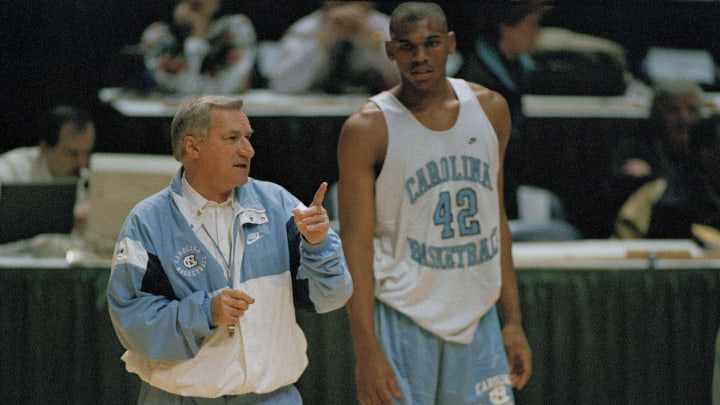
Jerry Stackhouse’s time at the University of North Carolina may have lasted only two seasons, but his impact in Chapel Hill was loud, immediate, and lasting.
Arriving as a McDonald’s All-American from Kinston, North Carolina, Stackhouse walked into the Dean Smith program carrying both hometown expectations and national buzz. What followed was a rapid ascent that reminded the college basketball world what elite Tar Heel wings looked like.
Stackhouse joined UNC in the fall of 1993, stepping into a program still navigating life after its 1993 national championship. The roster was talented but searching for a new offensive focal point, and Stackhouse’s physicality, confidence, and scoring instincts filled that void almost instantly. From his first games in Carolina blue, it was clear he was built differently—strong, aggressive, and fearless attacking the rim.
As a freshman, Stackhouse wasted little time becoming a major contributor. He averaged double figures in scoring, showed an advanced midrange game, and quickly earned Dean Smith’s trust on both ends of the floor. For a coach known for patience and structure, Smith allowed Stackhouse a level of freedom that spoke volumes about his talent and maturity.
The 1993–94 season culminated in a deep NCAA Tournament run, with Stackhouse playing a pivotal role as UNC advanced to the Final Four. On the biggest stage, against the toughest competition, he looked comfortable and composed, delivering timely baskets and physical defense. Though the Tar Heels fell short of a title, Stackhouse emerged from the tournament as a nationally recognized star.
It was during his sophomore season that Stackhouse truly took over. With increased responsibility, he became one of the most dominant scorers in college basketball, averaging over 19 points per game. His combination of strength and speed made him nearly impossible to guard one-on-one, and defenders often had to choose between fouling him or conceding points.
Stackhouse’s game was not just about scoring totals. He rebounded aggressively for a wing, defended multiple positions, and brought an edge that energized both teammates and fans. In an era when ACC basketball was brutally physical, Stackhouse thrived, embracing contact and setting a tone that UNC fed off nightly.
One of the defining aspects of Stackhouse’s UNC tenure was his competitive fire. He played with visible emotion, never shying away from big moments or marquee matchups. Whether it was a hostile road game in the ACC or a neutral-site showdown in March, Stackhouse carried himself like the best player on the floor.
Under Dean Smith’s guidance, Stackhouse also refined his basketball IQ. He learned spacing, defensive rotations, and the value of team-oriented offense, tools that would later serve him well in the NBA. Smith’s system demanded discipline, and Stackhouse’s ability to balance structure with star power made him stand out even more.
By the end of the 1994–95 season, the NBA was calling loudly. Stackhouse finished his UNC career with averages that placed him among the most productive wings in program history despite his short stay. His decision to enter the NBA Draft felt inevitable, and Tar Heel fans understood they were witnessing a brief but brilliant chapter.
Stackhouse left UNC as a top-three overall pick, selected by the Philadelphia 76ers, validating both his talent and the program’s continued ability to produce elite pros. His transition to the NBA further highlighted how well UNC had prepared him for the next level, particularly in terms of physical readiness and mental toughness.
In retrospect, Stackhouse’s time in Chapel Hill represented a bridge between eras. He helped sustain UNC’s national relevance in the post-Jordan years while paving the way for future stars who would follow a similar one-and-done or two-and-done path. His success reassured recruits that UNC remained a launching pad for greatness.
Beyond the numbers and accolades, Stackhouse’s legacy at UNC is rooted in presence. He brought swagger back to the wing position, reminding fans of the program’s tradition of elite scorers who also defended and competed relentlessly. His game was rugged, honest, and unapologetic.
Today, when conversations turn to impactful short-term Tar Heels, Jerry Stackhouse’s name remains near the top. Two seasons were all he needed to leave his mark, to excite the Smith Center, and to carry Carolina blue into the NBA spotlight once again.
Jerry Stackhouse didn’t just pass through Chapel Hill—he announced himself there. And in doing so, he added another powerful chapter to the enduring story of UNC basketball




