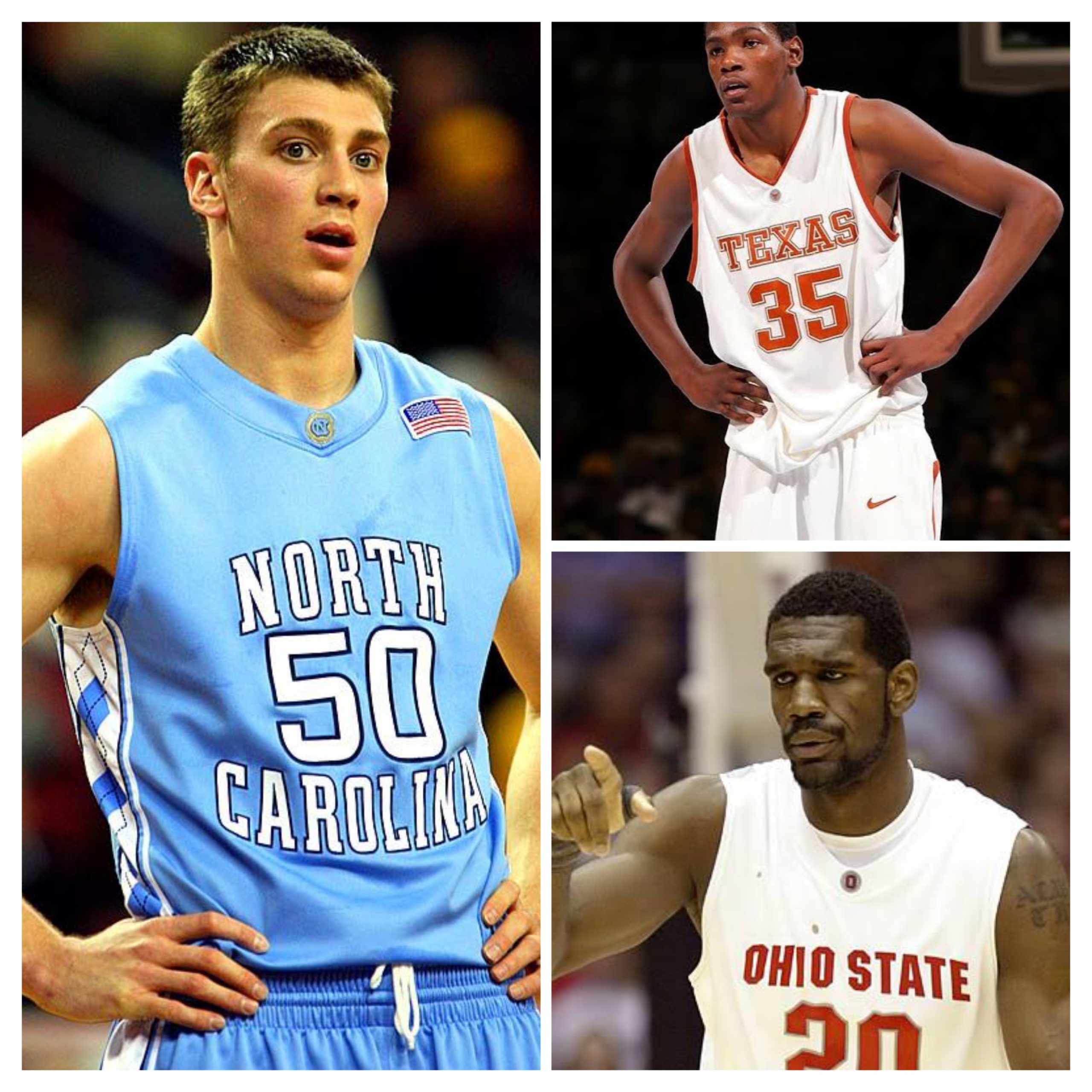
There was a time when it felt obvious how this story would end. Kevin Durant was too skilled, too fluid, too modern to be anything but the defining college player of his generation. Greg Oden was too big, too dominant, too inevitable to be denied. Tyler Hansbrough, meanwhile, didn’t look like the future at all. He looked like effort. Like sweat. Like elbows and bruises and relentlessness. And yet, years later, when college basketball history is discussed honestly and without the glare of NBA expectations, it is Hansbrough’s name that quietly rises above the others. Not because he was more talented, but because he was more complete in the only context that truly matters here: college basketball itself.
To understand why Hansbrough ultimately ended up above Durant and Oden in college basketball history, you first have to understand what college basketball rewards. It is not a professional league. It does not value upside more than impact. It does not crown champions based on projection. College basketball is about surviving seasons, enduring pressure, adapting year after year, and delivering when the games matter most. In that ecosystem, Hansbrough didn’t just survive. He thrived.
Kevin Durant’s lone season at Texas in 2006–07 was one of the most breathtaking individual campaigns the sport has ever seen. He averaged around 25 points and 11 rebounds, won National Player of the Year, and redefined what a freshman forward could look like. Night after night, he was unguardable. From a pure skill standpoint, no honest observer would argue that Hansbrough was better than Durant. Durant was smoother, longer, more versatile, and clearly destined for greatness beyond college.
But college basketball history is not built on one season alone, no matter how brilliant. Durant’s story at the college level is powerful, but it is also brief. One year. One tournament appearance. A second-round exit. His influence was seismic, but fleeting. He passed through the college game like a comet, leaving awe behind but no long-term footprint in March.
Hansbrough’s path could not have been more different. From 2005 to 2009, he was a constant. Four seasons. Four deep runs. Four years of being the focal point of opposing scouting reports and still producing anyway. While Durant was redefining possibility, Hansbrough was redefining reliability. In college basketball, that distinction matters more than people often admit.
Greg Oden presents a different comparison. At his peak, Oden was physically overwhelming. As a freshman at Ohio State in 2006–07, he anchored a team that reached the national championship game. His performance in that title game against Florida, despite playing with an injured wrist, remains one of the most impressive individual efforts in championship history. In that moment, Oden looked like the best big man in the country, perhaps even the best player.
But again, college basketball is unforgiving to availability. Oden’s body betrayed him early and often. Injuries limited his minutes, his development, and ultimately his legacy at the college level. The flashes were undeniable, but the sample size was small. He never had the chance to grow, adjust, and dominate across multiple seasons the way Hansbrough did.
Hansbrough’s advantage was not just health, though that mattered. It was his ability to impose the same physical, emotional, and competitive pressure year after year, even as opponents tailored entire game plans to stop him. Everyone knew what Hansbrough was going to do. He was still nearly impossible to move off his spots. He still drew fouls at an absurd rate. He still rebounded through contact. And perhaps most importantly, he still set the emotional tone for his team.
College basketball is deeply emotional. Momentum swings matter. Confidence spreads. Fear spreads too. Hansbrough had a rare ability to bend the emotional arc of a game. A hard offensive rebound. A scream after an and-one. A sprint back on defense. These moments don’t show up fully in analytics, but they define seasons. Durant inspired awe. Oden inspired caution. Hansbrough inspired belief.
Roy Williams’ system amplified Hansbrough’s strengths, but it also demanded more from him than from most stars. Williams played fast. He asked his bigs to run the floor, to defend in space, to rebound relentlessly, and to carry offensive responsibility without slowing the game down. Hansbrough didn’t just fit that system; he powered it. He was the engine that allowed North Carolina to play with pace and physicality simultaneously.
This is where the longevity argument becomes decisive. Over four seasons, Hansbrough accumulated records that still stand. He became UNC’s all-time leading scorer, a staggering achievement given the program’s history. He won National Player of the Year in 2008. He returned for his senior season when he could have left, and in doing so, he led one of the most dominant championship teams of the modern era in 2009.
That 2009 team is central to his legacy. It wasn’t just that North Carolina won the national championship. It was how they won it. They overwhelmed opponents. They controlled games from the opening tip. And Hansbrough, despite sharing the floor with NBA-level talent, remained the heartbeat. His leadership was not ceremonial. It was functional. Teammates fed off him. Younger players learned from him. Veterans leaned on him.
Durant never had that opportunity in college. Oden never reached that stage of continuity. Hansbrough did, and he maximized it.
There is also something important to be said about pressure. By his junior and senior seasons, Hansbrough was no longer a surprise. He was the hunted. Every arena he entered knew who he was. Every defender was told to make his life miserable. And still, his production barely dipped. That kind of sustained excellence under constant scrutiny is rare.
Durant, for all his brilliance, never faced that long-term burden in college. Oden never had to carry it for multiple years. Hansbrough carried it for four.
Critics often point to efficiency or aesthetics when diminishing Hansbrough’s standing. He wasn’t flashy. He didn’t stretch the floor. He didn’t create off the dribble like a guard. But those critiques miss the point entirely. College basketball history is not a beauty contest. It is a record of who shaped the sport during their time in it.
Hansbrough shaped his era through force of will. Through availability. Through leadership. Through winning.
It’s also important to recognize how Hansbrough evolved. Early in his career, he was primarily a scorer and rebounder. As the years passed, his understanding of the game deepened. He passed better. He defended smarter. He picked his moments. That growth is a hallmark of great college players and a luxury one-and-done stars rarely experience in that environment.
The NCAA tournament looms over all these discussions, and rightly so. It is the crucible in which college legacies are forged. Durant’s tournament story ended too early to fully resonate. Oden’s ended one step short. Hansbrough’s ended with confetti falling, not once, but with sustained relevance across multiple tournaments.
Even in defeat, Hansbrough’s teams were present deep into March. That consistency matters. It’s the difference between a brilliant chapter and a complete book.
None of this diminishes Durant’s greatness or Oden’s potential. They were extraordinary talents, and their NBA careers reflect that. But college basketball history operates on a different axis. It values who stayed, who endured, who led, and who won.
Hansbrough didn’t just play college basketball. He embodied it.
He represented an era when staying mattered, when growth was visible, when leadership was earned over time. His legacy is inseparable from North Carolina’s success during those years, and that inseparability is precisely why he stands above others in the historical conversation.
When future generations look back, they will marvel at Durant’s skill and wonder what Oden might have been. But when they study the arc of college basketball itself, they will find Hansbrough everywhere. In records. In banners. In the emotional memory of games that felt decided by will as much as talent.
That is why, ultimately, Tyler Hansbrough ended up above Kevin Durant and Greg Oden in college basketball history. Not because he was the most gifted, but because he was the most complete embodiment of what the college game rewards.