


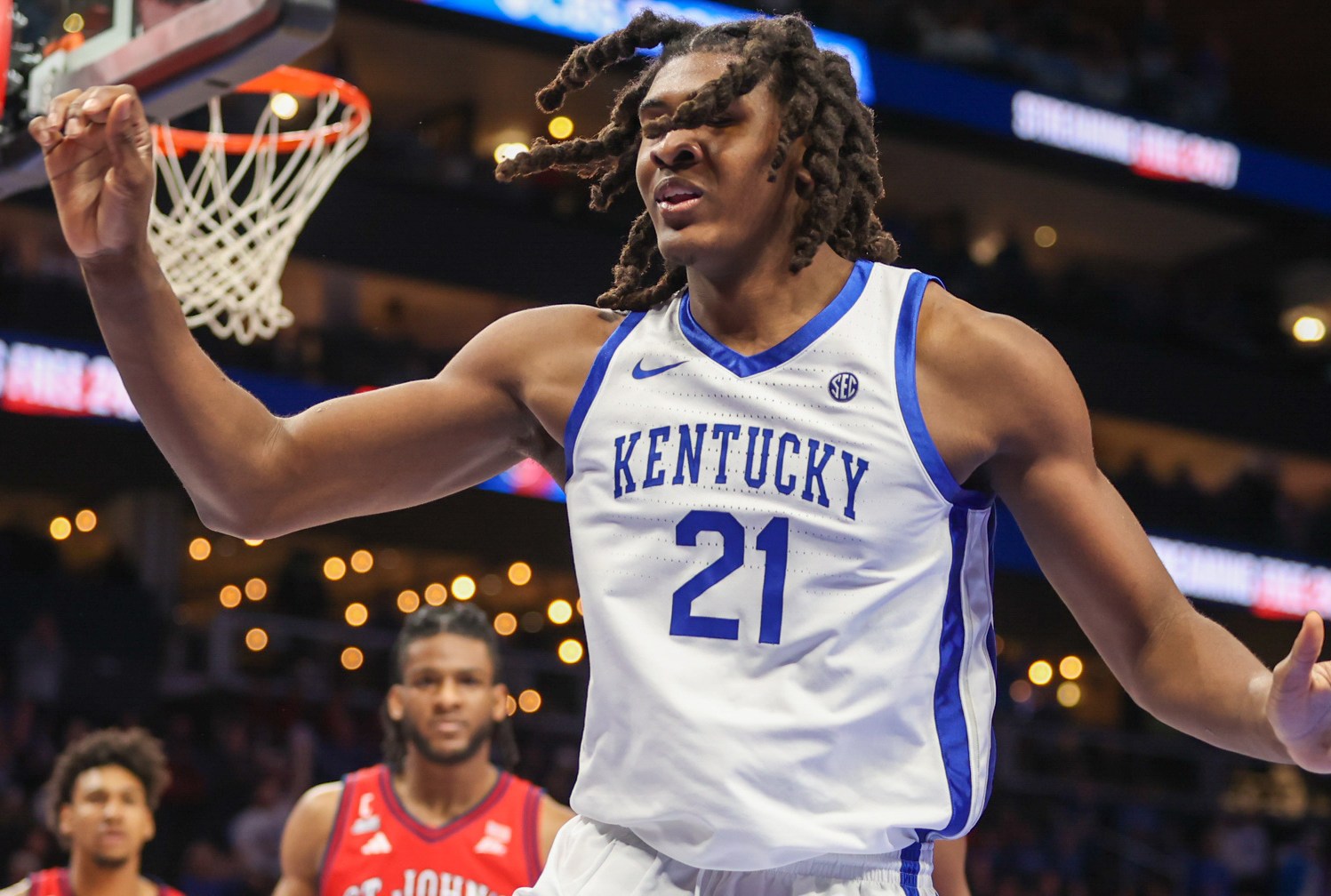
For the first time all season, Kentucky basketball looked like it could finally exhale. Not because everything was perfect, not because the Wildcats suddenly resembled a finished product, but because something they had been missing since opening night was finally back on the floor: possibility. When Jayden Quaintance checked into the game against St. John’s, the atmosphere around this team subtly but unmistakably shifted. Kentucky still struggled. They still bent. They still showed flaws that cannot be ignored. But for the first time in months, they also looked like a team that might still grow into something meaningful.
That fragile hope is exactly what makes this version of Kentucky so fascinating and so uneasy at the same time.
The Wildcats’ 78–66 win over St. John’s was not a statement victory in the traditional sense. Kentucky did not dominate wire to wire. They did not shoot the ball well. They did not overwhelm their opponent with depth or cohesion. Instead, the game felt like a test of emotional and physical survival, a reminder that this roster, despite its talent, is walking a narrow path between progress and regression. And right at the center of that tension stood Quaintance, whose long-awaited debut symbolized both the promise of what Kentucky could become and the reality of how quickly it could all unravel.
Quaintance’s return had been circled on calendars long before the season even began. The Arizona State transfer arrived in Lexington with expectations attached not just to his skill set, but to what he represented structurally. Kentucky did not just need another talented big man; it needed balance, rim protection, rebounding presence, and an interior threat that could stabilize everything else around it. For 11 games, that piece was missing as Quaintance continued his recovery from the torn ACL he suffered in February. Kentucky tried to compensate in different ways, sometimes successfully, often not. When he finally stepped onto the court against St. John’s, it felt less like a substitution and more like the restoration of something fundamental.
In just 17 minutes off the bench, Quaintance delivered a stat line that barely scratches the surface of his impact. Ten points, eight rebounds, and two blocks do not fully capture how his presence altered the geometry of the game. Suddenly, Kentucky had a player who could protect the rim without fouling recklessly. Suddenly, drivers hesitated. Suddenly, rebounds that had previously bounced into chaos were being secured and turned into controlled possessions. Quaintance did not dominate, but he stabilized, and for this Kentucky team, stabilization is invaluable.
There were moments when his instincts were evident even as his conditioning and timing lagged behind. He rotated early to contest shots, communicated defensively, and carved out space on the glass in ways Kentucky had struggled to do all season. At the same time, his limitations were equally clear. Quaintance is still working his way back physically, and the staff was careful not to overextend him. He is unlikely to play heavy minutes anytime soon, and every jump, every awkward landing, still carries an unspoken sense of caution. His return brings hope, but it also adds another delicate variable to an already fragile equation.
That fragility revealed itself in the most unsettling way possible through Jaland Lowe.
Kentucky’s season has been defined by instability, but few moments have encapsulated it as starkly as what happened early in the first half against St. John’s. Lowe checked into the game and lasted all of seven seconds before committing a foul on Joson Sanon. The whistle blew, and almost immediately, the mood shifted. Lowe did not react like a player frustrated by a quick foul. He reacted like a player worried about his body. Carefully, almost gingerly, he made his way toward the sideline, searching for the athletic trainer and avoiding any sudden movement that might worsen his shoulder issue.
Within moments, he was gone, disappearing into the tunnel and leaving Kentucky without one of its most important perimeter pieces.
For the next 16 minutes of game time, Kentucky was forced back into survival mode. The Wildcats looked disjointed, tentative, and uncertain of who should initiate offense or anchor the defense. This was not just about losing Lowe’s production; it was about losing the sense of order he brings to the lineup. Without him, Kentucky reverted to a version of itself that fans have seen too often this season: talented but scattered, capable of flashes but unable to sustain rhythm.
When Lowe finally reemerged after halftime, it felt like a small miracle. His return allowed Mark Pope to deploy something close to the lineup he likely envisioned when the roster was assembled: Lowe, Quaintance, Otega Oweh, Denzel Aberdeen, and Mouhamed Dioubate. For a brief but critical stretch, that group looked like a real foundation. They erased a deficit that had grown to as many as 10 points and wrestled control of the game back from St. John’s. The ball moved with purpose. Defensive rotations were sharper. The Wildcats looked connected.
And yet, even in that encouraging stretch, the fragility lingered.
Kentucky’s shooting issues did not disappear just because the lineup finally looked whole. The Wildcats went just 4 for 16 from three-point range, continuing a troubling trend for a team that was supposed to be built around spacing and understanding. Shots that should have fallen clanged off the rim. Open looks turned into missed opportunities. The offense still relied too heavily on effort plays, transition chances, and second opportunities rather than clean execution.
This is where the tension of Kentucky’s season truly lives. The Wildcats are a team designed to thrive when everything aligns, but they have very little margin for error when it does not. They are still one awkward landing away from losing Quaintance again. They are still one hard foul away from seeing Lowe disappear into the tunnel for good. Depth exists on paper, but not in the way that allows Kentucky to absorb those losses comfortably.
And yet, despite all of that, this version of Kentucky is still better than what came before.
Before Quaintance’s return, Kentucky was trying to survive without an anchor. Every lineup decision felt like a compromise. Every defensive possession required overhelping. Every rebound was a collective scramble. With Quaintance on the floor, even in limited minutes, there is a sense that Kentucky can build something coherent. His presence allows others to slide into more natural roles. It reduces the strain on Dioubate. It gives guards more confidence to pressure the ball knowing there is help behind them.
That does not make Kentucky safe. It makes them possible.
Mark Pope has been honest, if not always explicit, about the reality of this roster. It was built with upside in mind, not certainty. Injuries have stripped away much of the developmental runway that usually accompanies that kind of construction. Now, every game feels like both a step forward and a reminder of what could still go wrong. The Wildcats are learning who they are at the same time they are trying to win, and that is a difficult balance to strike in the unforgiving environment of college basketball.
The St. John’s game was a microcosm of that struggle. Kentucky found ways to win despite shooting poorly. They defended with enough intensity to disrupt rhythm. They rebounded when it mattered most. But they also looked vulnerable, uneasy, and one moment away from unraveling. The difference this time was that when things threatened to spiral, they had just enough stability to recover.
That stability has a name now, and it wears No. 1.
Quaintance will not solve everything overnight. His minutes will be monitored. His body will be protected. There will be nights when he looks rusty, and nights when his impact barely shows up in the box score. But his mere presence changes the ceiling of this team. Kentucky no longer has to imagine what it might look like whole. It has seen it, even if only in flashes.
Those flashes are both encouraging and unsettling. They suggest that Kentucky still has room to grow into something dangerous. They also underscore how little room for error remains. This team is not built to withstand prolonged adversity. It is built to capitalize on alignment, health, and momentum. When those things exist together, Kentucky can compete with anyone. When even one of them falters, the cracks become visible.
That is the paradox of this season. Hope has returned, but so has the awareness of how easily it can be taken away.
For now, that is enough. Kentucky is still standing. It is still learning. It is still discovering what it can be. Jayden Quaintance’s return did not make the Wildcats whole, but it reminded everyone that wholeness is still possible. And in a season defined by fragility, that possibility matters more than anything else.




