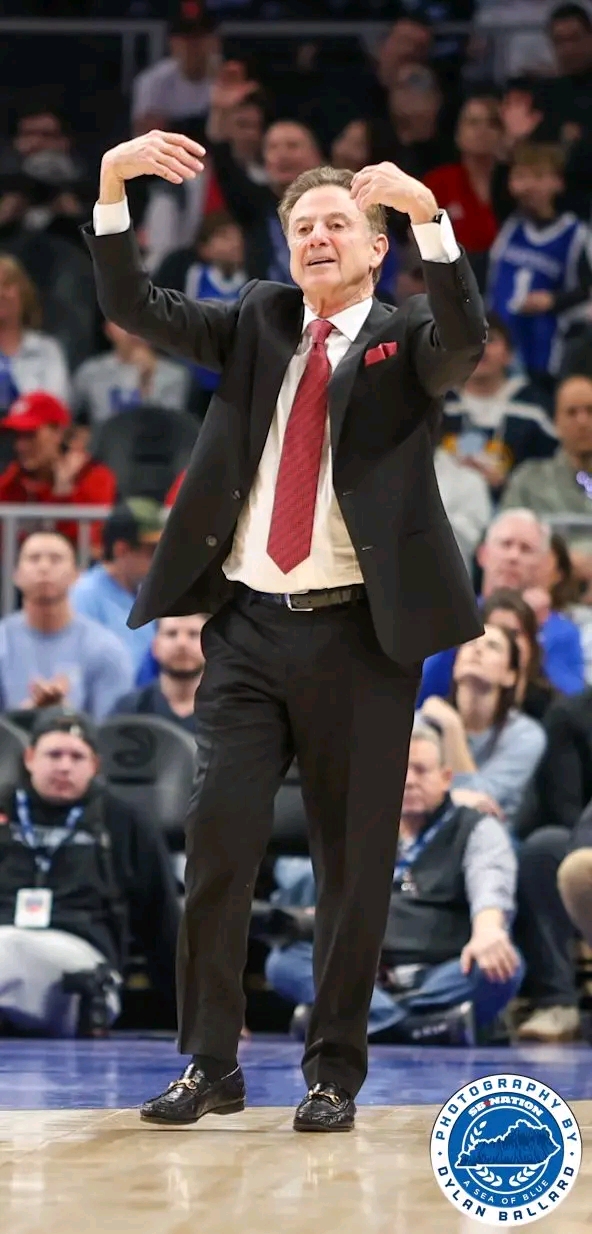
Sometimes the most revealing truths about a team don’t come from inside the locker room or the postgame podium. Sometimes they come from the one person who knows exactly what championship-level Kentucky basketball is supposed to look like — because he once built it himself. When Rick Pitino looked across the court and spoke honestly about what he saw from Mark Pope’s Kentucky team, it wasn’t just polite respect or postgame courtesy. It was recognition. And in that recognition was a quiet confession that something fundamental has shifted in Lexington.
Kentucky basketball, for the first time this season, is no longer trying to be what it thought it was supposed to be. Instead, it’s becoming what it has to be to survive — and possibly thrive.
Pitino’s words carried weight because they acknowledged a difficult truth: the version of Kentucky that was designed on paper never fully materialized. This was supposed to be a great shooting team, one that spaced the floor, punished defenses from deep, and overwhelmed opponents with offensive rhythm. Instead, reality intervened. Injuries disrupted continuity. Confidence wavered. Shots stopped falling. And rather than stubbornly clinging to an identity that no longer fit, Mark Pope did something far more difficult. He changed it.
That is what Pitino saw. And that is what he called brilliant.
Kentucky’s back-to-back wins over Indiana and St. John’s did not come in the way many expected. There were no three-point barrages. No offensive explosions. No highlight-reel shooting displays. Against Indiana, the Wildcats went just 3-for-15 from beyond the arc. Against St. John’s, the numbers were not much better. In another era, those shooting nights would have doomed Kentucky. Instead, they became irrelevant.
What replaced them was something far more revealing: toughness, physicality, and a willingness to win ugly.
Pitino noticed it immediately. He saw a team that no longer panicked when shots didn’t fall. A team that leaned into contact instead of avoiding it. A team that imposed itself defensively and treated every loose ball, rebound, and turnover as an opportunity rather than an inconvenience. That is not accidental. That is cultural.
“I think Mark did a brilliant thing,” Pitino said. “To have this great shooting team, and it’s obvious that it’s probably just an average shooting team, he said, ‘I’m gonna change the whole mindset.’ We’re gonna be a physical team. We’re gonna be a tough team.”
That statement alone says more about Kentucky’s season than any box score ever could.
This was not an easy adjustment for Pope to make. Coaches build systems based on personnel, preseason expectations, and long-term vision. To pivot midseason is to admit that something isn’t working — and to risk criticism in the process. But Pope didn’t hesitate. He leaned into what his team could control: effort, defense, rebounding, and physical pressure.
Against Indiana, the results were unmistakable. The Hoosiers entered the game fresh off one of the most efficient offensive performances of their season. Kentucky turned that confidence into chaos. Indiana was held to just 60 points, shot 4-for-24 from three, committed 18 turnovers, and watched Kentucky convert those mistakes into 23 points. Most of that damage came in the second half, when Kentucky simply overwhelmed them with pressure and persistence.
It wasn’t pretty basketball. It was effective basketball.
The same script unfolded against St. John’s, though the path there was anything but smooth. Kentucky’s first half was sloppy and uneven. The Wildcats committed 11 turnovers, many of them unforced, and allowed St. John’s to turn those mistakes into 16 points. The offense stalled. The three-point shots didn’t fall. And when Jaland Lowe left the game just minutes into the first half with shoulder discomfort, it felt like another night where Kentucky’s fragility would undo them.
This is where the identity shift mattered most.
Instead of unraveling, Kentucky stayed attached to the game. They defended. They rebounded. They absorbed contact. When Lowe returned early in the second half, the energy on the floor changed immediately. The offense found life, but more importantly, the defense found teeth. With 14:23 left in the game and Kentucky trailing by five, the Wildcats unleashed a 14–0 run that flipped the contest entirely.
That run was not fueled by shooting. It was fueled by stops.
Kentucky forced turnovers. They closed off driving lanes. They controlled the glass. St. John’s went eight minutes without a field goal, managed just 2-for-10 from three in the second half, and never scored a single fastbreak point. Kentucky, meanwhile, attacked the paint, scored 22 points inside, and went 14-for-16 from the free throw line.
That is smash-mouth basketball. And it is not something Kentucky has consistently leaned on in recent years.
The most telling part of Pitino’s assessment wasn’t just that Pope changed the identity — it was that the players embraced it. Teams can hear a coach preach toughness every day and still resist it subconsciously. Kentucky didn’t. They absorbed it. They became it.
That shift is especially important for a roster that has lived on a razor’s edge all season. Injuries to key players like Lowe and Jayden Quaintance robbed Kentucky of continuity and forced constant lineup adjustments. When Lowe is off the floor, the Wildcats struggle to organize their offense. When Quaintance is absent, they lose rim protection, rebounding stability, and interior presence. Relying on shooting under those circumstances was unsustainable.
Pope recognized that reality and acted accordingly.
Quaintance’s return has only reinforced that decision. While his minutes remain limited as he works his way back from injury, his presence amplifies Kentucky’s physical identity. He protects the rim. He rebounds in traffic. He allows perimeter defenders to be more aggressive knowing there is help behind them. When he and Lowe share the floor, the energy is unmistakable — and contagious.
That energy is what Kentucky can lean on moving forward.
Pitino also acknowledged the importance of health, noting that injured players returning make Kentucky “a much better basketball team.” That is true, but it is only part of the equation. Health alone does not fix identity. Kentucky has had healthy teams before that struggled because they didn’t know who they were when Plan A failed. This team, finally, has an answer.
And that answer is defense-first, toughness-driven basketball.
This does not mean Kentucky has abandoned shooting or spacing entirely. It means those things are no longer the foundation. They are bonuses. If shots fall, great. If they don’t, Kentucky believes it can still win. That psychological shift matters as much as any tactical adjustment.
It also makes Kentucky dangerous in a different way.
Opponents can no longer assume that a cold shooting night guarantees victory. They must now prepare for a team that will pressure the ball, attack the glass, and turn games into physical battles. In March, that identity travels. Shooting can disappear in neutral gyms. Toughness rarely does.
That is why Pitino’s words felt like a confession rather than a compliment. He wasn’t just praising Pope. He was acknowledging that Kentucky has rediscovered something fundamental — something that once defined the program at its most successful moments.
Mark Pope didn’t change Kentucky basketball by reinventing it. He changed it by stripping it down to its most reliable elements and rebuilding from there. Physicality. Defense. Aggression. Togetherness.
This Kentucky team is still flawed. It is still fragile. It is still one injury away from having its margin for error vanish again. But it now knows how it wants to play, and more importantly, who it wants to be.
Rick Pitino saw that. And when someone with his history and standards notices a shift like that, it means something real is happening.
Kentucky is no longer waiting for shots to save it. It is fightin
g for wins instead.
That may be the most important change of all.