


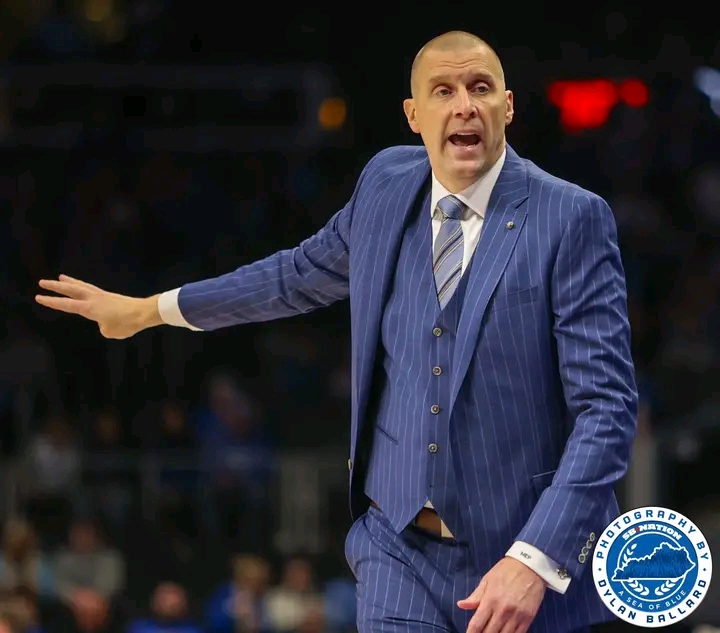
Rick Pitino knows better than almost anyone what it means to coach at Kentucky — and what comes with it when things don’t go perfectly. The wins are expected. The losses are magnified. And patience, especially from the outside, is often in short supply. That’s why, after Kentucky’s 78–66 win over St. John’s, Pitino didn’t just tip his cap to Mark Pope. He delivered a pointed message to the media and anyone who rushed to write Kentucky’s obituary too early.
Pitino was gracious in defeat, but not passive. His words carried the weight of experience, perspective, and loyalty — loyalty not just to Kentucky basketball, but to a former player he clearly believes is built for this job.
“This is what happens when people judge too fast,” Pitino said, shifting the conversation beyond one game and into a broader indictment of the narratives surrounding Kentucky this season. In the process, he offered a rare, unfiltered defense of Pope — and a reminder that context still matters in college basketball, even in an era obsessed with instant results.
A Win That Meant More Than the Score
On paper, Kentucky’s win over St. John’s was solid but not overwhelming. A 12-point margin. A controlled second half. Another ranked opponent added to the résumé after weeks of frustration. But inside Rupp Arena — and especially in Pitino’s postgame comments — it felt much bigger.
This was Mark Pope’s first win over Rick Pitino in two attempts. More notably, it marked just the fifth time in 23 career matchups that Pitino has lost to one of his former players. That statistic alone underscores how rare it is for anyone in Pitino’s coaching tree to get the better of him.
Yet Pitino didn’t sound bitter. He sounded vindicated — not about himself, but about Pope.
The timing mattered. Kentucky had been under fire. Critics questioned rotations. Fans debated identity. Media voices wondered aloud whether the Wildcats were capable of being a real contender this season. This win didn’t solve everything, but it changed the tone — and Pitino made sure to highlight why.
“You Can’t Judge a Team Without Its Team”
Pitino’s sharpest remarks weren’t aimed at Kentucky players or even opposing coaches. They were aimed squarely at the media.
“But I think you all need to learn a little bit of a lesson as writers,” Pitino said bluntly. “Because you’re expecting Kentucky to be this great basketball team with all those injuries.”
It was a classic Pitino moment: direct, unapologetic, and rooted in basketball logic. Kentucky’s struggles, he argued, were never about coaching incompetence or cultural decay. They were about availability.
At various points this season, Kentucky was missing core pieces. Jaland Lowe, the team’s primary ball-handler, was sidelined. Mo Dioubate, a physical presence inside, was unavailable. Jayden Quaintance — one of the most intriguing talents on the roster — hadn’t played a single game after tearing his ACL nine months ago.
“You can’t be a great basketball team without two of your best players,” Pitino continued. “With no point guard. No big men.”
To Pitino, the criticism ignored basic roster math. Kentucky wasn’t underperforming expectations — expectations were detached from reality.
Jayden Quaintance’s Debut Changed Everything
Perhaps the clearest evidence of Pitino’s argument came in the form of Jayden Quaintance’s long-awaited debut.
Nine months removed from ACL surgery, Quaintance finally took the floor — and immediately altered Kentucky’s ceiling. In his first game, he finished with 10 points, 8 rebounds, and 2 blocks, but the box score only hinted at his impact. His presence alone reshaped Kentucky’s spacing, rim protection, and rebounding.
“I think he’s a big-time basketball player,” Pitino said. “They’re only going to get stronger with him and Lowe.”
The second half told the story. With Quaintance and Lowe on the floor together, Kentucky looked like a different team. The Wildcats surged, winning the plus/minus battle decisively as Lowe and Quaintance combined for a +38 efficiency impact.
This wasn’t theoretical upside. It was tangible proof.
Jaland Lowe’s Grit and the Turning Point
Lowe’s return wasn’t smooth. Just seven seconds after checking in during the first half, he reaggravated his shoulder and missed nearly the entire half. In past games, that might have been a breaking point.
Instead, it became a turning point.
Lowe returned in the second half and steadied Kentucky’s offense. His ability to organize, penetrate, and create changed the tempo of the game. Suddenly, Kentucky wasn’t forcing shots. They weren’t guessing. They were playing with purpose.
This was the version of Kentucky Pope had envisioned — the version critics hadn’t yet seen.
For Pitino, the lesson was obvious: judging Kentucky before seeing its full roster was not analysis. It was impatience.
Mark Pope, the Captain Who Became the Coach
Pitino’s defense of Pope wasn’t just professional. It was personal.
Mark Pope wasn’t just another former player. He was Pitino’s team captain at Kentucky — a leader who understood accountability, preparation, and the weight of wearing that jersey.
Even earlier this season, when Kentucky suffered an embarrassing loss to Michigan State, Pitino didn’t hide from Pope. He called him.
“I told him to get his act together,” Pitino admitted with a smile.
That moment mattered. It revealed the dynamic between the two: honesty without ego. Criticism without malice. And trust built over decades.
So when Pitino praised Pope’s coaching as “brilliant,” it wasn’t flattery. It was evaluation.
Why Pitino Thinks Pope Is Built for This Job
Coaching at Kentucky is unlike any other job in college basketball. The spotlight is relentless. The margin for error is microscopic. And patience — from fans, media, and boosters — is almost nonexistent.
Pitino knows this because he lived it.
That’s why his endorsement of Pope carries so much weight. He didn’t praise recruiting buzz or press conferences. He praised structure. Adaptation. Survival.
Pope didn’t panic when injuries piled up. He didn’t abandon his system. He didn’t throw players under the bus. Instead, he adjusted, experimented, and waited — even as the noise grew louder.
From Pitino’s perspective, that’s not weakness. That’s coaching maturity.
The Media Narrative vs. the Basketball Reality
Pitino’s frustration with the media wasn’t about criticism itself. It was about timing.
“I think everybody really exaggerates one game or two games or three games,” he said.
At Kentucky, every loss is a referendum. Every slump becomes a storyline. And every setback invites sweeping conclusions.
Pitino’s message was clear: evaluation without context is meaningless.
Kentucky got blown out earlier this season — something that rarely happens in Lexington. But to Pitino, that wasn’t evidence of failure. It was evidence of circumstance.
“When they come back,” he said, referring to Lowe and Quaintance, “two gigantic pieces.”
That sentence captured the entire argument.
A Team That Hasn’t Even Been Whole — Until Now
Perhaps the most revealing detail of all: the St. John’s game marked the first time all of Kentucky’s players were active this season.
Even then, it wasn’t perfect. Lowe missed most of the first half. Chemistry is still forming. Roles are still settling.
And yet, the second half looked like something real.
For the first time, critics were forced to confront an uncomfortable truth: maybe Kentucky wasn’t broken. Maybe it was just incomplete.
What This Win Really Signaled
This wasn’t just about beating St. John’s. It was about validation.
Validation for Pope’s patience.
Validation for Kentucky’s roster construction.
Validation for the idea that growth doesn’t always follow a straight line.
Pitino saw it clearly. And he wanted everyone else to see it too.
Kentucky isn’t finished. It may not even be close.
The Bigger Picture for Kentucky Moving Forward
With Lowe healthy, Quaintance active, and the roster finally intact, Kentucky’s season enters a new phase. Expectations will rise again — as they always do.
But now, there’s evidence to support them.
Pitino didn’t guarantee championships. He didn’t predict Final Fours. He did something more important: he restored perspective.
And when someone with his résumé tells you that Mark Pope is “brilliant,” it’s worth listening.
Final Thought: When Rick Pitino Defends You, It Matters
Rick Pitino doesn’t hand out praise lightly. He’s seen too much basketball, too many coaches, too many false narratives.
So when he says Kentucky was judged too fast, he’s not making excuses. He’s making a case.
And when he explains why Mark Pope is brilliant, he’s not protecting a former player — he’s recognizing a coach who understands what this job demands.
Kentucky fans wanted answers.
Critics wanted proof.
On this night, both got something they weren’t expecting: Rick Pitino, standing firmly in Mark Pope’s corner — and reminding everyone that in college basketball, patience is still part of the process.




