


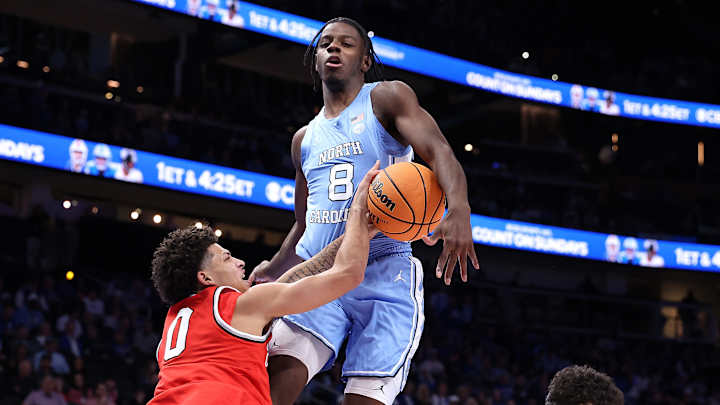
For all the noise that surrounds college basketball in November and December rankings, hype, early-season stumbles, breakout stars — there is one quiet truth that always reveals itself by January:
Teams are either ready for conference play, or they’re pretending.
On Monday night at the Dean E. Smith Center, the North Carolina Tar Heels made it clear which side they’re on.
The scoreboard alone told a dominant story. A 99–51 dismantling of East Carolina doesn’t leave much room for interpretation. But the real significance of the night went deeper than a lopsided margin. It was about how North Carolina played, why they played that way, and what it suggests about where this team is headed as the ACC grind begins.
And at the center of that conversation stood freshman forward Caleb Wilson — not just because of his stat line, but because of what he said afterward.
A Record That Looks Good — But Needed Context
At 12–1 entering the final stretch of non-conference play, North Carolina’s resume already looked strong on paper. Wins piled up. Talent flashed. Depth showed itself in bursts.
But even with that record, there had been moments — especially against inferior opponents — where the Tar Heels struggled to sustain focus across a full 40 minutes. A sluggish first half here. A careless second half there. Games that should have been buried early instead lingered longer than necessary.
Those are the kinds of habits that get exposed in conference play.
Against East Carolina, that didn’t happen.
North Carolina came out sharp, stayed sharp, and never gave the Pirates a chance to believe. The effort didn’t dip. The defensive pressure didn’t soften. The pace didn’t slow. From opening tip to final horn, it looked like a team with its eyes already set on January, February, and beyond.
That’s why this win mattered — and why Caleb Wilson’s words carried weight.
Caleb Wilson’s Night Wasn’t Quiet — It Was Loud
Wilson didn’t just participate in the blowout. He controlled it.
The freshman finished with:
21 points
12 rebounds
3 steals
4 blocks
That’s not just production — that’s impact. Wilson influenced every area of the game. He ran the floor. He protected the rim. He cleaned the glass. He finished plays others started and created some of his own.
For a freshman in a program like North Carolina, that matters. Playing well is one thing. Playing comfortably is another.
Wilson looked comfortable.
Not rushed. Not tentative. Not overwhelmed by expectations or surroundings. Just steady, physical, and decisive — the exact traits UNC needs as it transitions from non-conference experimentation to ACC survival.
“End It the Right Way”
After the game, Wilson was asked about the team’s approach with conference play looming. His response was telling — not because it was flashy, but because it was mature.
“Everybody is ready to go on this break, you want to end it on a good note,” Wilson said. “That kind of approach, just take the whole game seriously and make sure we play throughout the game. So, we left on a break [before conference play] feeling good.”
That sentence explains the night.
North Carolina didn’t treat East Carolina like a formality. They treated it like a test of discipline. And they passed it.
That mindset — taking the whole game seriously — is often the last thing young teams learn. It’s also the difference between teams that survive conference play and teams that stumble early and spend months trying to recover.
Wilson’s comment suggests this group understands that now.
Playing Two Complete Halves — Finally
One of the most encouraging signs from Monday night was how consistent North Carolina looked on both ends of the floor.
In previous games against lesser opponents, the Tar Heels sometimes:
Relaxed after building early leads
Lost defensive intensity
Settled for jump shots
Allowed unnecessary runs
None of that happened against ECU.
North Carolina defended with urgency, moved the ball with purpose, and ran the floor relentlessly. The Pirates were overwhelmed not just by talent, but by sustained pressure.
That’s the kind of habit that translates directly to conference play, where no possession can be wasted and no lapse goes unpunished.
Transition Basketball Is Becoming a Weapon
One of the most noticeable improvements in UNC’s game has been its efficiency in transition.
Against East Carolina, the Tar Heels piled up fast-break points with ease. Missed shots turned into runouts. Defensive stops became immediate scoring opportunities. The game was played at a pace ECU simply couldn’t match.
Wilson was asked about that improvement — and he pointed to a key factor.
Seth Trimble’s Return Changed the Rhythm
“I would definitely say Seth [Trimble] is a big part,” Wilson said. “Honestly, we have just been playing smart basketball and making sure to emphasize it with our size and athleticism to get up the court.”
That quote matters.
Trimble’s return hasn’t just added another body — it’s added balance. His defensive instincts, decision-making, and ability to push the ball have helped UNC turn chaos into controlled speed.
With Trimble back in the lineup, North Carolina looks more connected. Guards are more decisive. Bigs run harder. Wings fill lanes with purpose.
Wilson’s acknowledgment of that chemistry shows awareness — and buy-in.
Size and Athleticism Are Finally Being Maximized
For much of the early season, North Carolina’s size advantage felt underutilized. The pieces were there, but the execution wasn’t always consistent.
Against East Carolina, it was.
UNC used its length to:
Dominate the glass
Disrupt passing lanes
Protect the rim
Finish plays at the basket
Wilson embodied that approach. His rebounding was aggressive. His shot-blocking was timely, not reckless. His steals came from anticipation, not gambling.
That combination — size paired with discipline — is dangerous.
And it’s exactly what conference opponents struggle with when games become physical and margins shrink.
The Henri Veesaar Factor
Another subplot that continues to grow louder is Henri Veesaar’s shooting.
Over the last five games, the 6-foot-11 center is 11-for-19 from three-point range — a number that changes how defenses must approach North Carolina.
Wilson addressed it directly.
While centers often get labeled strictly as interior players, Veesaar’s ability to stretch the floor has opened driving lanes, reduced help defense, and forced opposing bigs into uncomfortable decisions.
When a center can shoot, everything else gets easier.
For Wilson, that spacing creates more room to operate inside. For guards, it means fewer bodies in the lane. For the offense as a whole, it means flexibility.
That’s not just a hot stretch — it’s a schematic advantage.
What This Win Says About UNC’s Identity
The East Carolina game didn’t reveal something new about North Carolina’s talent.
It revealed something new about its identity.
This looked like a team that knows who it wants to be:
Fast, but controlled
Physical, but disciplined
Confident, but connected
And perhaps most importantly, it looked like a team that understands the importance of details.
Those details — closing out shooters, running the floor hard, making the extra pass — are what win ACC games in February when legs are tired and scouting reports are thorough.
Caleb Wilson’s Role Is Growing
For a freshman, Wilson’s comfort level is striking.
He’s not forcing offense. He’s not hunting stats. He’s letting the game come to him — and when it does, he’s ready.
That bodes well for UNC moving forward.
As conference play tightens rotations and demands consistency, having a freshman who can be trusted on both ends of the floor is invaluable. Wilson isn’t just producing — he’s stabilizing.
And stability is everything in January.
Leaving Non-Conference Play the Right Way
Wilson’s postgame comments weren’t about himself. They weren’t about numbers. They weren’t about accolades.
They were about approach.
Ending non-conference play with a complete, focused performance sends a message — to the locker room and to the rest of the ACC.
North Carolina isn’t just talented.
It’s ready.
Final Thought: The Timing Feels Right
Blowout wins don’t always mean much in isolation. But sometimes, they arrive at the perfect moment.
This one did.
With conference play looming, with roles becoming clearer, and with confidence quietly building, North Carolina looks like a team that understands what’s coming — and isn’t intimidated by it.
Caleb Wilson said it plainly.
They wanted to end it right.
They did.
And if this performance is any indication, the Tar Heels aren’t just entering ACC play with momentum — they’re entering it with purpose.




