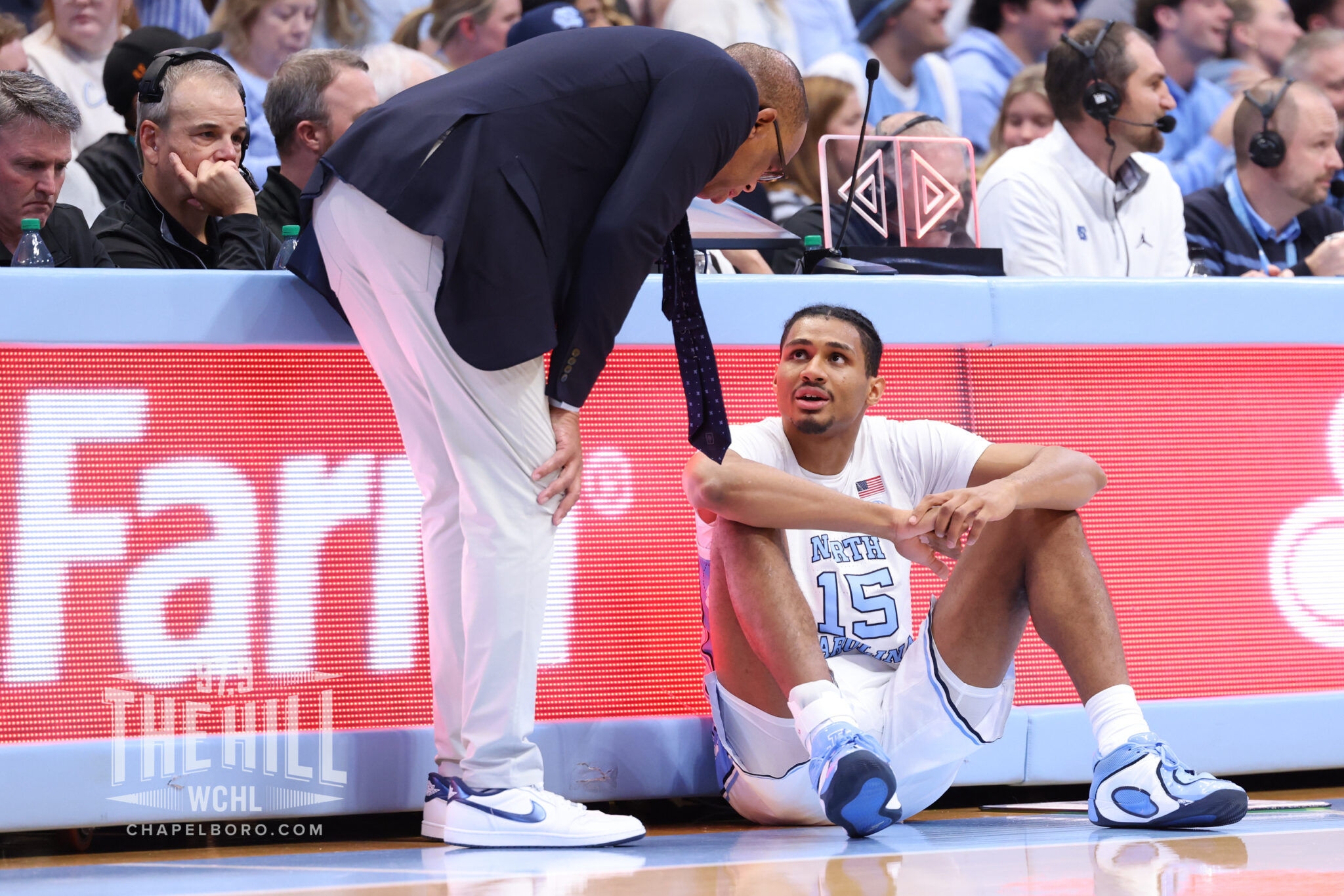
To reflect on the year, Chapelboro.com is re-publishing some of the top stories that shaped and defined our community’s experience in 2025. Few stories loomed larger than the dramatic transformation of UNC men’s basketball — a program forced to confront hard truths, embrace change, and reinvent itself in a rapidly evolving college sports landscape.
The 2024–25 season fell well short of UNC’s championship standards. After beginning the year ranked in the preseason Top 10, the Tar Heels stumbled through inconsistency, frustration, and mounting scrutiny. Carolina limped into the NCAA Tournament as the final at-large team, sparking national debate over whether the selection was based more on brand recognition than on performance. A First Four win offered a brief reprieve, but the season ended abruptly with a first-round loss to Ole Miss. Change was no longer optional — it was inevitable.
That reality came into sharp focus on Monday, February 3, 2025. UNC had dropped four of its last five games, including an 87–70 dismantling by Duke at Cameron Indoor Stadium that felt even more lopsided than the score suggested. Sitting at 13–10 and back on the tournament bubble for the second time in three seasons, head coach Hubert Davis faced the media — and the fanbase — with rare candor.
Speaking on his weekly radio show at Top of the Hill in downtown Chapel Hill, Davis delivered a message that would become a turning point.
“The old model for Carolina basketball just doesn’t work,” he said. “It’s not sustainable. There’s NIL, the transfer portal, agents, international players — all of it. You need a bigger staff so I can focus on doing what I’m supposed to do: coach basketball.”
The statement signaled a philosophical shift for one of college basketball’s most tradition-bound programs. While peers such as Duke had already adapted by hiring general managers, UNC had remained resistant. Even within the university, men’s basketball lagged behind: football employed a general manager under both Mack Brown and Bill Belichick, while women’s basketball hired former Tar Heel Liz Roberts to the role in 2023.
Less than a month later, Davis made history. On February 25, UNC named Jim Tanner as its first-ever Executive Director and General Manager. A UNC alumnus and Morehead-Cain Scholar, Tanner brought deep experience as a prominent NBA and WNBA agent, representing stars such as Vince Carter, Ray Allen, Tim Duncan, and numerous former Tar Heels. His résumé — and his Carolina roots — instantly lent credibility to the program’s new direction.
Once the season ended with a 23–14 record, Tanner’s real work began. The roster turnover was staggering. R.J. Davis, one of the most accomplished players in program history, departed after a record-setting five-year career. Soon after, the exits continued: starting point guard Elliot Cadeau, five-star freshman Ian Jackson, forward Jalen Washington, transfer wing Cade Tyson, and Ven-Allen Lubin — whose decision to transfer to rival NC State stung deeply. Combined with graduation and the NBA Draft declaration of Drake Powell, UNC lost every end-of-season starter.
In response, Tanner and Davis attacked the transfer portal with urgency and precision. The results were immediate and wide-ranging. Carolina landed center Henri Veesaar from Arizona, guard Kyan Evans from Colorado State, forward Jarin Stevenson from Alabama — a Chapel Hill native returning home — and wing Jonathan Powell from West Virginia. The incoming freshman class was equally impressive, highlighted by five-star forward Caleb Wilson and guard Derek Dixon. Adding an international twist was Luka Bogavac, a Montenegrin professional with experience in Europe’s Adriatic League.
By the start of the 2025–26 season, the roster was almost unrecognizable. Eleven of the 16 players were new, and only four returners had scored points in a Carolina uniform. Despite the uncertainty, Davis remained confident, emphasizing chemistry, connection, and time spent together as the foundation of the rebuild.
Early turbulence threatened to derail momentum when Bogavac faced eligibility issues tied to his academic record, keeping him out of exhibition games. But just hours before the season opener, he was cleared, easing fan anxiety that had reached a boiling point.
Hovering over everything was the unspoken truth: Davis was coaching for his job. That pressure made early-season wins — including victories over Kansas, Kentucky, and Georgetown — feel especially meaningful. The new faces delivered. Veesaar and Wilson emerged as stars, becoming the team’s leading scorers and rebounders and accomplishing a statistical feat rarely seen in UNC history. Their impact was crucial as the Tar Heels navigated adversity, including a broken forearm suffered by veteran guard Seth Trimble.
As 2025 turned toward 2026, UNC found itself in unfamiliar — but welcome — territory: well clear of the NCAA Tournament bubble. The bold offseason gamble appeared to be paying off.
Yet in today’s college basketball, stability is fleeting. Rosters reset annually, and success demands constant adaptation. Carolina’s facelift may have restored belief, but sustaining it will require the same willingness to evolve that sparked this transformation in the first place.