


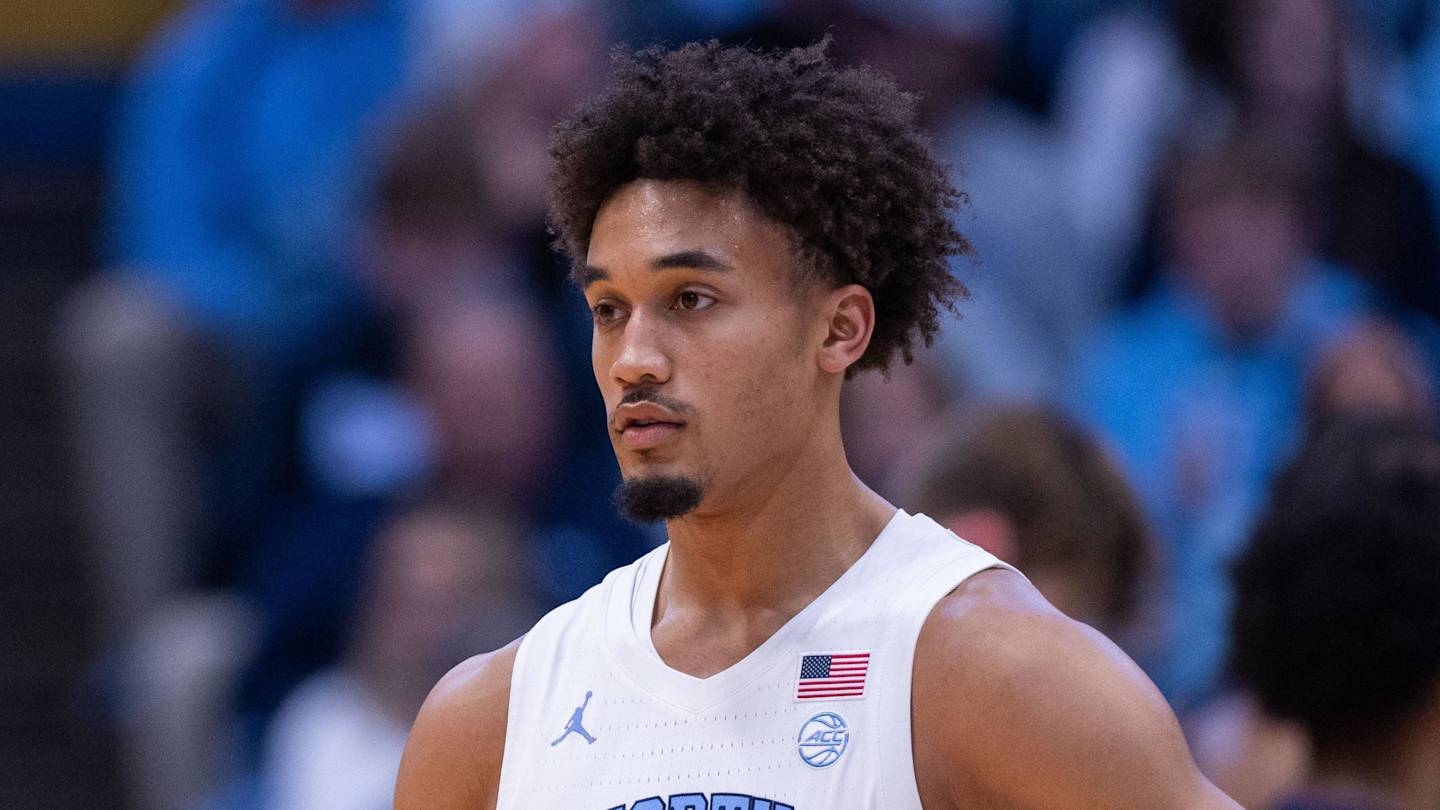
For any team with championship aspirations, growth rarely comes from comfort. It comes from disruption, adversity, and moments that force players to adapt or fall behind. For the North Carolina Tar Heels, that defining challenge arrived shortly after their marquee win over Kansas on Nov. 7, when veteran guard Seth Trimble suffered a fractured forearm that sidelined him for nine consecutive games.
At the time, Trimble’s injury felt like a major setback. A proven, experienced guard with leadership responsibilities, his absence left a significant void in the backcourt. North Carolina was suddenly stripped of a stabilizing presence—someone who understood the system, set the tone defensively, and could be trusted in high-pressure moments. What followed, however, was not a collapse, but a transformation.
Trimble returned to the lineup last weekend against Ohio State and wasted no time reminding everyone of his value. The 6-foot-3, 200-pound guard poured in 17 points to go along with two rebounds and three assists, shooting an efficient 6-of-13 from the field and knocking down 2-of-3 attempts from beyond the arc. His performance looked seamless, as if he had never left. But behind that smooth return was a team that had quietly evolved in his absence.
In the early stages after Trimble went down, North Carolina’s backcourt experienced its share of growing pains. Rotations were unsettled, chemistry was inconsistent, and players were forced into unfamiliar roles. Yet with each game, those struggles began to turn into learning experiences. Confidence grew, communication improved, and players who might have otherwise remained on the periphery were thrust into meaningful minutes.
That forced evolution became one of the most important developments of the Tar Heels’ season.
“When you have a player who plays a lot of minutes, who has a big role, who’s had experience trying to lead a team, and that guy goes out, it forces other guys to step up,” Trimble said while speaking to the media earlier this week. “Guys have no choice. If they don’t, we’re [going to] get left behind as a team.”
Trimble’s perspective highlights the reality of high-level college basketball: opportunity often arrives uninvited. With no safety net, the remaining guards had to learn on the fly. Mistakes were inevitable, but so was progress.
One of the clearest beneficiaries of that stretch was Derek Dixon. With Trimble unavailable, Dixon stepped into a role that may not have existed otherwise. The increased responsibility accelerated his development, giving him valuable game reps and confidence that can’t be replicated in practice.
Henri Veesaar emphasized just how sudden and demanding the adjustment was for the backcourt.
“It definitely just kind of threw them out in the fire—they didn’t have backup,” Veesaar said. “They kind of had to figure it out, and I feel like Derek [Dixon] improved over the time tremendously, and now it’s just carrying over. He keeps playing amazing, and we need him to kind of be the facilitator that he is.”
That growth didn’t just benefit Dixon individually—it elevated the entire team. The Tar Heels became more versatile, less dependent on a single ball-handler, and more willing to trust multiple players to initiate offense. By the time Trimble returned, North Carolina had developed a deeper sense of balance and resilience.
Caleb Wilson echoed that sentiment, pointing to the broader maturity that came from navigating adversity together.
“Honestly, it kind of forced our hand in maturing as a team and being able to trust younger players and players that wouldn’t have got as much time and experience as they would have had he (Trimble) been there,” Wilson said. “So, I definitely think it was beneficial for us, and he’s a great player, and just to have him back is really good.”
That trust is now paying dividends. With Trimble healthy again, North Carolina isn’t reverting to old habits—it’s building on what it learned. The team now features a stronger rotation, more confident decision-making, and a collective understanding that success doesn’t hinge on one player alone.
While no team ever welcomes injuries, the Tar Heels found value in the challenge. Trimble’s absence tested their depth, exposed weaknesses, and demanded accountability. Those lessons, learned under pressure, have strengthened the foundation of the roster.
Now, with Trimble reintegrated and others elevated by experience, North Carolina looks like a more complete and dangerous team. The discomfort they were forced to endure may ultimately be what prepares them for the biggest moments ahead.
Sometimes, growth doesn’t come from what you gain—but from what you’re temporarily forced to live without.




