There are nights in college basketball when the box score lies just enough to fool you. The shooting percentages look ugly. The numbers feel incomplete. And yet, when the final horn sounds, one team walks off knowing it controlled the game exactly when it mattered most.
Tuesday night at the Smith Center was one of those nights for North Carolina.
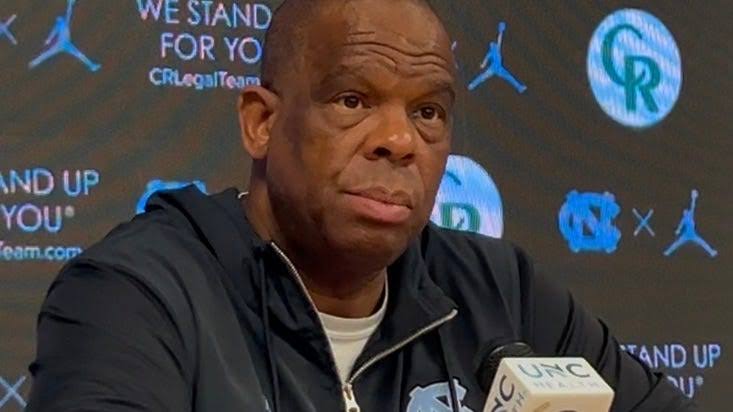
The Tar Heels didn’t shoot the ball particularly well from three-point range. In fact, by modern standards, the percentage was downright uncomfortable. But when Hubert Davis stepped to the podium after UNC’s 79–66 win over Florida State, his message was crystal clear: the shots that mattered most weren’t the ones that inflated the stats — they were the ones that bent the game in Carolina’s favor.
Those were the timely threes. And they changed everything.
A Game That Never Felt Safe — Until It Did
From the opening tip, Florida State played exactly the type of game that makes opponents uneasy. Long. Physical. Aggressive. The Seminoles clogged driving lanes, challenged shots, and dared UNC to make decisions under pressure. It wasn’t beautiful, but it was disruptive — and for stretches, it worked.
North Carolina jumped out early but never fully broke free. Every time the Tar Heels appeared ready to put the game away, Florida State answered with a run, a second-chance three, or a momentum-shifting possession. The lead hovered in that uncomfortable zone — big enough to feel encouraging, small enough to feel fragile.
That’s where the context matters.
UNC attempted 29 three-pointers, the second-most they’ve taken all season. They made just seven. On paper, that’s inefficient. But basketball games aren’t decided on spreadsheets — they’re decided in moments.
And UNC owned the moments that swung the game.
Hubert Davis Was Honest — And That’s What Made It Powerful
After the game, Hubert Davis didn’t pretend the shooting night was flawless. He didn’t spin percentages or gloss over missed opportunities. Instead, he acknowledged the reality — and reframed it.
“Offensively, to be the best that we can be, we’re going to have to consistently knock down shots from three-point range,” Davis said. “I don’t think we shot a great percentage tonight, but I thought we had timely threes that really helped us, and that was huge.”
That distinction matters.
Timely threes aren’t about volume. They’re about impact. They come when the defense is leaning one way, when momentum is threatening to flip, when the opposing bench is standing and the crowd is holding its breath.
UNC didn’t shoot well — but when Florida State made pushes, the Tar Heels answered. And that’s why the game never truly slipped.
Caleb Wilson Was the Center of Gravity
While the three-point conversation dominated the postgame narrative, the engine of the win was Caleb Wilson.
Wilson finished with 22 points, 16 rebounds, and six assists, becoming just the sixth Tar Heel ever to record a 20-10-5 stat line. That’s not just productivity — that’s control.
What made Wilson’s performance special wasn’t just the numbers. It was when and how they came.
Florida State tried to speed him up. Tried to bump him off his spots. Tried to force him into rushed decisions. Wilson responded with patience. He passed out of pressure. He attacked mismatches. He rebounded traffic. He dictated tempo.
When UNC needed calm, Wilson supplied it.
And when UNC needed someone to tilt the floor just enough to free shooters, he did that too.
The Threes Didn’t Start Falling Until UNC Earned Them
One of the most revealing parts of Hubert Davis’ postgame comments came when he discussed shot selection — especially early.
UNC didn’t just miss threes. They settled for some.
“I felt like we passed up some. You just can’t be hesitant,” Davis said. “I felt like at the beginning of the game, we settled for threes… our first 10 possessions, seven of them were threes.”
That’s not UNC basketball at its best.
The Tar Heels want paint touches. Post penetration. Offensive rebounding pressure. When those elements are present, the floor opens naturally — and threes become earned, not forced.
That’s exactly what happened in the second half.
UNC attacked inside. Wilson established himself. Guards drove with purpose. And suddenly, the same shots that felt rushed earlier became rhythm looks.
Those were the threes Davis trusted.
Kyan Evans Didn’t Shoot Perfect — He Shot Fearless
No player embodied the idea of “timely threes” more than Kyan Evans.
Evans attempted 12 threes, making five — a feat he accomplished just once last season. The confidence to keep shooting wasn’t accidental. It was earned through spacing, ball movement, and trust.
Evans didn’t hesitate when the ball found him. He didn’t overthink misses. And most importantly, he took shots that came within the flow of the offense.
Some nights, shooters get hot.
Some nights, they stay aggressive.
Against Florida State, Evans did the latter — and it mattered.
A Three-Guard Lineup That Changed the Game’s Rhythm
One of the quiet turning points came when UNC rolled out a lineup featuring Derek Dixon, Kyan Evans, and Jonathon Powell together.
The effect was immediate.
Florida State thrives on length, deflections, and chaos. That only works when opponents lack ball-handling depth. With three capable decision-makers on the floor, UNC steadied itself.
“In order to run any type of offense, you need multiple ball handlers,” Davis explained. “Guys that can make plays, get us into our offense… that helped us offensively.”
The ball moved cleaner. The offense flowed earlier in the shot clock. And Florida State’s defensive pressure lost its bite.
That lineup didn’t just help UNC score — it helped UNC breathe.
Length Was the Silent Advantage
When Caleb Wilson and Henri Veesaar shared the floor, Florida State’s offensive comfort evaporated.
Davis didn’t hide it.
“It’s a huge weapon… defensively, we have the ability to do switches where they can guard guards out on the perimeter.”
Florida State loves drive-and-kick threes. UNC countered with length that discouraged straight-line drives and closed out quickly without over-helping.
The Seminoles still took 40 threes — but many came later in the shot clock, contested, or off broken possessions.
That matters more than raw volume.
Why Florida State Never Fully Took Control
Florida State shot 12-for-40 from three and 34.8% overall. They generated looks, but rarely clean rhythm.
UNC’s discipline improved as the game progressed. Over-helping decreased. Defensive rebounding tightened. Second-chance threes became rarer.
When Florida State did cut into the lead, UNC responded — often with a timely basket or, yes, a timely three.
Momentum never lingered.
This Was a Win About Identity, Not Aesthetics
UNC didn’t win because they shot lights-out.
They won because they stayed true to who they want to be.
They defended.
They rebounded.
They trusted their spacing.
They didn’t panic when shots didn’t fall.
And when the moment demanded it, they hit shots that mattered.
That’s growth.
Why This Matters Moving Forward
In the ACC, not every night will feel smooth. Not every opponent will allow clean looks. Not every three will fall.
What separates good teams from dangerous ones is the ability to survive imperfect games.
Against Florida State, UNC proved it can.
Caleb Wilson showed he can anchor games.
Kyan Evans showed he can stay aggressive under pressure.
The coaching staff showed flexibility and trust.
The team showed composure.
And Hubert Davis showed clarity.
He didn’t celebrate the percentage.
He celebrated the timing.
Final Thought
UNC won’t always shoot well from three.
But if they keep earning their looks, defending with length, and responding in the moments that matter most, the Tar Heels will continue to win games that don’t look pretty — but feel meaningful.
On Tuesday night, the percentages didn’t tell the story.
The timing did.
And that made all the difference.